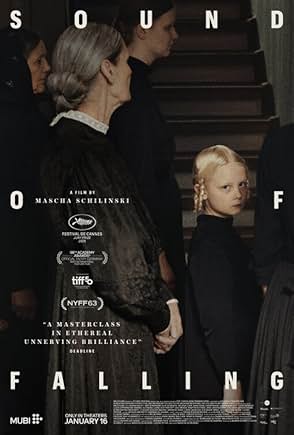

Germany’s submission to the 2026 Oscars’ “Best International Feature” category, “Sound of Falling” (2025), had “Looking into the Sun” as the original title and perhaps is the only time that the original title is not as fitting as the marketing one. If you are planning to see it, you must see it in the theater because at home on the television or any smaller screen, it may be a Herculean challenge to spend two hours thirty-five minutes watching a non-linear narrative in a foreign language without being distracted and at the end, confidently look back and even give a bare bones, blow-by-blow summary of what happened, forget a more insightful examination of the film’s themes. The film shows life at a German rural farm over the course of over one-hundred years.
About a half hour into “Sound of Falling,” I decided to cheat to figure out the era and the location because real talk, the opening scene’s characters, which took place in the Forties, felt almost indistinguishable from the 1910s scenes except for one person. Seeing movies on the big screen makes it easier to notice details because they are magnified, and there is nothing else to do in a theater but watch it. If I had not seen “Nickel Boys” (2024) in theaters, it would still be possible to glean the message, but much harder to want to; however, “Chronology of Water” (2025) was dynamic enough to overcome a lyrical, nonlinear narrative. The number of characters and time jumps in this fractured tale on the small screen is like putting a book in a blender at low speed. Sure, you can pick out words, but enough to walk away with the same experience as you would have before it was dumped into an incompatible device? No.
To be clear, “Sound of Falling” is no “Nickel Boys” or “Chronology of Water” which invented a new way of using camera perspective to tell a story. Editor Evelyn Rack, director and cowriter Mascha Schilinski and cowriter Louise Peter make a story about surfaces where the cracks are there if you know what to look for with lyrical logic but may have worked equally well chronologically though less artistically rigorous and unique. Because it is told out of order, there is more mystery, which is intended to make viewers more curious to uncover the commonalities and differences and relationship between scenes. In each era, there is a girl who is curious about the world. If the relationships and eras were clearer, it may be more consumable.
For instance, there is a girl named Erika (Lea Drinda), who is the focus of the opening. A man slaps her. Should that man appear in the 1910s sequence, or does he? What was he like then? He is not the point. Erika does not play a big role in the movie, and her behavior is shocking for a multitude of reasons that would spoil the story, but as the movie unfolds, she reappears but does not have as memorable a presence so if you are not looking for her, the conclusion to her story and relationship to the Eighties story is elusive. Also, a person who would be related to Erika and her contemporary plays a harmful role in the Eighties, but is not obviously present in Erika’s era, which is supposed to be the Forties. This missing connective tissue hurts the story, especially if the theme is how people, even unrelated, share certain qualities and have similar experiences. It may be because the filmmakers did not want to center men, but it felt germane to the idea that on the surface, people seem to be having a great time, but underneath a complex story is being told. If a little girl explains the abuses that are happening in the narration, but it is not shown soup to nuts, it is like leaving money on the table. The movie is already long so a few more scenes for clarity would only help.
Here are the memorable characters: Alma (Hanna Heckt), a blonde little girl from the 1910s who gets teased as if she is dead and not really there; Angelika (Lena Urzendowsky), who wears cutoffs, is testing her limits, but also placed in an untenable position that exposes her to harm; and present day Lenka (Laeni Geiseler), a girl who feels as if she does not measure up so she tries to emulate others or imagines how she can get more attention; however at the end, it is her little sister Nelly (Zoë Baier), who bears the closest relationship to the past and gets drawn to repeat history with mixed, ambiguous results. Even oneiric fantasy scenes are shot realistically and are hard to distinguish until the next moment is shown. Without context of subsequent events, it feels like harmful lessons are effortlessly repeated without any instruction.
As much as psychological horror films are prevalent and annoying when they are not solid horror films, “Sound of Falling” probably would have worked better as one as it answers the central question of what happens when a person dies: someone else occupies the space, and life is still messed up. Some transitions are marked visually with one image bleeding into another as if it is possible for the characters from different decades to travel like a ghost into another time, and other times, it sounds like a record at the end of playing a song. Certain locations become associated with death: a river, a threshing floor, photographs. The idea of blind spots is essential as most people refuse to understand what they are seeing such as group games, teasing or practical jokes hiding more sinister intent usually sexual violence; however, there is a classist betrayal embedded in the story as assumptions about Trudi (Luzia Oppermann), a servant in 1910s, are made without her ever voicing her feelings and intent. She rejects some advances and initiates others.
There are also a big incest theme and deliberately causing physical harm among family members. Fritz (Filip Schnack in 1910s and Martin Rother in the 1940s) is the most visible victim of this phenomenon. “Sound of Falling” is apolitical, which is pretty counterintuitive considering late in the move, it is revealed that World War I occurs during the 1910s storyline, it is before WWII in the Forties storyline, and the Eighties reveal that the location is in the German Democratic Republic, which means despite everyone seeming joyous, it is actually an innately oppressive, cruel atmosphere. Fascism is often associated with incest in a literal way as a natural, but disgusting result of a family believing that physical, individual autonomy is not permitted, and extreme racial purity requires incest. Families are microcosms of the state, and when in a patriarchal society, a strong man, the head of the family, can exercise any form of control, including incest, but also physical abuse that is not sexual. Other members of the family are capable of this conduct as a way of modeling inappropriate behavior because it is treated as normal and there is no exposure to the outside world. Instead of others calling out the behavior or helping the victim, they blame the victim, force them to bear the burden of bearing it silently or unintelligibly, or denigrate them for it even happening. The only acceptable remedy is death, lying or isolation.
“Sound of Falling” is definitely well made, but maybe too artsy fartsy for the average moviegoer or even cinephile. If you are new to the artsy fartsy scene or foreign films, stay away, but if you are not, this movie may still be challenging to you, but will not turn you off from experimenting in the future. Waiting until the eleventh hour to provide context and retroactively imbue meaning to certain moments makes the film more inscrutable than it had to be, which is a deliberate creative choice. If the point is to remain faithful to the filmmakers’ vision, then it is a success, but if it is to also to convey a concept and story to the audience, it fails more than it succeeds.