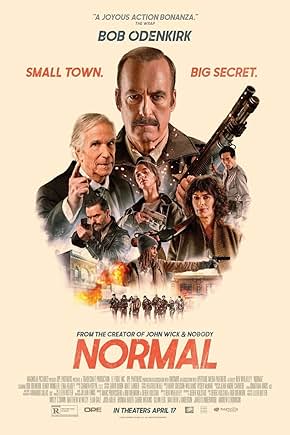

Are you ready for a forgettable fun movie? Maintaining a healthy distrust of small towns, “Normal” (2025) is what “Storm of the Century” (1999) would have been without the supernatural. During his first of eight weeks as interim sheriff in Normal, Minnesota, Ulysses Richardson (Bob Odenkirk) notices that a handful of things do not add up but does his best not to notice them until a bank robbery reveals that the town has a secret and will kill anyone who is not complicit. Will Ulysses remember who he is and save the day? It is that time of the year when you get your Odenkirk action film. Your feelings about the “Nobody” franchise will determine how much you enjoy “Normal.”
The less that you know about “Normal” going in, the better so go see it then come back of you feel like it. “Normal” feels like a neo-Western, neo-noir comedy where an outsider comes in and must check a sinister, occupying force except the catch is that the people do not want anyone to clean up the town because it will ruin a good thing. Because of something that happened in Ulysses’ past, he is on the run from himself. There is running narration in the form of Ulysses leaving messages for his wife, Penny (the Penelope and Odysseus references feel more superficial than substantial). The point of the film is to wake him up from his stupor, teach him to trust his instincts again, and accept the past. Running on automatic instead of not trusting his instincts, he ignores his sense that something is rotten in Denmark. He just accepts the homespun veneer with small town problems. Odenkirk is perfect for the role, and if he keeps making different variations of the same theme, a seemingly ordinary guy being a one-man army, everyone will be happy with no sign of him wearing out his welcome.
Ulysses cannot stop noticing the clues such as the town raising $16 million, and director Ben Wheatley knows when to linger a second longer to highlight Ulysses’ observations. If Wheatley sounds familiar, he used to make less commercial films with broad appeal like “Kill List” (2011) or strange films hoping to attract attention with mainstream stars like “High-Rise” (2015), but at some point, he turned his eye to “Meg 2: The Trench” (2023) so technically, this popcorn flick is a step up. The local restaurant, Ernie’s, is decorated with walls of loaded shot guns, which will naturally play an important role later in “Normal.” The prior sheriff’s memorial has a bit of a verbal altercation between Deputy Blaine Anderson (Ryan Allen), who is running for election so he can get a promotion, and the prior sheriff’s child, Alex (Jess McLeod). Without being heavy handed, there is a neat, brief lesson in gender and pronouns when Ulysses meets Alex. Ulysses has a knack for hitting it off with strangers, handling suspicious behavior and giving people second chances even when they cross the line. When he sees the well-stocked sheriff’s armory, he casually wonders if they have been properly trained so writer Derek Kolstad, who penned the entire “John Wick” and “Nobody” franchises, with a story credit for Odenkirk, distinguish Ulysses from the bad apples in law enforcement. He is the mythical good guy with a gun, which is all the moral authority needed.
“Normal” has a sweet and sour style. Once the bank robbery starts, Kolstad and Wheatley rip the mask off the townspeople while the unlikeliest outliers value human life even though they are outnumbered. Usually the majority determines morality. Stephen King would approve. Nope. If animals like the character, then that character is a good guy. The audience will appreciate a throwaway line that the dog was left in the van with the heat on and complete his storyline to soothe all concerned viewers that Olive the dog got fed and cared for.
The people do not get as happy an ending. The violence is outrageous and impeccable with the most unlikely people either panicking at the prospect of finally facing real opposition or unleashing their most homicidal selves regardless of their respectable position. Part of the irreverence is guilt free, maximum harm inflicted on people normally immune to any ire whether the parish priest, the mail man or a certain store proprietor. The violence is mostly unrelenting and merciless once it begins. If you are squeamish, even though people get smashed like bugs and blown to bits, it does not feel real and more like a live action cartoon. None of these characters are seeing a therapist afterwards to cope with what they did, which is part of the fun. Unfortunately, unlike “Normal,” it suffers momentum problems when the town gets an undeserved ridiculous redemption arc as a breather before one final moment of mayhem complete with the required kitchen fight. It is the kind of thing where most of the audience will accept it, but it screams scraping the bottom of the barrel because Kolstad is running out of ideas on how to leave no dangling threads. It also relies on language barriers, which are inconsistently an obstacle depending on the scene’s needs.
If “Normal” is slightly disappointing, it builds up Alex as if they are going to play a pivotal role, especially given their veteran status, but they end up playing a fairly cookie cutter role and never do anything that special. Lena Headley is underutilized as bar owner Moira, who gets set up as a possible love interest or at least a sympathetic listener for Ulysses. Lauren Cochrane plays the sheriff office’s receptionist, Sally Johnson, who is the usual pleasant ho-hum, underestimated person so when she starts fighting, it is oh too brief, especially because in a different context, her size goes from being a healthy Midwestern woman to Amazonian bruiser. Billy MacLellan offers reliable comedic relief as Deputy Mike Nelson even when revealing his character’s callous side. Deputy Blaine’s story arc is the most surprising. There are lots of characters that could have been maximized but got curtailed instead.
“Normal” does explore deeper themes, but it is easy not to notice. One of those themes is turning a blind eye in the deeply Freudian sense. Once Ulysses spends the night in Normal, the past haunts him like a black box theater scene. His conscience is giving him a second chance at not screwing up until it is too late. He becomes akin to a surrogate father to Alex and others, which ushers in the issue of relatable economic anxiety and the limits of bending morality. Small towns are introduced as in crisis, which should put the thumb on the scale in favor of the town, but the town is constantly cantankerous. In contrast, a couple is friendly, loving to each other and caring to strangers. The actual treatment of the sheriff becomes the barometer of morality: is a character nice or kind? Is looking perfect preferable to being flawed if your actions are life giving or soul killing? These sound like easy questions with the answers taken for granted, but they are open book tests that people fail daily.