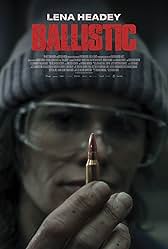

Nance Redfield (Lena Headey), an Ohio mom, works for Price Ammunition Inc. to financially afford to raise her son, Jesse (Jordan Kronis), but the bullets that helped them live may have killed him once he joins the Army and gets stationed in Afghanistan. Will Nance figure out who is responsible for killing her son or be able to continue living? When you want to make a movie about how American bullets end up in the hands of the Taliban, but documentaries don’t make any money, reframe the story as a mother seeking revenge for her killed-in-action son in “Ballistic” (2025). Just prepare for no actual revenge in this bait and switch movie, which is sure to anger people unless they are Headey fans.
It is nice how everyone agreed that a British actor is totally convincing as a blue collar bad ass (“Fighting with My Family”), a ruthless, ruling class avenger (“The Purge,” “300,” Cersei Lannister from “Game of Thrones”), or a mom who loves her son so much that she will kill anyone who dares to hurt her little boy (“Terminator: The Sarah Connor Chronicles”). If you can accept that “Ballistic” is a character study, then you will be able to appreciate Headey’s work. She is convincing at every stage in Nance’s life from proud, happy mama with unshakable faith in the system to a furious, grieving mother constantly changing the goal post as she unravels the thread to make sense of what she lost and who is responsible.
I’m going to quote myself from “The Shrouds” review: “One way to gain control and rein in the sprawling helplessness of grief is to imagine a conspiracy and lash out in the real world against a concrete subject.” So “Ballistic” works because it exposes the inherent contradiction of the American government sending troops to another country to fight while private American companies, allegedly with the help of the American government, provide bullets to the other side. It also works because it examines the real-world effect that it would have on a person, a family and a community. It is cynical for not making the story into a drama but aims to get more butts in theater seats with the revenge thriller angle. Movie goers cannot get enough movies with parents burning down the world for their child, so the movie will attract the wrong audience, and sales will plummet once word gets out, but there is an audience for it as a contrast between the fantasy and reality of the limits of revenge. Unfortunately, that last half hour of the ninety-minute movie becomes a slog, and you will need a coffee to get through it. With a revenge movie, you get a climax. With a sad movie, collapse and acceptance, which may be realistic, but is not exactly memorable even in a poignant sense, just in a sunrise, sunset way.
Behind door number one is life with her expecting daughter-in-law, Diana (Amybeth McNulty), whose biological family is not up to snuff so Diana leans on her mother-in-law. The opening montage is a mix of home videos from happier times, which includes Diana, but the meat of the movie only shows conflict the moment that Jesse is on ice. Conflict is a natural part of any relationship, but “Ballistic” suffers from the same problem that a lot of movies do. The filmmakers do not put in enough time into making the relationship convincing before tearing it apart. It almost feels as if they are making the argument that both women would be dodging a bullet if they called the whole thing off.
Behind door number two is mad mama pulling an Arya with a list of people responsible for her son’s death: her boss, Rick (Enrico Colantoni), the Army official who told her about her son’s death, Galindo (Amanda Brugel), the translator/support group leader/gun instructor who was in the US and not directly related in any fashion, Kahlil Nabizada (Hamza Haq), because he is the closest Afghan, or the army recruiter (writer and director Chad Faust). The only thing that gets a spanking is an innocent steak, a garage door that was probably willing to open and a desk that was in the wrong place at the wrong time. It is obvious fairly early that Nance is channeling her anger in the wrong way, and while everyone (except the translator) bears a level of responsibility, Nance’s way is wrong and self-destructive. On one hand, as an audience member, we want to see what Nance would do unleashed. On the other hand, we also do not want Nance to hurt the wrong person; thus herself. So we end up relating to Nance’s momentum with no outlet, but it is not as visceral in conveying the grief though Headey does her best. Grief is not the priority. If “Ballistic” has a flaw, it is not providing a powerful emotional counterweight to the anger, which is necessary to appreciate the denouement.
“Ballistic” also reflects how acceptable violence is in the mainstream or considering her circumstances. There is a terrific open carry scene in which everyone is nervous and two-thirds of the people in the building are armed and ready for action. Another scene is a complete standoff. Because of the law, quotidian locations transform into war zones. Nance gets physically aggressive and rarely faces consequences except for being body checked, but everyone uses appropriate force and mostly pulls punches. It is an interesting study of who gets to be angry without facing consequences. There is no psych hold, and Nance is just allowed to navigate society as if she is not a violent person with no protective measures for anyone else. Is it realistic or not? Maybe. Because people do not see women as human beings, they are treated as if they cannot be violent and only victims.
The film’s priority is the message. Why are Americans making, transporting and selling bullets to people who will kill Americans? It is a good question that never really gets answered. There is not a constructive countermeasure just a resigned acceptance that the system is a mess as if to imply that any accountability is unhealthy for a mourner’s mental health. There is no call to action embedded in the story. No one expects a mother and factory worker to become an activist or a legislator, but that is often what happens with mourning mothers. So “Ballistic” chose to make it about choosing life, not choosing change. So if you want homework, contact lawmakers to stop civilian sale of military grade ammunition, destroy or transport arms and ammunition instead of abandoning and leaving them in war zones, not supplying even allied foreign governments with weapons and ammunition which can end up in the other side’s hands if power shifts legally or corruption occurs in allied governments, add tracking devices to arms and ammo if transported overseas. I’m not an expert in this area, but when Nance does a little web search, if she had gone further, these are some of the solutions that she would have found.
“Ballistic” is a solid movie to showcase the acting prowess of the cast and bring awareness to an important issue, but at most, it is worth matinee prices, or you can wait until it is available for home viewing. Don’t say that I didn’t warn you about the lack of action and the inherent lack of catharsis.