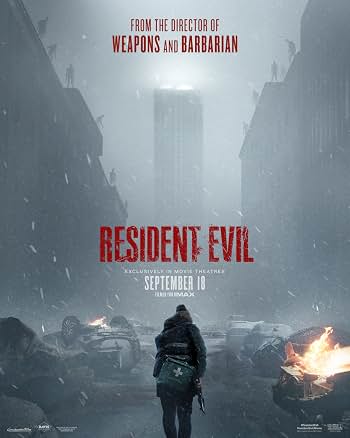

Set in Colorado, “Resident Evil” (2026) follows Bryan Hodukavich (Austin Abrams), a medical courier who works for Lightfoot Medical Transport. While completing his last delivery for the night at St. George’s Hospital and talking to his girlfriend, Michelle, he accepts one more delivery with the promise of double pay if he goes to Raccoon City General and drops off another delivery. While talking to Michelle during a snowstorm, a woman (Adrea Milnerová) points at him and walks into the road in front of his car (very “Evil Dead Burn”). It is only the first of many events that complicate his delivery as he tries to navigate numerous obstacles and soon realizes that whatever is wrong, it is out of the ordinary. Undeterred, he dutifully tries to complete the delivery, but will he make it out alive? Director and cowriter Zach Cregger reboots a franchise with a hilarious blend of horror, survival and comedy, but depending on the moviegoer’s tastes, may not quite stick the landing.
If “Resident Evil” is a box office success, it is primarily because of Abrams’ ability to carry the entire runtime as an everyman in over his head in this sidequel adaptation of the Japanese horror video game. It is as much a character study as it is a survival horror, and Abrams’ ability to be funny soup to nuts is a hard skill to master, but he makes it look easy. If he looks familiar, he was the unhoused person in “Weapons” (2025). If Cregger manages to make it unique, it is because he centers the disappointing boyfriend who rises to the occasion. In the real world, he does not get affirmation for his growth in character, and instead, the horrors of the night reinforces his original instincts to delay dealing with his relationship issues and encourage that they slow down before getting more serious. The love is not the mistake, but the possibility of creating a future together is doomed.
“Resident Evil” requires no homework. Potential movie goers do not need to play the video game or be familiar with the earlier movies. It is a slow burn movie starting in a remote area with gradually escalating monstrosities. It starts like an average zombie movie. There is an explanation embedded in the dialogue of the central act that explains why people and animals are acting strangely and becoming mutated. Think of the plant in “Little Shop of Horrors” meets tentacle horror. If you saw “Colony” (2026), the way that the zombies work together required a hive mind to come up with counterintuitive ways of congregating and moving. Here everything is automatic and biological. Bodies recombine like human tumbleweeds. People jump off roofs and land with an explosive thud to attack uninfected people.
Bryan is a perfect audience surrogate. In the opening, uneventful sequence, he is curious and cannot stop looking even if what he sees grosses him out. He is not terribly clever or the priority in any scene, but he is good at improv. When someone has a good idea, he picks it up, adapts it and levels up whether it is how to get a signature upon delivery, borrowing a rebuke from a doctor to rationalize his decision to take an extra job, or taking his girlfriend’s headline and using that language to glorify his job. He is a little self-serving, but he also has an impulse to try to save people in trouble even if he does not have the skills to do so. “Resident Evil” shows how a normal person would react in a zombie apocalypse. He is not automatically good with guns, thinking strategically, or prioritizing his safety over others. During one scene, someone better at survival gets got, and for the first time, he does not follow instructions and stops rescuing. A side effect of the outbreak is not just the physical mutation, but the psychological callouses that develop so survival and killing other living beings without seeing their former humanity becomes possible.
Cregger and cowriter Shay Hatten turns “Resident Evil” into a subtle moral Rorschach test. Is it possible to save the world if you turn off the impulse to save the person in front of you whether it is a stranger or a loved one? It is not obvious while watching it, but upon further reflection, if the ending does not turn you off and make you toss the movie to never think about it again, it is the lesson that remains. The horror metaphor is not immediately apparent, but Cregger and Hatten’s story rests on the pulse of what ails contemporary society: a lack of empathy, prioritizing money over safety or skill, and a lack of thoroughness, honesty and professionalism.
How does it look? The most arresting scene occurs after Bryan retrieves his hit and run victim, puts her in his car and drives away. The camera stays behind the car, and as the car drives forward, the headlights produce a column of light that makes the organic environment feel like a light moving forward in a maze. The camera often remains over Bryan’s shoulder, but there are a ton of point-of-view shots, which creates constant tension. There are a lot of jump scares, but they are effective. Some scenes feel as if they were pulled from the zombie movie greatest hits: the tunnel choked with cars, the hospital with silhouettes of zombies moving around in the lobby. A random cameo from the “Dune” franchise was unexpected and raised more questions than answers. It generally feels very grounded in the real world, and Cregger humanizes the creatures with the set composition showing photographs of all the victims at better times or playing the answering machine.
“Resident Evil” is better than “Barbarian” (2022), but not as solid as “Weapons” (2025), which comparatively felt like literature. Still Cregger and Hatten succeeded at approaching a franchise in a way that Christopher Nolan aimed for and failed in “Dunkirk” (2017): “The empathy for the characters has nothing to do with their story. I did not want to go through the dialogue, tell the story of my characters….The problem is not who they are, who they pretend to be or where they come from. The only question I was interested in was: Will they get out of it?” Cregger and Hatten do both. They make a nobody into the protagonist. They also instill more empathy and frustration in the audience while they watch this world fall apart and the sparse, briefly appearing supporting characters get absorbed into the chaos in a more satisfying process than “Annihilation” (2018).
S
P
O
I
L
E
R
S
Michelle is pregnant, and even though Bryan decides it is a great idea after facing the horrors of the night, the result tells another tale. Every encounter with a child is a complete nightmare, and of course he has to go through a maternity ward in the final act. “Resident Evil” is the anti-“Exit 8” (2025).