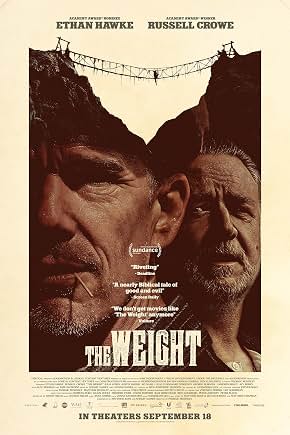

Set in Oregon around 1933, “The Weight” (2026) follows World War I veteran and single dad, Samuel Murphy (Ethan Hawke), who gets arrested on some specious charges then sent to Deschutes County Convict Labor Camp. With the prospect of forever losing custody of his daughter, Penny (Avy Berry), he accepts a deal from his warden, Clancy (Russell Crowe), to transport gold through the wilderness in exchange for an early release. That gold attracts unwanted attention, and their journey is full of peril. Will Murphy survive and be able to reunite with his daughter? When the acting is this good, and the cinematography so lush and verdant, it does not matter if the story feels familiar because you will still be in for a riveting good time. Now that is a movie!
Soup to nuts, Hawke is such a good actor that his name alone feels like a promise of quality. He gets Murphy on a fundamental level and anchors the film with an ease that other actors should study. Murphy seems authentic and knowable even if he does not get a lot of dialogue. Paired with the editing in the first act thanks to first time feature director and coeditor Padraic McKinley and coeditor Matthew Woolley, the rhythm of the scenes shows what Murphy cares about. During his time with his daughter, the past and the future blur together, both sounds and images as if he is rushing for disaster. McKinley shoots “The Weight” as if the technology of that time was as cutting edge as it felt to those living in that era or that McKinley time traveled with current filmmaking equipment to shoot the movie according to the norms of our time.
Crowe does not appear often or long in “The Weight,” but he sets the stage perfectly before the journey begins. Like the audience, Clancy watches and assesses Murphy, his effectiveness, his motivation and his nature, to see how he can manipulate him. Hawke and Crowe (ha, lots of bird names) are excellent partners with the filmmakers almost becoming one with the camera in conveying their characters’ inner worlds. It is obvious that Clancy is feigning camaraderie and kindness to get what he wants out of Murphy, but Murphy also loves the opportunity to perform meaningful work that suits his talents. Murphy falls for Clancy’s schtick so even when it is obvious that it may not be such a great deal, Murphy never appears stupid, just hopeful.
Murphy chooses three other convicts to shoulder the burden: the erudite Indian American Singh (Avi Nash), the loud mouthed, biased Rankin (Austin Amelio) and fresh-faced farmer Olson (Lucas Lynggaard Tønnesen). It is kind of obvious how the group will get along, but there are still some surprises in the store for the interpersonal dynamics that makes the denouement a pleasure to watch. Their guards are the abrupt, gruff Amis (Sam Hazeldine) and the giant Letender (George Burgess). All of them receive their logistic marching orders from Taggert (Alec Newman), who plans to meet them at the end of their hike and take the less scenic route. Indigenous woman Anna (Julia Jones) decides to embed with them instead of remaining in camp when the workers will eventually realize that there is no gold, and the mine will be shut down. It is somewhat disappointing how the romance angle is as visible as their campfires at night, but at least it is not ridiculous.
The plan’s final outcome seems obvious and predictable from the outset, but part of the tension is what else can go wrong along the way. “The Weight” is essentially a heist movie set in the great outdoors thus there are survival elements too. Like most media, the biggest danger is a human being and who will be the first to double cross and who will be betrayed. As they hike, each person’s story gets revealed, and if a character does not get a backstory, they may be a bad guy. While these vignettes may be sparse, they provide the right amount of heft, so the movie is not a pure spectacle or action movie. Cowriters Matthew Booi, Shelby Gaines and Matthew Chapman with a story credit to Leo Scherman are sending the message that the law enforcement officials are not as honorable as the criminals or people of color, and each of these people got criminalized for surviving within a cruel, exploitive system. While the message is not subtle, it is not so heavy handed that it is obviously a critique of our present day carceral system. While it has ahistorical moments such as the predominate acceptance of Singh or the relative safety of Anna, it is not so glaring as to disrupt the suspension of disbelief.
McKinley shoots the journey as if this team consists of drafted soldiers on a war front in a fight for their lives, especially during the shoot outs. Some scenes feel disjointed if you blink too long and may not realize that the missing connective tissue is intentional. For instance, when someone hijacks a car, the rightful driver is not shown. Is it necessary to have another character? No, but those gaps create a mental dissonance that may spark a desire to rewind even in the theater. Editing scenes to be disjointed is a creative mistake, but not a cardinal sin, and the scene using lightning at night like the lo-fi equivalent of a strobe light effect in a dance club as the assassin approaches the target is so effective. The tension is visceral and makes for a visually arresting moment.
The biggest complaint about “The Weight” will be how it borrows elements from other movies, but it gets awarded the same points as “Onslaught” (2026) for doing it well thus raising it from imitation and derivative to homage status. If it was truly derivative, it would be dull and putting moviegoers to sleep, but with just under a two-hour runtime, the movie flies by and never bores. Each act’s title provides helpful information about when and where the characters are then becomes a countdown to delivery or death depending on whether all the gold makes it and if someone gets the drop on someone else. Cinematographer Matteo Cocco shoots the German woods in a way that makes them indistinguishable from the Oregon forest to this Yankee. Forests have not been depicted so beautifully since cinematographer Michael McDonough worked on “Leave No Trace” (2018). It is a neo-Western without the desert dust. While Hawke is the clear lead, the ensemble cast is riveting when it is their turn to share the spotlight.
There are so many movies that are not good soup to nuts that “The Weight” is a pleasant surprise for its consistency and excellence. It may not reinvent the wheel, and it may take some well-worn tracks along the way, but it sure knows how to steer and where to go without leaving anyone behind.