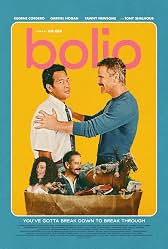

Filmed in Gardner, MA, “Bolio” (2026) is the last name of a sad sack shop teacher, Dale Bolio (Eugene Cordero). On the last day of school, he meets speaker and life coach Chuck Swayze (Gabriel Hogan), who befriends him so Bolio can get himself together. Of course, Chuck may have an ulterior motive. Will they be able to help each other out? Actually, no, but will they become friends? Director and cowriter Jim Issa has a lot of good ingredients that do not quite come together to coalesce into a seamless whole.
Comedy is hard, y’all, and more filmmakers may just need to bill their movies as comedies and dramas, so people are prepared for the roller coaster ride when the lows get really low. Fortunately, I was in the right mindset because I just saw “Loves Company” (2026), which is completely unrelated, but had some tragedy mixed in with the levity. Trigger warning: Bolio is suicidal and dealing with some serious setbacks. The gym teacher, Barnes (Amir Talai), physically bullies him as if they are the students, not the teachers, and seriously, Bolio needed to file a sexual harassment complaint. The art teacher, Clara (Emily Tarver), clearly has a crush on him but he only eyes for Gale (Tawny Newsome). When Chuck speaks at the school assembly, he shines an unwanted spotlight on Bolio that attracts the school’s ridicule minus Sam (Geneva Myhrvold), an earnest student who appreciates Bolio.
Cordero is affable and easy to root for, but the events in his life define his character, and it is hard to get a sense of Bolio as a person in a vacuum. He was a wrestler, a good son and a devoted partner. His most unique characteristics are how willing he is to trust strangers and his inability to form anything other than instant or long-term connections. Clara seems to be a crucial character based on how she is a catalyst for a number of events, including an amusing awkward small talk scene between Bolio and her friend, Paula (Sarah Baker, who was also in “Loves Company”). On one hand, I’m normally against a main character getting into a romantic relationship instead of knowing themselves. On the other hand, she feels more pivotal than Gale and needed to play a bigger role. Even though school is over, Sam seemed fairly important to understanding Bolio and considering the box car racing would later function as a bow on the gift that is “Bolio,” it feels like a dropped ball not to leverage Myhrvold’s talent more.
Do not confuse criticism of the size of other supporting characters’ spotlight with detraction from Hogan’s work. When “Bolio” hits narrative speedbumps, Hogan delivers the kind of performance that makes a moviegoer go with the flow. Think of Hogan as a hotter, friendlier John G. McGinley type meets Cary Elwes. While it is obvious that Chuck is up to shenanigans, Hogan infuses the character with enough sincere emotion that it makes him likable even when he commits unforgivable sins. He has a big brother energy and is hot to boot. Compliments to the chef, i.e. wardrobe for making him cook shirtless in a frilly apron. Cordero and Hogan have great chemistry, which keeps the comedy afloat even when the situation hits stormy weather.
“Bolio” shares a common problem with lots of comedies. Cowriters Issa, Annie Humphrey, Rob Poynter and Loren Tarquinio in their writing feature debut sometimes raise the stakes too high that it makes a character irredeemable, leans too much into interchangeable comedy elements like drug trips or fails to fully explore the consequences of an absurd scenario. They like their characters too much or perhaps are mirroring reality in not wanting to fully follow the thread and villainize them after bad behavior. For example, Gale invites Bolio to a church singles mixer with an Eighties theme. On a minor note, the dialogue and wardrobe explicitly reference the television series “Miami Vice,” but does not fully commit to making Dale and Chuck play Crockett and Tubbs. Why are we leaving laughs on the table but making high jokes? Once you find out why Gale invited Bolio, there should be a ton of jokes at her expense and the church. On one hand, it is very mature for Bolio to recognize that Gale does not have to be into him just because he likes her, but once you know more about their shared history, the writers underplay the situation, a consistent problem that persists with many of the characters. There are a lot of pulled punches.
One substantial development in the last act involves a random couple, Sondra (Brooke Adams) and Tag (Tony Shalhoub), but it likely works because of Adams and Shalhoub’s acting skill. It is so great to see Adams, who is a horror icon from “Invasion of the Body Snatchers” (1978) with Donald Sutherland and “The Dead Zone” (1983) with Christopher Walken. Adams is a legend, and she plays the real deal affirming stranger that Chuck is imitating. Tag compliments Sondra, and Shalhoub can equally mix warmth with gruffness. Does the situation feel tailored to fit Bolio’s specific situation? Not really, but because the acting is convincing, it generally works.
“Bolio” is one of those movies that a great cast can help first time writers’ flaws. The story actually reveals that the writers may want to ask themselves about which behavior that they have accepted in their lives when the red flags are waving, and they should have run the other way. The ending is way too cheery and pat almost lending a sitcom-esque tone to the denouement. The issue of grief is not fully tackled, but let’s sign a waiver because most Americans are not deft at handling that subject; however, the house cleaning sequence largely works because it is a practical image of one way to address the reality of mourning. It also provides an entry point into understanding Bolio’s history and culture, which is the one moment where he feels like a unique individual. It also cements Chuck’s comfort with being uncomfortable and kindly telling hard truths, not just shining him on. There is likely a stronger comedy that does not rely on the ulterior motive to provide momentum and is just a story of two men hitting it off, getting to know each other and letting down their facades. It is the strongest element of the story.
The ensemble cast of “Bolio” create a world and immediately get the audience invested in the characters and the scenario. The filmmakers may not have made a perfect comedy, but they had enough promising ideas to attract an audience and keep them entertained. The writers only needed to work on recognizing the full implications of their ideas and follow the threads through their furthest corners. Considering it is most of the filmmakers first or second time working on a feature, it is a solid start with quite a few laughs and a well-intentioned sweet spirit.