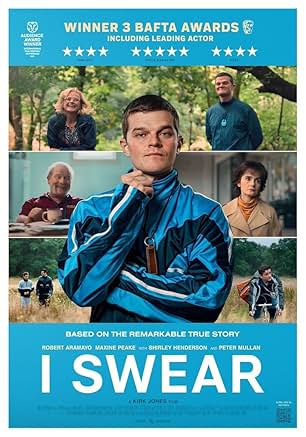

“I Swear” (2025) is a biopic about John Davidson, a Scottish man with Tourette’s Syndrome who has also appeared in television documentaries: at 16 years old, on “Q.E.D.,” a BBC 1 award-winning science documentary series, specifically, Season 10 Episode7, “John’s Not Mad,” which aired on March 15, 1989 and was twenty eight minutes; at thirty years old, on “The Boy Can’t Help It” (2002); and at age thirty-seven years old, on “Tourettes: I Swear I Can’t Help It” (2009). The scripted feature starts in 2019 with John (Robert Aramayo) freaking out because he is worried how he will act when he meets the Queen to receive the MBE (Most Excellent Order of the British Empire) for his work in spreading awareness about Tourette’s Syndrome and helping children. Most of the film rewinds to the point just before he started showing signs of the disorder in 1983 and how he earned the honor before returning to the opening and showing how his life progressed after receiving the award up to 2023. It is a sad, predictable and ultimately uplifting story, but it also makes the BBC and BAFTA seem more like monsters for knowing as much as they do about Davidson’s story and making his life worse on a global scale after overcoming so much.
Without child actor Scott Ellis Watson’s foundational work in the first act, Aramayo would not have much to work with. Watson depicts John as a confident young man with a promising future. Maybe “I Swear” lays it on too thick, but on his first day of school, John appears to be the well-rounded leader of the pack with prospects as a football player, a well-adapted social butterfly, especially considering that he is in the throes of awkward adolescence. Writer and director Kirk Jones depicts the movie from John’s subjective experience so the external change in John’s external demeanor has a domino effect in his world. One act destroys everything, including his family.
By mainly focusing on John’s relationship with his uptight mother, Heather (Shirley Henderson), “I Swear” symbolizes and focuses the crumbling of his family support structure on one person and fairly or not puts the blame on her shoulders. It was a weird creative choice for one of his siblings to exist and play a huge role during the award ceremony, but not for most of the film. His spiritual sibling is Murray (Francesco Piacentini-Smith), an easily forgettable character who only appears briefly in the childhood sequences and reappears when he is an adult deep into crisis. He is more of a conduit to meeting people who would be instrumental in having a full life instead of being treated like a pariah who deserves punishment, but Murray is more of a background cheerer than a close friend in the way that the film presents him.
“I Swear” becomes a story of John finding his chosen surrogate parents, i.e. the parents who chose him when he was at his worst, not the biological parents whose love was conditional. Murray’s mom, Dottie Achenbach (Maxine Peake), basically adopts him and treats him well regardless of his behavior and understands that he cannot help it. Even though it is hard to believe that someone would get a chuckle over getting clocked in the face even if a grown man could not control his physical movements, it is true. Stay for the closing credits, which includes clips from the aforementioned documentaries. Some people are built different and thank God for it. Dottie’s husband, Chris (David Carlyle), is depicted as initially wary, but later an enthusiastic helper though not a father figure. That role goes to someone else.
Dottie introduces him to Tommy Trotter (Peter Mullan), the local community center caretaker with a dog, who starts with mostly ignoring the condition to encouraging John to educate the world about it. Mullan steals every scene because if this blue-collar guy can be sensitive, no one else has a reasonable excuse. Their relationship provides a roadmap for how John decides to live his life with a few underexplored detours such as living on his own in council housing, and the locals exploiting him. It felt like a detail that needed to either be expanded as a theme or omitted entirely.
“I Swear” excels at showing how having a disability is like being in exile from society and watching your potential flush down the toilet. A disability is like a Rorschach test for others regarding whether they are worth having in John’s life, not blood, status or age group. It is a mostly sad tale, and the uplifting part is just as sad. The happy ending is a life of teaching people how to have empathy and learn about disability. So, the person with the least capacity, privilege, money and resources has the burden of helping everyone else become better people. The only way to be accepted is to be of service to the people who torture you. Of course, it is the lesson that would be delivered in a movie from an empire. So, while it is the story, it should not be accepted blindly as the way to go with everyone getting off scott free for abuse or neglect. The lack of accountability is a feature, not a flaw.
If “I Swear” made a big error in crafting its film, it should have hired another actor to play the older John to mirror the stages of each adapted documentary. The sense of time passing is symbolized in tunes and the time flashing on screen, but it should be visceral. Yes, Aramayo gets to show his acting chops in a rigorous role for the entire span of the film, but there is no effort to age him. Also, some of the film’s humor relies on laughing at his outbursts, which is a tricky gray area. It was also a strange creative choice to pretend within the world of the film that he was not a well-known public figure and how that affected him. Did the documentaries have no effect whatsoever on the John’s world? Also, it does not address how Murray’s siblings felt about having to share their mother with an adopted brother. The film often pretends that Murray was an only child except one dinner scene shows two other unnamed siblings. It is a sad situation that it is realistic that John’s father, David (Steven Cree), disappears after his son’s prospects of becoming a star athlete disappears, and most moviegoers will accept it as realistic.
Movies love to tout the beneficial effects of getting off medicine when some people really need it. It feels irresponsible to just include that detail and assume that because Dottie is a nurse and compassionate, she is right, and his mother, who is also a nurse, is wrong. Instead, there must be more than just a tug of war over John’s humanity. Something is missing. If it was not for the cursing and violence, it would be an ideal television movie of the week albeit a quality one in the way that it keeps the story simple.