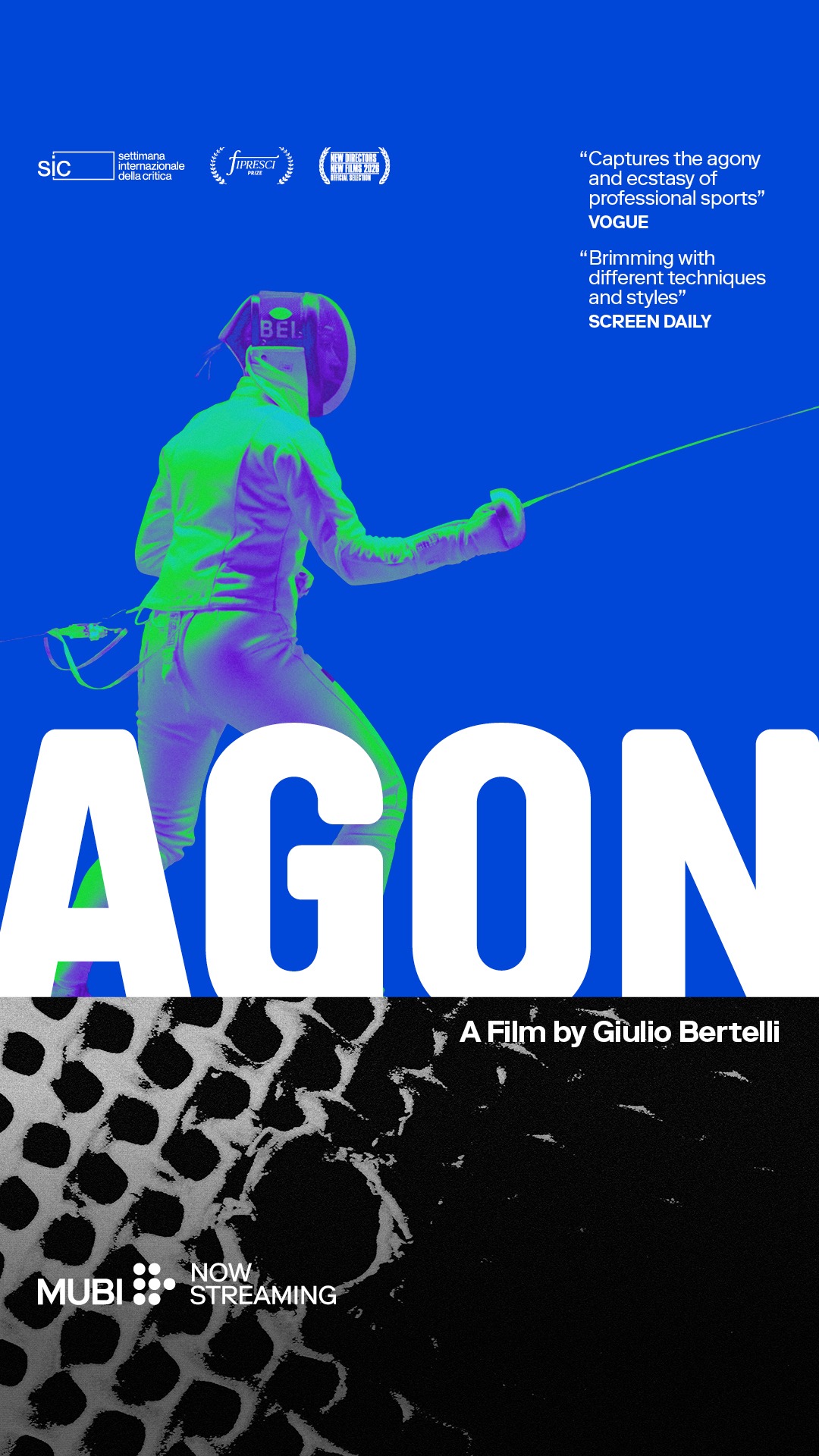

“Agon” (2025) is more of a personified intellectual analysis of the origin of sports, the Olympics and its innate nature in a world that seeks to sanitize and separate it from its bellicose origins. The scripted feature revolves around three Italian women athletes competing in three different martial sports in the fictional 2004 Ludoj Olympic Summer Games. Alice Bellandi, who is playing a fictional version of herself, is competing in judo and is an absolute unit. Tokyo Gold medalist Alex Sokolov (Sofija Zobina) is back to compete in rifle shooting. Fencer Giovanna Falconetti (Yile Yara Vianello) spends most of her time listening to her coach (Francesco Acquaroli). Each of them will encounter obstacles to achieving their dreams. After reading this review, you may be better prepared to appreciate the movie more than if you went in cold.
The title refers to an ancient Greek god who personified an athletic contest. The Olympics is supposed to be a religious festival honoring Zeus, but in theater, thus movies, it symbolizes the struggle between a protagonist and an antagonist, but these characters are barely protagonists in the traditional sense of the world, and the only antagonist to these three women is themselves, a system distilled to a moment, or their chosen field of expertise. All these sports are innately violent yet are made as safe as possible so no one can get hurt. Each athlete treats it more like a science and are verging on emotionless. It is almost a monk like competition, but chance rejects control and re-inserts variables and feelings.
“Agon” opens with a quote from Pierre de Coubertin, who is known as the father of the modern Olympic Games, urging. “The idea of war must never cease to inspire them.” First time cowriter and director and seasoned competitive sailor Giulio Bertelli, cowriter Pietro Caracciolo and cowriter Luigi Alberto Cippini instead depict the Olympics in a mechanical way that almost takes humanity out of the process and thus war, which unfortunately is an innate part of human existence, yet the innate harmful nature of sports, the injury that can be caused when engaging in such sports, is impossible to exorcise from the activity. They depict the actual games without bystanders cheering and in vast empty spaces as if they were performing in front of a blue screen for a movie with special effects. More time is spent on the preparation, which is accurate, and is fractured with close ups of movements that seem extraneous, a handheld camera for actual moments when two or more people are physically engaged with each other.
Consider yourself warned, but a great deal of focus is spent on digital imaging of body parts to examine and determine how to heal them. If you are squeamish, skip this movie because a knee surgery is shown in clinical detail. There is also a breakdown of the factory process of making bullets, rifle parts and the steel plate used to protect fencers’ faces. Despite all this human scientific knowledge, “Agon” suggests that there is something essentially unknowable about the human body, nature and sports. Alice gets the most screentime as she prepares her body for competition from physical therapy to laser hair removal. Alex has the most conventional story as her image and sponsorships are endangered after a video is leaked of her engaging in an activity that seems hypocritically against the Olympics’ policies considering her sport. She is the only player whose personal life affects her public life. Giovanna’s story is the most surprising, and Bertelli depicts it in the most antiseptic way. Bertelli denies his audience the thrill of sports and even a scintilla of spectacle or sensationalism.
In some ways, “Agon” is like “Tron: Ares” (2025) except the digitalized world applied in the three-dimensional world does not make machines more human, but human beings more into machines with a similar emotional palette. The expectation of the Olympic experience is of a simulation with no consequences. It is international without being unique or representative of the various culture. It is artificial, not an organic use of space and is almost completely devoid of nature. There is not even a plant. To experience nature, one must leave the Olympics, which is the last thing that any of the three women want, but once in nature, are the Olympians capable of experiencing it? The oddest quality of this world is a receipt machine that spits out phrases that could be nonsense or poetry a cinematic avatar of how AI has taken over creativity, and human beings are the machines.
“Agon” is like “The Drama” (2026) without drama as the morality of events gets debated in a dry, dispassionate way complete with a NPR-esque interviewing style. It asks the question about what to do if no one is to blame when something bad happens. The nature of competition is unfair because of physical ability, environmental conditions and mental state. There are unknown unknowns. In Alice’s climax, it does not even seem as if anything even happens before her fate is sealed. If Bertelli has a style, it is the opposite of Yorgos Lanthimos’ surreal sensationalist style, which seemingly arbitrarily magnifies and exaggerates some aspect of society to expose its absurdity. Bertelli adopts a hyper real, gynecological style to show the absurdity of the rituals with science as the religion. For example, a urine drug test is conducted with the rote solemnity of a service. He is lifting the veil of what is happening behind closed doors instead of leaving it relegated to the journalistic margins of a news story about a victory and a loss.
As an ignorant American, a radio story references how Italian Olympians make good money because Italy has no economic problems. Is it satire, and if so, what aspect of Italian society is being mocked? The fictionalized aspect makes it more opaque. In contrast, American films about Olympians show how impoverished they are and lacking in any level of support. These athletes seem pampered with every tool at their disposal, but not in any better psychological condition. Fun fact: Brazil is considered a top competitor in judo whereas Italy is a second-tier nation, so it is not a case of fucking with Black people. Singapore is competitive, but not a contender in fencing whereas Italy usually medals. A 1982 event allegedly inspired “Agon” according to a closing caption, but it specifies nothing else. It is likely an event that occurred at the 1982 World Fencing Championship between Italia fencer Marco Marin and Vladimir Smirnov, but do not look it up before watching the movie because then you will be spoiled. So, is a stylized film like “Agon” worth your time? “Agon” is a deconstructed film, and if you come to it expecting a traditional sports drama, prepare to be bored out of your skull. If you come to it expecting an artsy fartsy meditation on the nature of violence in the civilized world, how it is embraced and repelled, you still may be bored, but not disappointed.