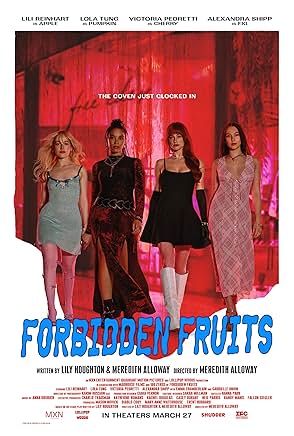

“Forbidden Fruits” (2026) follows a year in the day-to-night operations of the employees at a Free Eden store in Dallas Highland Place Mall. Considered mall royalty, the trio are tight knit, but when a newcomer with an agenda, Pumpkin (Lola Tung), vies to join their ranks, she discovers that they are witches/sisters and are not as close as they appear. Is the sisterhood nothing but a ruse or is there magic behind the mystique? This film adaptation of cowriter Lily Houghton’s stage play, “Of the woman came the beginning of sin, and through her we all die” (2019), has great style, perfect atmosphere and delicious performances, but feels as if it lacks a center as it meanders to the ending.
Everyone who works at Free Eden is named after a fruit. The Queen Bee is Apple (Lili Reinhart) who has the strongest attitude and presence but is a bit of a mystery. Apple is a controlling, strict rule maker who created Paradise, the after-hours coven with three rules, and she is always on guard against snakes. The Biblical Garden of Eden theme should be obvious, and Apple’s license plate says, “6Lilith6,” which is a combo of Adam’s first wife and the anti-Christ. At times, Reinhart resembles Dakota Johnson, and her performance seems like a less selfish, utopian minded Regina George. By the end of “Forbidden Fruits,” you will be sad that she was not featured more. Her version of witchcraft is a weird mix of pop culture, commercial consumption and misandry, but seems about as supernatural as her surroundings. It feels more like a psychological experiment.
Cherry (Victoria Pedretti) gets the most screentime as Apple’s pet project. Pedretti resembles Rose Byrne and provides the comedic relief with her character’s high voice, secret vices and utter devotion to the group and Apple. Alexandra Shipp is probably the most famous member of the cast and gets the second most screentime as Fig, a scientist saving up for grad school. She is the one who helps Pumpkin get into the group and impress Apple. If there is a forbidden fruit, it makes sense that it is carbs since Pumpkin uses pretzels to lure the group into straying from the strict mall hierarchy. Pumpkin is the audience surrogate as the newcomer learning the group’s rules and trying to figure out what their deal is. When she realizes that Cherry and Fig are less devout to Apple’s principles, she encourages their dissent and widens the wedge among the friends, but not in a malicious way. She just thinks the rules are random and challenges Apple as often as possible because she is suspicious of a few weird stories wafting around Apple such as who is the employee who used to hold Pumpkin’s position. She also has an agenda.
If you expect “Forbidden Fruits” to be a traditional witch horror film, don’t. This story could be read two ways. They are witches, but not good at their craft. They are not witches. They are women trying to make sense of life in a post-modern world without religion, conventional or otherwise, so they cobble together what they know. They are trying to create community and empower each other in unsustainable ways while avoiding the pitfalls of what befell their mothers. When they cast hexes, the ensuing mayhem can be rationalized as something that would have happened without the spells, but their guilty conscience makes it a self-fulfilling prophecy. The charm bracelets are a clever play on this duality.
“Forbidden Fruits” is better with repeat watches. Houghton and director and cowriter Meredith Alloway made a film thinking that the central premise and conflict would be obvious to anyone. It is not, but the clues are obvious during the second watch. It is essential a battle for control of the group between Pumpkin, who does not believe all men are bad, and Apple, who does, because of their different life experiences. Initially it presents as Apple wanting her friends to not have romantic relationships, which is partially true but reductive. Instead, the film keeps the protagonist as mysterious as Apple thus making her motives seem ambiguous. By the end of the film, it feels more like a pilot for a television series or a shameless plug for a sequel, which would be welcome either way, especially considering there is a cameo from a terrific movie star who plays the store manager, Sharon.
All the horror is saved for the denouement though there are plenty of horror movie references, which include Nicole Kidman in “Practical Magic” (1998), the movie poster reminiscent of “The Craft” (1996), a black and white photograph that feels like a shout out to “The Shining” (1980), a guy named Norman in honor of “Psycho” (1960), and styling a mysterious figure like the titular mama in “Rosemary’s Baby” (1968). There are only a few brutal deaths and a couple of offscreen deaths. Chekhov’s meat cleaver makes an appearance, and it is pretty awesome. Do not worry. The cat does not die. True horror fans looking for thrills will be on a diet, but not wholly unsatisfied because the contrast with the environment and comedy are perfect. It does not hurt that there are casual punchlines resting on moviegoers’ knowledge of Britney Spears’ songs and “The Devil Wears Prada” (2006), which is perfectly timed for the imminent release of the sequel.
Costume director Sarah Millman cooked with all the women’s distinct looks that matched their personalities. “Forbidden Fruits” succeeded in creating a clique that consisted of individuals and allowed for a certain level of differences. If the filmmakers first film had a major flaw, it was not finding a way to get serious about some of the more tenebrous quotidian themes implied such as worshipping Marilyn Monroe, especially when Cherry’s confessional reveals her mental state. Many of the characters shake off and hide these cracks relatively quickly considering how heavy the internal story is. No one wants this movie to lose its verve, but these deeper issues are more disconnected than they should be once they are introduced.
S
P
O
I
L
E
R
S
While no one is condoning Apple’s one off-screen murder, Pumpkin was the villain. Also, Pumpkin threatened Billie Jean with hot water for no discernible reason. I was disappointed that “Forbidden Fruits” abandoned Cherry’s suspicion of Pumpkin. That group would have broken up eventually, and because she went in trying to speed up the process, she exacerbated the situation. It also explains why Apple gets a happy ending from people who accept her at her nadir. Apple was trying to create the childhood that she wished that she had and have sisters! Not a single girl or woman in her family sympathized with her. I also liked the touch that it was a relatively older group of women at the end so it was unlikely that Apple would become Queen Bee again. Apple could get off the controlling train and receive nurturing.