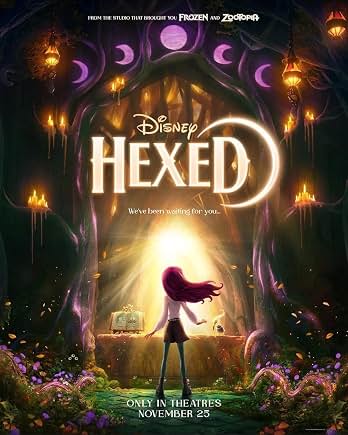

“Hexed” (2026) is set in a world where people persecute witches and wizards so they fled to Hexe, another dimension, thanks to an extraordinary witch who died before she could finish the spell. There is a prophesy that another extraordinary witch would be able to complete the spell. Fast forward to contemporary times to mother and daughter, Alice (Rashida Jones, cowriter of “The Invite”) and Billie (Hailee Steinfeld) Doe. Alice fears what could happen if Billie knew that she had powers, used them and then attracted the wrong kind of attention. Billie feels as if Alice is overprotective because there is something wrong with her. When Alice accidentally discovers that she has powers, she jumps right in and discovers Hexe. Mom is close behind to get her daughter back to regular life in Ohio before Queen Celeste (Jodie Foster) sees Billie as a threat, but news of Billlie’s arrival spreads to Celeste almost immediately. Undeterred, Billie turns to local familiar Beef Roger Crummchuk (Walton Goggins) for magic lessons. Who will fulfill prophesy? Who is the chosen witch? Like its characters, “Hexed” takes roughly an hour to find its footing and individuality, but once it does, it soars. Prepare to cry for the entire second half. It is brilliant marketing to release this movie the day before Thanksgiving because it is perfect for the whole family. Try to avoid spoilers and just see the latest Disney film.
While Billie is the protagonist of “Hexed,” Alice is not far behind, and their relationship is fairly normal with Alice as the well-intentioned, but overprotective mom, and Billie as an adventurer who loves being a do-gooder. While it is likely a coincidence, Billie’s course feels like a mashup of “Forgotten Island” (2026) without the friendship or culture, “Hoppers” (2026) without the anger and lying at least on Billie’s part, and “Wildwood” (2026) because of the scenario. Billie is not a well-defined person and has no friends or relationships, which explains why the movie initially lacks momentum. She has good vibes, and Steinfeld is great actor, so Billie feels three-dimensional while being an emotional impression. There is not a lot of specificity to her, but her plight is relatable because the audience knows that she should live a bigger life. Alice could be a villain if her fears were not viable. Ravens tried to kidnap her daughter as a baby (Kira Green). Alice’s rendering and Jones’ acting reflect her good intentions. She comes across as a normie trying really hard not to freak out over the constant threat of danger.
“Hexed” does not come to life when these ladies arrive at Hexe. When Billie finally has another sentient being to talk with, the movie stops being a sketch of a normal mom and daughter tug of war about freedom, which is not enough to make it a story. Goggins is the fuel that gets this rocket off the ground and propels it into the stratosphere. He makes every line sound profound. Beef Roger Crummchuk looks like a three-eyed cat and is called a familiar, never a pet. When he is trying to be fearsome, he treats his body like Mr. Fantastic and allows his neck to invade his opponent’s personal space. He definitely gives off a dude vibe and a world weariness, but soon teams up with Billie, who does have a history with animals though she is no Disney princess. Her relationship with animals is always a little off kilter. Also, there is a neat theme with owls not wanting freedom and retreating to the back of their cages, which feels related to Alice’s story. For Billie, this journey is about fearless self-discovery, but for Alice, magic is unsafe, and normalcy is easier. Billie’s lack of fear and relationship to magic as one of joy and freedom without trauma is a corrective experience that helps heal Alice’s trauma and suppression and estrangement from her own magic; however, the story does course correct lest movie goers leave with the wrong lesson of parentification. Billie may need to heal family curses, but it is still Alice’s job to protect her daughter and do the heavy lifting. She is still mama. A lot of stories screw that part up, but not “Hexed.”
“Hexed” uses the trope of the chosen one to fuel the narrative then find clever ways to subvert it that will be obvious to frequent moviegoers and armchair psychologists but will shock most audiences with the frequent revelations and twists. It feels as if the story was created like a parable to help audiences recognize themselves in the characters, expose the hidden-in plain-sight enemies, reveal the core problems that hold them back, trace how these problems originated, show how they reproduced those wounds in the world, heal their core wounds and apply all those lessons to live a different life upon leaving the theater. Codirector and co-story conceiver Josie Trinidad, co-story conceiver Phil Johnston, cowriter and co-story conceiver Jared Bush, and cowriter Dana Ledoux Miller were doing the Lord’s work. Also, are all of them ok and do they need someone to curse out anyone treating them badly or would they just like a hug? They nailed depicting narcissistic dynamics as a vampiric force.
Celeste is a great villain who looks perfect and powerful but projects her real status on to others to rob them of their power. Her henchmen, the ravens, morph into stylish women who would fit into a sequel of “KPop Demon Hunters” (2025) except they are silent and may not be able to talk. I have coined a saying that I use all the time in my daytime job. Power as a bank is destructive and will destroy the person storing and hoarding the power. If power flows through a pipe to others, it empowers. Celeste’s reign of terror over Hexe is heavily implied but not fleshed out with “Hexed” prioritizing her relationship to Billie and Alice to illustrate her ruling style. Movies tend to equate goodness with beauty, so it was a great idea to have Celeste appear benign for most of the movie. The key to her story is paying attention to how and why she uses her power and her words. She is a moral monster incapable of having relationships that benefit anyone but herself and only sees others as threats even if they are children. The illustrators use Billie’s disastrous flailing crash into a huge wall size moral of Celeste as a terrific visual, i.e. telling the whole story in one moment.
“Hexed” has such a strong story and excellent cast that while the filmmakers cared about the quality, they clearly prioritized some elements and delegated others such as the music and world building, which were not on the top of the list. Homage versus imitation will be the argument regarding the rendition of the supporting characters and the environment, but there are visual references to “Alice in Wonderland,” “Beauty and the Beast” (1991), and Ursula in “The Little Mermaid” (1989) complete with a cameo from Jodi Benson as Cursula. Regarding the soundtrack, instead of pairing a composer and lyricist to make a great musical exclusively for this movie, there are needle drops of Dua Lipa’s “Levitating” and Demi Lovato’s “Confident,” a cover of the Cars’ “Magic,” and an instrumental rendition of Queen’s “I Want to Break Free.” These are great songs that work well in their new context, but it detracts from making “Hexed” into a timeless movie with a complete soup to nuts invented world. These are not deal breakers, but with such an excellent story and talented cast, it feels as if a perfect score was within reach, but they decided for whatever reason not to go for it.
No matter because “Hexed” is practically perfect and should be required viewing for everyone. It may be a life changing movie for people if it is their first time watching a movie that resembles their life experiences. As fellow critic Erin Underwood says, this is therapy-like exploration through fantasy. Oh, and kids will like it too.
(Who is the dad?)