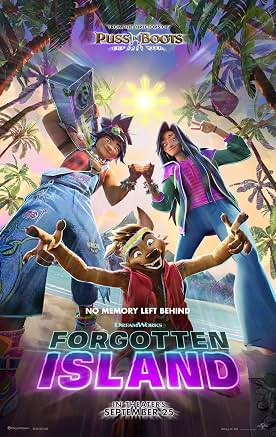

Set in the Philippines, “Forgotten Island” (2026) refers to Nakali, a (fictional) island full of mythical creatures. In elementary school, Jo (H.E.R.), Josephine Cleopatra Yuson, gets in trouble for enthusiastically telling the story of one of the inhabitants, Manang (Lea Salonga), a demon vampire woman who can separate parts of her body. Jo discovers that her classmate, Raissa (Liza Soberano), shares the same interests so they immediately become best friends, and Raissa promises that it will be forever. Jo’s Lola (Dolly De Leon), which translates to grandmother, nurtures their friendship and their love of the island. As they grow up and are about to go their separate ways, a portal finally opens, and they go to Nakali, but to leave the island and return home, they may have to sacrifice their memories. If they lose their memories, they will lose their friendship. Will Raissa break her promise? While codirectors, cowriters and real-life friends Joel Crawford and Januel P Mercado are seasoned directors, it is their writing feature debut, and their ambitious, heartfelt, nostalgia filled story is overstuffed with goodness that may be hard to fully absorb but is a good problem to have. It is easier to cut than to run out of ideas.
Jo and Raissa complement each other. Jo is the free spirited, exuberant and bold one. Raissa appears more strait laced, studious and shy. Jo brings Raissa out of her shell and unleashes her sense of adventure and creativity. The friendship is genuinely moving, including the aging montage. Crawford and Mercado can write for girls and women. It is interesting that a couple of guys would prefer to write about them since “Forgotten Island” is a tribute to Mercado’s late father and Crawford and Mercado’s friendship. Because the leads’ relationship is so convincing, it almost paints Raissa in an unfavorable light when she begins to push Jo away. Even so, the denouement rectifies those issues completely because of the effort that Raissa expends to keep them together so if it was a conscious choice, it was very risky, and ultimately there were no hanging threads. At least, the story did not fall into the usual friendship story pitfalls where the split is so egregious that the mending does not convincingly resolve the differences.
It was exciting to immediately recognize that during the first act, “Forgotten Island” unfolds in the Philippines. This opening celebrates the culture: flying chanclas, karaoke, whole roasted pig, valuing academic excellence and the brain drain to the US. There is an understated theme of people going to the US, leaving people behind and acting as if they do not care, especially in Jo’s life. It is a subtle example of a real-world problem that is not hammered home as serious or indicative of other issues that children may not care about and would derail the fun. The most important cultural contribution is the mythology, which is used to populate the rest of the cast of characters on Nakali.
The Sarimanok, a giant, multi-colored bird who resembles a chicken, is a symbol of good fortune. He provides transportation. The friends’ Nakali guide is Raww (Dave Franco), a were-dog, specifically an aspin, which means Filipino dog, but is a street dog or stray. Batiba (Jenny Slate) lives in caves and looks like a cheshire cat. The folklore makes her seem scarier as a batibat, a vengeful demon who lives in a tree and seems like a sleep paralysis demon, but the “Forgotten Island” version is completely dissimilar. Bungi (Manny Jacinto), a demon baby, has blue skin, a third eye in the center of his forehead, and resembles a big baby complete with an umbilical cord. The origin is a Tiyanak, a vampire who uses its looks and baby cries to attract unsuspecting Good Samaritans. They completely defang him and change his cries into a dramatic asset. This guy loves making tapestries that move so he is a filmmaker with thread. Truffle Wuffle (Ronny Chieng) is the King of the Duwendes or Duende. Their demeanor is fierce, but they look like adorable mushroom people. In folklore, Duendes are tiny humanoids who live in caves, trees, rocks, or ant or termite mounds and could be good or bad, but it is bad luck to accidentally step on them. Mermanh (Kevin McCann) has two different looks depending on his level of hydration. When moisturized, he appears blue-skinned, sports duck lips, is muscular and has lush black hair and Starfish Pasties (Nico Santos), but dehydrated, he looks ready to adorn any house for Halloween. In the mythology, he is a Kataw who can manipulate the water, but that power is not featured. Because he never gets what he wants, his character’s storyline feels unfinished. The tree people include Datu (Jo Koy) and his tribe. They may be based on the kapres, who are just giants who live in trees. Manang is the one character who closely adheres to her mythical origin as a manananggal though they have no association with volcanoes or fire. A lot of these characters personify an issue that the friends are experiencing, but a few cuts (Rawr, Mermanh and Duendes) would have streamlined the story. Based on my love of movies, I’m probably more like Batiba, and I feel ripped off that Manang’s story is not fully told.
If “Forgotten Island” has a flaw, there may be too many characters and too much rapid fire, context free mythology to completely absorb before moving on to the next character or situation. On one hand, it is incredibly clever to have a relay race narrative style that gives each character a chance to tell a story, which in turn allows the animators to use different styles of animation and show off their talent. It keeps things moving, but because the terms and names are unfamiliar, and there are a growing number of viewers who use subtitles who do not need it for the original intended purpose, it may have been helpful to find a way to show the characters’ names and/or species in the scenes as they did with Nakali on the jeepney’s side with graffiti. For instance, Bungi has a shop so his name and genus could be printed on a sign. The kapre village could have a sign on the entrance. Bear in mind, this could be a niche take, but it would be helpful.
While I did not want to rush through the mythology, around the one hour eight-minute mark, the momentum started to slow down. As fresh and fun as “Forgotten Island” is, elements can feel derivative from such contemporary films as “Maleficent” (2014), “Moana” (2016 or 2026) and “Hoppers” (2026) even if they are not. The Eighties and Nineties needle drops were infectious, but the era markers, including a clip from “Predator” (1987), almost became plot points; however, the creative choice makes sense because of how important music is during that stage of life complete with the cassette mix tape made from listening to the radio. It is so authentic, but is it essential to move the story forward? Also, it is one of those movies where no one is a villain, just misunderstood, which is realistic, but not entirely satisfying.
“Forgotten Island” may be a lot of movie for most kids (and some adults) to absorb, but parents, drag them anyway because you will have a great time reliving the days of your youth. It is colorful and captivating infused with genuine emotion but needed a more ruthless collaborator to kill the filmmakers’ darlings for a tighter movie experience. Also, if you watch the trailers, they are incredibly misleading regarding a few plot points, which are actually cleverer in the movie, especially the friends’ autonomy in choosing their destiny and the actual risks.