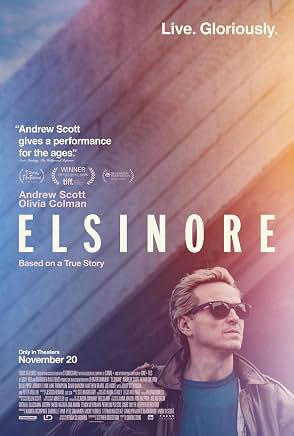

“Chariots of Fire” (1981) or rather Vangelis’ score haunts actor Ian Charleson (Andrew Scott) in 1989 London. Performing in film and being beloved are not enough to make Charleson feel whole. He would love to be back on the stage and is keenly aware that Daniel Day-Lewis is having Charleson’s dream work experience playing Hamlet at the National Theater, so when the renowned actor walks off stage, Charleson leaps at the opportunity to replace him. There is one catch. He has HIV, and there are physical signs that it has become full blown AIDS. Can he live long enough to fulfill his dream? Andrew Scott. Check. Eighties pandemic. Check. My favorite Shakespeare play. Check. It did not matter. I did not cry during “Elsinore” (2026). I wanted to, but it tries too hard and never stops telling its audience exactly how to feel and what to think long enough for us to actually do it.
Scott is an undeniably great actor, and he did his job in a way that no one else could do. He occupies a character from the inside out, so he does not have to look or sound like them. It feels real because he is clearly playing a role in such a way that if Charleson resurrected and came on set, it is likely that the real-life actor would apologize for intruding on his own life because Scott rightfully occupies the spot. “Elsinore” feels like it is set in the Eighties without using intrusive, shiny Eighties elements like most movies do. It renders gay men’s perilous and pleasurable times evenhandedly albeit perhaps a little too neatly. Who knows? Maybe the immunity of a theater community was like a portable force field that protected them off stage. There are no nostalgic moments where the cultural touchstones take center stage. It feels lived in, taken for granted and present, but not emphasized, which is actually the movie’s problem.
“Elsinore” does not show a similar restraint in telling Charleson’s story. It keeps interrupting this world that Scott and the ensemble cast have convincingly created between the. Instead of letting the audience savor it, every five minutes, the film ties him on the railroad tracks and blows the whistle. There is a point in the story when it is less about Charleson and more about everyone watching him nervously or appreciating him, which renders him into an object exactly at the point where the moviegoers need to focus on feel him as a human being. There is a good movie in here about how to die as passionately as living if the film would let it unfold.
The first hour of “Elsinore” is the best as it depicts the rhythm of Charleson’s life before he starts working at the theater. Characters are introduced organically and do not feel staged. Sean Mathias (Matthew Beard) walks to a night spot with Charleson, and they bump into Georgie (Luke Thompson), one of Charleson’s former lovers then Derek (David Dawson) holding a stack of books who upbraids Charleson for being closeted and mainstream. Throughout the film, these characters are recognizable and reappear at intervals so as in life, through Charleson, the audience gets to know them too, and it offers a way to discover the nature of their relationship to Charleson. The supporting parts are mostly three-dimensional characters living their own life who independently intersect with Charleson. Derek becomes an essential foil for the way that he and Charleson navigate their careers and lives. For the kids, think Magneto and Professor X except with sexual orientation and being out and proud.
To be fair, Sean straddles the function of a full-fledged person and a person who is mostly depicted providing support to Charleson, but the first appearance of such characters is normally as a friend in Charleson’s sphere. Patsy (Billie Piper) and her daughter, Alice (Sadie Soverall), allow glimpses of their career and personal lives in the dialogue, but they become the quotidian chosen family. All the clips from “Hamlet” primarily focus on Charleson’s performance, and it would have been a nice balance for it to be less quippy and more developed to fully see the dynamic of bringing everyone together to put on a show and contrast Charleson’s navigation with other actors who feel as passionately but are not dying. It mostly works because everyone is so breezy, fun and clever. Ralph (Paul Chahidi) is a standout as a considerate costumer, who knows exactly what is going on. Linda (Monica Dolan) as the stage door supervisor is like a charming signpost to tell everyone how to feel. Fellow castmate, Sylvia (Juliet Stevenson), who plays Gertrude, Hamlet’s mom, offers rides so Charleson can stop risking jetting between the clinic and the National Theatre on a used dirt bike named Elsinore.
Oh yes, the clinic. If you are seeing “Elsinore,” because you love Olivia Colman as Dr. Margaret Johnson, a medical professional devoted to saving her patients from AIDS, then it is a mixed bag. Doc is seething that Charleson is willing to reduce his life span for a job. It is another battle of the wills after Derek, but similarly, the trajectory softens to adoring looks and inspirational, artistic moments in the clinic. The screentime is quality, not quantity.
People who are more familiar with the famous people depicted in “Elsinore” will have an advantage because the context is sparse. In addition, if you are one of the lucky people who saw Scott play Hamlet, then it is more apparent in the legion “Hamlet” montages that Scott is not just playing Hamlet but playing Charleson playing Hamlet, a Russian nesting doll performance extraordinaire. Alas, it will be lost on most of the audience, but it is a credible claim because (gestures wildly) Scott. The film successfully conveys that playing Hamlet is an emotionally arduous task equivalent to climbing Mount Everest, and the timing was simultaneously wretched and fortuitous. If there were fewer intercutting montages between life and “Hamlet,” juxtaposing a scene of Charleson in agony at home with Hamlet dying on stage would have packed more of a punch, but by then, the creative narrative choice was overused, and you may be numb.
The transitions between scenes were perfect. It is like a relay race. If you pay close attention, a scene indicates precisely what will follow. After a while, it robs the viewer of the pleasure of discovering any moments for themselves. It begins to feel like being lead on a tight leash. It also does not help that when Charleson tells a story at the beginning of “Elsinore” to the mother and daughter about a theater specific ritual, you just know it will be depicted. It sucks all the magic out of it. The movie was not messy enough. When people’s condition worsens, they just toss more pale makeup on, but prose dump about coughing up blood. It is more tell than show. On one hand, it is understandable to avoid grossness and prioritize the triumph of life, but the logistics of dying is part of the story. With its blue and brown palette, it is too measured and pretty like a storefront selling tasteful decline.
2026 has been a year of pure sobbing over movies: “Mouse,” “La Bola Negra,” “Hexed,” “GOAT,” and “Being Heumann.” “Elsinore” is not that. If you love the cast, you should, definitely give it a chance. They deserved a better showcase for their talents because this film screams television movie, not cinema, except for one forest cruising scene which would not survive for a second on broadcast television. It’s a mediocre wannabe masterpiece. Free tip for filmmakers: when someone is giving a stunning performance, do not cut to a different scene even if it features the same actor! Film should be a steak, not ground hamburger.