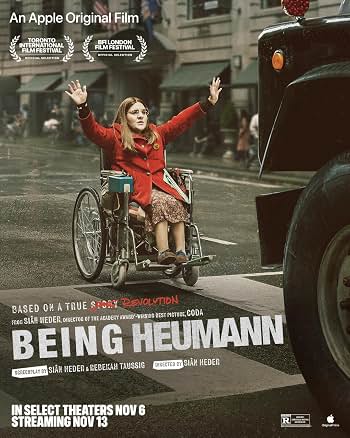

“Being Heumann” (2026) adapts disability rights activist Judith Heumann’s memoir, “Being Heumann: An Unrepentant Memoir of a Disability Rights Activist.” Ruth Madeley stars as the author briefly starting in 1972 Manhattan before fast-forwarding to 1977 San Francisco and Washington DC shortly before Judy and other activists across the nation protested so the Rehabilitation Act of 1973’s Section 504 would finally get implemented. By occupying the offices of the then federal executive agency, the US Department of Health, Education and Welfare (“HEW,” currently known as the US Department of Health and Human Services starting in 1979), which was responsible for its administration, they hoped to force HEW’s agency head, Secretary Joseph Califano (Mark Ruffalo), to sign and issue regulations, which explains how to execute the law in more detail than the statute. Califano stalls and hopes to dodge them, but they shall not be moved. Less a biopic than an on-the-ground slice of history brought to life, it is disabled people’s turn to get the civil rights conventional movie treatment, but with the energy and verve of a Sixties-esque love fest on its best days. Cowriter and director Sian Heder’s latest film practices what it preaches and shows why Section 504 needed to exist, how disabled people just want to have fun, and how the people of that time did not know what they were doing, but did the thing anyway. Bring the tissues for the unexpected groundswell of emotion and relating to these everyday heroes and bring a notepad on how to be courageous because courts have already begun to strike down key provisions of the law. It may be our turn to reinvent the wheel.
While Judy is the catalyst for “Being Heumann,” it is more of an ensemble piece with everyone making a meal out of a morsel and fully embodying their characters. Ed Roberts (Michael Patrick Thornton) is the relative elder statesman who keeps the movement grounded in self-care and living as a form of protest. Kitty Cone (Madeline Delp) wears pearls and is the soft power counterpart to Judy’s bull in a China shop approach. Brad Lomax (Antwan Tolliver) is a Black Panther with MS who has a lot of connections that support the movement along with an extra set of abled bodied hands in the form of Chuck (Ray Fisher, aka Cyborg from “Justice League”) to do the heavy lifting. Dennis (Charlie Rush-Reese) is a baby faced, blind, first-time activist who stayed longer than he expected and befriends Milton (Rio Finnegan), a man with a lot of fight who pushes his body to its limits. Cece (Rein Barcel) is a formerly sheltered woman who lets loose during the protest. Hale Zukas (Andrew Pilkington) has a lot of profound statements if people are patient enough for him to spell out his words using a wooden pointer on a board sporting the alphabet. (Think if Stephen Hawking did not have that device to speak for him.) Ron Washington (D’Arcee Charington Neal) is a Black, gay man in a wheelchair who draws on the success and battles of prior civil rights movements to apply their best practices in the struggle for disability rights. Olin Fortney (Russell Harvard) provides support and solidarity, but like many deaf activists, would prefer segregation from majority culture and has well-founded pride in his disability.
“Being Heumann” handles the differences and clashes of each sub-interest group’s demands in a more nuanced way than most films that sand down the rough edges. Each disability has its strengths and drawbacks as a blind man becomes someone’s legs, wheelchairs become battering rams, and the one with mobility issues becomes his eyes. One person’s accommodation would further disable another’s. Your heart and your mind will grow ten times large after watching this movie that is if anyone watches this movie because even admitting the existence of people with disabilities is a hard sell in the movie’s universe and real life.
Imagine getting giddy that a single character on some random CW show or movie is disabled then watching a movie of people with a variety of disabilities, races, sexualities, demeanors, gifts, flaws just being people, openly disabled, and talking about it. Before the 504 Sit-in starts, it is already revolutionary to have representation in a substantial quality and quantitative way. Disabled people are often invisible because of lack of accommodations or out of necessity/survival. Seeing a film where they exist in large numbers as agents of change without disguising their vulnerabilities, needs and fear is already a gift. “Being Heumann” may be slightly heavy-handed in showing them engaging in lighthearted, fun-loving activities to diffuse the serious subject matter, but there is value in prioritizing their humanity and just showing them like college kids their first time away from home in huge numbers. It is the point: the need for the regulations so they can have these quotidian experiences instead of staying isolated. In a film with a different set of characters, sexualizing the women activists may be insensitive, but because disabled people are infantilized, it is a powerful, adult counterimage.
The people in the majority are either their cowardly counterparts with government jobs or left in the margins though still three-dimensional human beings who are consciously using their privilege to serve others. Califano is an image of a nice guy baffled that his lefty credentials give him no credit at the intersectional store, and Ruffalo plays him like a buffoon who gradually relates to them as he is physically stuck in a corner without a feasible way to escape their presence. It is a lesson that will hopefully hit home for smug blue state residents who assume that they are on the right side of history when they are unwilling to be consistent with the application of their politics instead insensitive and practical when the rubber hits the road. Officer Fanelli (Raphael Grosz-Harvey) provides comic relief as building security who is stuck between taking orders and seeing the entire affair as a meet and greet. FBI Agent Sullivan (David Hewlett) occupies a middle ground in between bumbling fool and active threat who has no public shame in bullying women or disabled people.
Chuck is one of the least developed allies, but reporter Evan White (Dylan O’Brien) has an efficient and effective story arc as an insensitive lout to an opportunistic man looking for the spotlight to a sincere agitator who uses his position to get their message out. Jim Pechin (Jon Beavers) plays a vet who has the hots for Judy and uses his brawn as a tool for the group. Jon Breves (Roberta Colindrez) is a lesbian caregiver to Heumann. (For a second, it felt as if Heumann was also repping for bisexual visibility, but it is ambiguous.) Congressman George Miller (Rob Delaney) helps the activists make inroads with the Carter administration. Lynette (Sienna Rafter) functions as an ASL interpreter with zero experience as a running gag on her well-intentioned ineptitude. Ericka Huggins (L.A. Sweeney) is one of the few allies who is introduced starting on the right foot and makes a big impression in a short amount of time.
When did I start to cry? Not when you would expect. How many of you watch movies and television series at home using subtitles? Do you realize that is an accommodation? I’m used to going to the movies and straining to understand what is being said because of hearing processing issues. Within ten minutes of watching “Being Heumann,” I realized that I could understand everything, and then I realized that there were subtitles, and I was automatically reading them. They may not have been intended for someone like me, but they are inclusive of someone like me. A movie modeled its values and showed a stranger more care and met my needs more than the people to whom I articulated my needs and claimed to care about me. From the opening scene to postproduction details, this film makes the struggles and successes of disabled people into a visceral experience for the audience. It never feels theoretical or like a heady, intellectual exercise.
If you do not know the history of that era and are worried that you will not be able to follow “Being Heumann,” don’t. The most confusing section is a couple of references to the New World Liberation Front, which was a name used at different times and was associated with bombings during its last iteration. There are theories that a couple was responsible for the hullaballoo. There is a commercial for Hertz, but they call it a U-Haul, which bothered me more than it should have.
“Being Heumann” may be a movie that paints a picture with broad strokes, but it is the way that movies evolve. While it is long overdue for disability rights activists to get the spotlight, the timing is perfect. The “integration mandate” rule, which requires services to be provided to people with disabilities in the community instead of isolating them in institutions, is no longer in effect, but the underlying statutes and case law that supported it are. This movie is not about the past. It could be a glimpse into the future of how some people want the world to revert to the past before there were protections that enabled disabled people to participate in public life.