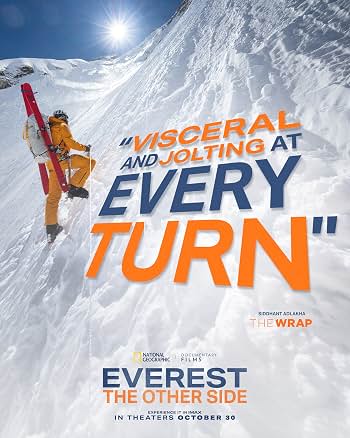

“Everest: The Other Side” (2026) is the latest documentary from married codirectors, climber and skier Jimmy Chin and Elizabeth Chai Vasarhelyi, and they also appear in it. Described as elite ski mountaineers and a couple in love, Hilaree Nelson and Jim Morrison decide that they want to take the direct, treacherous north route to Everest which only five people climbed. Afterwards Morrison will ski down, which no one has ever done. It will take a month to complete this expedition, but years to make a successful attempt because of the conditions. Spanning from 2018 through 2025, the film charts the nadirs and zeniths of this project, which ultimately was successful, but at a high price. If you enjoyed Chin and Vasarhelyi’s prior film, “Free Solo” (2018), or any films that involve extreme sports set in nature, especially mountain climbing then you will love this film, but even though it is handled tastefully, you may leave a little traumatized after seeing this staggering film.
“Everest: The Other Side” is a participatory documentary, which means that Chin and Vasarhelyi appear in the film and are intimately familiar with everyone involved in the film and the expedition. To make this film, the crew must be able to do enough to keep up with Nelson and Morrison, i.e. they are climbing the tallest mountain in the world too while carrying camera equipment and filming it flawlessly. It is bananas, and this footage is the closest that most people will ever get to having this experience. If you love looking at awesome sights in nature, this movie is a must-see film on the biggest screen possible. It is also the safest way to navigate it.
“Everest: The Other Side” functions in multiple ways: a character profile of primarily Morrison and Nelson then all the other participants, a nature documentary about Everest’s less travelled side, which is in China, an anthropological look at a subculture in action involving foreign climbers and Nepalese sherpas, and a sports movie with announcements on the progress during the final, successful ascent and descent. Underlying all these themes is the human drama of asking why anyone would risk their lives and engage in such a dangerous, elective pastime. The overall answer is connection to loved ones whether spiritual or practical.
Related side note: in my experience, when people are approaching the end of their life, sometimes they report seeing and interacting with dead loved ones. When people engage in high altitude climbing, their body is literally beginning to break down and die because of the reduced access to oxygen and lower atmospheric pressure. People who recently had eye surgery will find that the climb almost reverses the healing process. It is not a big surprise that anyone engaging in such an enterprise has an emotional reason for climbing Mount Everest. A lot of the expedition participants claim that they feel close to their deceased loved ones when they climb, including Morrison who has a lot of loved ones on the other side, thus the double-edged meaning of the title, “Everest: The Other Side.” The exclusive interviews address the motivation behind and logistics of the ascent.
Interviewees include and the participants who appear onscreen are Nelson, Morrison, Nelson’s sons Grayden and Quinn O’Neill, the couple’s labradoodle dog Wilson, Nelson’s siblings (Ann-Margaret Johnson and Stan Nelson), Morrison’s mom Joann Morrison, Chin, Vasarhelyi, the first person to ascent via the West Ridge in 1963 Tom Hornbein, skateboarder Jeremy Jones, mountaineers (Yukta Gurung, formal name Pur Bahadur Gurung, and Mingma Tenzi Sherpa), North Face teammate Fernanda Maciel, cinematographers (Pemba Sherpa (Sharwa), Erich Roepke and Leo Hoorn), Pemba’s mom Ngawang Karma Sherpa, Erich’s fiancée Kate Swimley, camp manager and new father Mikey Schaeffer, fixing time leaders (Mingma David Sherpa, Esteban “Topo” Mena and Carla Perez, who is described as co-lead though Mena is just described as leader, no qualifier), fixing team members (Sandesh Sherpa, Pasang Nuru Sherpa, Pasang Dorjee Sherpa, Dawa Temba Sherpa), the expedition physician Dr. Judy Klein, film producer Shannon Dill, and climber Tico (government name does not appear onscreen, but is Tomas Ceppi).
If you are wondering why so many people possess Sherpa as a surname, Sherpas were originally mononyms (think Madonna, Cher, Oprah, etc.). Sherpa, Gurung, and Tamang are examples distinctive ethnic groups’ names based on a patrilineal lineage that were later adopted as last names. Even though the following appear on screen, some people are not explicitly identified with a name and title in “Everest: The Other Side” such as Jim’s family in Polaroids though their names are referenced in the interviews, Marina, the filmmakers’ daughter, and the filmmakers’ unnamed son, Schaeffer’s orthopedic surgeon wife, Yukta’s wife of eighteen years, and Yukta’s son, along with a man who was with them at their home.
“Everest: The Other Side” uses montages of photographs still in the album pages, archived newspaper and magazine articles, archived news footage, home videos, exclusive interviews, screen casting of social media posts and the zoom conversations discussing logistics, and tons of exclusive in-person footage whether the subjects are in the cozy or contemporary interiors of their home or tents of a variety of sizes at multiple camp sites, the improvised living, camping outdoor space next to vans or firepits or footage captured during more common climbs or on top of the world. Even if you are not ordinarily into sports, especially skiing (slowest skiing ever), watching the descent will have you on the edge of your seat.
“Everest: The Other Side” is not a found footage film because it is real. With a documentary like “You Can See Everything” (2026) introducing the presence of artifice in a genre of films whose success depends on feeling true, this documentary feels like the antidote. Clearly dismayed at her husband’s onscreen, increased, unanticipated participation in the project, Vasarhelyi says to Chin, “This movie, the worst happened.” People die and get injured during the movie and soon after it ends. A lot of reviewers are spoiling who died but try to avoid this news. When it happens, it feels so casual that it is easy to stay in denial that the result packs such a devastating impact like a grenade. It takes a long time to adjust to the information because they correctly do not show the body, but the bloodied snow and discarded clothes tell the story. I just kept thinking, “Did that happen?” Stay for the credits to find out who died in an unrelated job but soon after the movie was completed, which reveals the inherent danger of this activity. You will have to Google to find out who else worked on the film, died shortly after it finished, but did not get honored in the credits. There is footage of two monumental cataclysms: one of a retrieval of a recently deceased member and a rescue that includes nighttime footage.
“Everest: The Other Side” also includes a rare moment of footage revealing an infrequent sign of division within the camp between foreigners and the sherpas who earn their living based on their patrons’ risky appetite. After disaster strikes, one Sherpa exclaims, “You can’t order us to do whatever the foreigner says! Life is precious to everyone.” If a Sherpa thinks that you are going too far, a line is crossed, and though the foreigners sound casual and open to differing opinions, it is obvious that it is unusual for them to hear a no. The positive news is that they accept the no instead of pushing ahead.
“Everest: The Other Side” may be an old-fashioned, glossy, conventional documentary, but it is a perfect example of the sincerity of the genre when done well. It is not just a commercial project though money is an important element. It is a testament of the individual personalities and personal and professional relationships, which hold up under the pressure of time, elements and high stakes. It may be a gut punch to some movie goers. Just because it is a movie, does not mean everything is alright and everyone is fine, so judge accordingly.