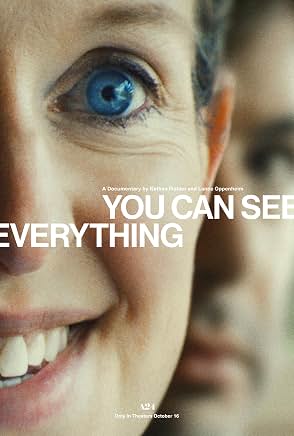

“You Can See Everything” (2026) is the buzziest documentary of them all with Nathan Fielder codirecting and starring in his film. With a two hour fifty-four-minute runtime, the first hour and a half is devoted to Fielder embedding with Elizabeth Holmes, Theranos founder, thirty-four days before she begins an over eleven-year sentence at Federal Prison Camp in Bryan, Texas. her partner, William “Billy” Evans, heir to a chain of San Diego based hotels called Evans hotels, and their two children, William and Ivy, are present during Fielder’s stay. Depending on your appetite for extended eye contact, uncomfortable close ups and a lot of talk about nothing, the first half may be a bit of a slog, but the rest of the film is a deep, dishy dive into meta filmmaking and what actions can be attributed to Holmes without coming directly from her. Did the film have to be so long to get to the good stuff? You have to be a fan of Fielder’s schtick, interested in Holmes and into reality television to make it through the first half, but the second half is so much fun that you will want Fielder and his on-screen sounding board to take this show on the road.
“You Can See Everything” is my first exposure to Fielder, but it is his second feature length documentary, and he has a long-storied television career. To a certain degree, documentaries are not supposed to be scripted, but the act of observing someone or something changes that which is being observed, and here, nothing feels real. It is a participatory documentary, because Fielder appears in his documentary, but it is hard to believe that it is not a scripted movie. Fielder takes a basically sink or swim approach. There is no narrator and not a lot of context outside of what comes up in conversation or if Fielder opens his laptop and watches archived television news segments about Holmes defrauding investors. On screen, Fielder absolves himself of a requirement to provide a quality, informative documentary that hashes out the crime because he does not understand the science. He casts himself as the everyman who gets to determine her innocence.
In the first half of “You Can See Everything,” there are three main characters: Fielder, Holmes and Evans. The children are more like props, and the supporting actors are Holmes’ parents, Christian Rasmus Holmes IV, a former Enron employee, and Noel Anne. Holmes says that she hates publicity yet invites Fielder and his crew into her house on the beach to live with her family. She is not into money, but she happens to follow the adage that it is just as easy to fall in love with a rich man as a poor man. While Fielder interrogates her, afterwards when he is processing, he basically deploys the critical thinking of a gnat. Though he scoffs at her assertion that she never lied since high school, which is already a lie, he also is willing to bend himself into pretzels to take her at her word with Billy as her source of validation. While leaving the screening, one person who also bought her spin theorized that she was autistic because Billy kept suggesting that she does not think like other people. Um, neurodivergence has a lot of flavors such as psychopath or more generously, CPTSD if her father was delivering an accurate armchair trait of the diagnosis. An autistic woman staring deeply into someone’s eyes would have a hard time keeping track of a conversation. You know who does not blink? Predators. Oh, Oppenheim of “Primetime” (2026) also codirects and gets a nonspeaking role in a reenactment along with Gary Wilmes, Phillip Andre Botelo and more.
“You Can See Everything” is basically a movie where Fielder gets to have a parasocial relationship with Holmes. It becomes a movie with various men competing for exclusive access to exonerate her of all wrongdoing, save her from unworthy men, and blame them for victimizing her. The first big bad is Ramesh “Sunny” Balwani, Theranos former president and COO, who is definitely sus for the age gap alone, but he only appears on laptop screens or in the fictional Hulu series, “The Dropout,” as a character. After two years of Holmes in prison, Billy is next on the list as a guy who sniffs a lot, tweets in Holmes name and authorizes questionable acts in her name, which is the fuel for the second half of the film. He was not a paragon of being an upstanding fellow before Holmes’ imprisonment. Most damning: he believes that a shower is just for letting the water fall over him while he brushes his teeth. Warning: random full-frontal nudity, but Evans later verbal revelations are the ones that should have been kept under wraps and will not age well. Fielder buries the lead and begins to explore his earlier misgivings about Billy and seeks to save Homes from Billy’s manipulation, but who can he talk to about his concerns?
The spoiler is already out there, but Fielder gets someone as interested in Holmes as he is, and they confer about his discoveries. It is quite unexpected that the most normal person in “You Can See Everything” is a person who should not even be involved in a documentary. This person basically becomes the true audience surrogate who says exactly what the audience is thinking and challenges Fielder’s willingness to accept Holmes at face value. Fielder leverages the limitations of his production, i.e. times when he was not authorized to record. He takes his notes, writes a script and creates high-quality reenactments that are aligned perfectly with earlier scenes. So does the documentary become a docudrama or is all of this ludicrousness scripted and staged?
The story explores the grey area of whether Holmes is creating plausible deniability or is a patsy. It also becomes a question of accuracy. How do we know that Fielder is accurately representing what happened even if he has benign intentions? Is “You Can See Everything” entirely a made-up movie with real people playing themselves to make an audience believe that they are watching reality and want to satisfy their curiosity? There are numerous conversations about a New York Times reporter misquoting Holmes, and Evans and Holmes claim to have audio recordings that prove that Holmes never said it, but when Fielder asks to hear them, Evans flatly refuses. The truth is boring and would end the fun, but the mystery and allegations keep them spotlight worthy. The unnamed reporter also refuses according to a postscript scroll of events that happened after the movie ends. After seeing “Zodiac Killer Project” (2025), it is completely fair to ask whether the books used to prop up the laptop during one viewing session even belongs to the person sharing screentime with Fielder? Are the horses really part of their routine?
“You Can See Everything” satisfies the prurient desire to be a fly on the wall of one of the most notorious people in yesterday’s news. It is most fascinating for embodying the idea of Holmes’ image as a way for men to do drag while still being themselves, but using her image, voice and fame to amplify their own power and privilege. While Holmes has her own agency, there is something very primal about how these men require a woman’s body and presence to move forward as if they are insufficient to reach the level that they want independently. Holmes implicitly uses the “pleading the belly” argument dating back to the fourteenth century of using her body as a breastfeeding mother to elicit sympathy and plays the deferential partner. There is also a futuristic element with the men going as far as to use stop motion technology to recreate her and less expensive alternatives. It feels very “Metropolis” (1927) except Maria is in on the act. Less a documentary and more a piece of autofiction with fake documentary, horror and sci-fi elements, Fielder’s second film is a snail’s pace slow burn movie that skyrockets in the second half and equally entertains and manipulates the audience to such a degree that there is not even room for the concept of objective truth.