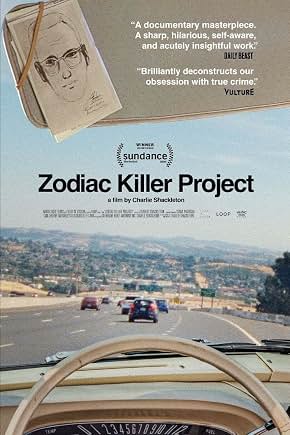

If life gives you lemons, make a movie. When director Charlie Shackleton claimed that he could not get the rights to Lyndon E. Lafferty’s book, “The Zodiac Killer Cover-Up: The Silenced Badge,” he decided to proceed anyway and make a documentary about how he would have visually translated Lafferty’s words into images” (2025) ends up being a pastiche of meta-analysis of the true crime documentary genre, a movie about Lafferty’s investigation, an analysis of Lafferty’s disappointment over the eclipsing success of Robert Graysmith and his definitive book, “Zodiac: The Shocking True Story of the Hunt for the Nation’s Most Elusive Serial Killer,” and Shackleton’s own dashed hopes over not being able to realize his vision. If you enjoy true crime, media analysis and vicarious career fails, this film is for you.
“Zodiac Killer Project” is probably a better and more memorable movie than anything that Shackleton would have originally made, but who knows. The documentarian’s past work is unconventional and experimental. His filmography includes a film consisting of a little over ten hours of white paint drying on a wall (Andy Warhol and Chantal Akerman are jealous), a ninety-minute film collage about fear using footage from existing movies, and another compilation film that only consisted of clips of actors who are deceased. If anything, his latest project is downright conventional and one of his more approachable projects. It could have even been the movie that Shackleton always planned to make.
Shackleton becomes the star of his film as the narrator, and if you like British accents, you are in for a treat. His affect is humorous, dry and self-deprecating. The narration is mocking the genre, Lafferty and himself but not without a sense of bittersweet acknowledgment of the unbridled hunger for success and legacy with a dash of psychological profiling of how Lafferty, who died March 5, 2016, became increasingly bonkers at the prospect of making it big. He notes how Lafferty and filmmakers are unhinged for leaping over any ethical concerns while pearl clutching when others do not share their sensitivities and ruin the race to the finish line whether it comes in the form of an arrest, a book publication or a movie release. When Shackleton turns that perspicacious eye on himself, he acknowledges his shortcomings as a filmmaker and in a rare bit of vulnerability, wonders if he would have more interest in his work with the book rights in his arsenal.
Or is “Zodiac Killer Project” all part of his latest experimental bit and a reflexive documentary was always part of the plan? While Shackleton turns his audience’s attention towards revealing the true crime documentary filmmaking tricks, he distracts from the possible sleight of hand that Shackleton could be engaging in when he skirts some topics behind the making of his movie. Has anyone from the Lafferty estate ever verified Lafferty’s account that they were in talks? Do they even know about the documentary? It seems strange that they would be so eager to get a better deal then not say a peep about Shackleton?
Shackleton talks about the first time that he saw the book, but he waits until late in the film to depict it. For a movie about the making of a movie, it is interesting that “Zodiac Killer Project” never even devotes a single montage to how he tried to get the rights: finding the contact information for the right person, the paperwork, the voicemails, the emails ending on a dramatic note of the moment when Shackleton hears the dreaded no that killed the project. “Chronovisor” (2025) has spoiled everyone. Instead, the movie largely adapts Lafferty’s book using other sources from police reports to interviews with the author. Shackleton reads excerpts from the book without any legal explanation why he can do that without fear of reprisals.
“Zodiac Killer Project” is truly about how exchangeable all true crime documentaries are, and Shackleton proves it. He shows a random building, talks about a specific location such as a police station, which leads the viewer into believing that they are seeing not just a police station, but the police station that the narrator is referencing. Well, in Shackleton’s film, that police station is actually a library. Shackleton then reveals how difficult it is to get permission to film at any police station. Now imagine that trick happening numerous times: a church exterior with the lens focused on a gate, an empty house interior, an empty diner, an office building interior, a house exterior, a steakhouse interior, a four-way intersection, driving on the highway, a post office exterior. Movie magic is all about the art of suggestion, not facts or authenticity. We want to believe, and if the filmmaker does not reveal his hand, no one is going to care about the truth unless there is a random person who decides to fact check every image.
It is not until the middle of “Zodiac Killer Project” when Shackleton appears on screen in a sound booth with the most beautiful of the aforementioned images, a sunset while an unseen person drives on the highway, reflecting on the glass walls of the booth. During the movie, occasionally a voice is heard interacting with Shackleton, but that person is never named or credited. There are theories that Shackleton is talking with himself. The location is never discussed so is he watching the final cut and talking organically or just watching clips that later appeared in the movie? While he is eager to expose the secrets of the true crime filmmaking, his filmmaking secrets stay firmly tucked away.
Shackleton further reveals how he would recreate the past. He hires two actors to play the author (Guy Robbins) and the suspect, George Russell Tucker (Lee Nicholas Harris), but there are other onscreen roles: Eddie, a guy who tries to get Tucker’s fingerprints, and Lyndon’s wife. Do the same actors play these roles too or uncredited people? Smoke and mirrors! It does enforce the trope that this genre never fully shows people jokingly described as “backtors.” There are also montages called Evocative B Roll: a hand pulling items out of manila envelopes then a close up of the items, a cassette tape, a table, a flashbulb, a footprint, ashtray with a lit cigarette, reel to reel tape recorder, a ticking clock on wall, a hanging interrogation lamp, corded telephone receivers being picked up, burning papers, a car tail light, a garbage, a thick file, a chair, falling shell casing, pay phones, crime scene tape, “blood,” a fishbowl in a trunk, and most hilariously, pulling back wheat to show graffiti drawn on the side of a California house. Wheat! Once Shackleton calls attention to this absurd game of association, the melodrama seems retroactively absurd.
Shackleton is not just a filmmaker. He is a fan. After he pulls his cinematic impression, he either references or shows clips from iconic true crime documentaries such as the “Paradise Lost” trilogy, “The Jinx: The Life and Deaths of Robert Durst,” or “Making a Murderer.” If you are looking for something to watch, have a notepad ready to joy down his implicit suggestions. All the opening credits are in fact similar. Generic home video of random children playing provides a slice of Americana to evoke a sinister underbelly. The most astonishing similarity is rooted in interviewees such as investigators describing themselves using the same nickname.
Shackleton’s exploration stops at why he still loves a genre that is so canned. What makes people coming back for more and how come with all the people consuming this content, no one other than Shackleton has noticed how manufactured it is instead of true? Shackleton’s film is not as freewheeling and improvised as it may appear. It is a clever and incisive tool that seeks to subvert and recreate the genre while piecing the veil. During the last third of “Zodiac Killer Project,” he discusses the final act for Lafferty’s book. That kind of preciseness does not just happen, and it is absolutely delicious and impeccable craft. If he omits information, it is probably as deliberate as the pacing. While this documentary is droll, it may only suit people into film analysis or fans of the genre who know that Shackleton will not spoil their fun.