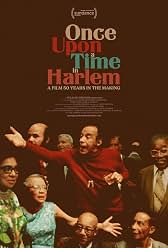

The posthumously released “Once Upon a Time in Harlem” (2026) is a nesting doll, time machine of a film that transports its audience to August 1972 in Harlem where Duke Ellington’s home hosts partygoers who played a pivotal role in the Harlem Renaissance. The raconteurs regale each other with memories of that time, its significance, how to define it, and its effect on their present day. If you like parties, intellectuals, and Black people, this documentary is a must see, but the melodic voices and lack of structure may require repeat viewings to fully absorb it instead of just skimming the surface and generally enjoying the atmosphere. Bring a coffee if you arrive at the theater feeling sleepy.
“Once Upon a Time in Harlem” is a participatory documentary though it is hard to tell whether the execution is faithful to original director William Greaves’ intended vision. After his death, his son and codirector David Greaves, who was present during filming, and granddaughter and codirector Liani Greaves, finally finished the movie with the crucial help of editors Anne de Mare and Lynn True. If William had finished the film while he was alive, would he have included shots of himself improv-ing as a clapboard, asking questions, or greeting guests at the door? Only he would know, and people familiar with his earlier films or had access to the man or his prep work could make an educated guess. If not, the documentary would be observational to capture the living luminaries before they were lost; however it is as much the son and granddaughter’s work, which suggests that their definition of the Harlem Renaissance was that it would never end. Its spirit continued in their dearly departed loved one as much as the people who were there from the beginning. Completing it after William’s death suggests that “Once Upon a Time in Harlem” is as much about love and memory of individuals as history and honoring of the collective past.
“Once Upon a Time in Harlem” is structured around the party. The cameras capture the outside with the famous Apollo marquee prominent in the exterior shots then gradually makes its way inside with people greeting each other at the door before peeling off and having exclusive tete-a-tete. Gradually the party gets louder, and more people are gathered in the living room observing each other or enthusiastically talking over one another to share their thoughts. The only concerning aspect is the lack of food in the composition, which is hopefully provided in abundance off screen. The camera and sound equipment are visible, but there is a creative choice to present a hand of God-like visual contrivance with an invisible pencil writing the concepts of the film in the opening and middle or an invisible typewriter composing the invitation. The reason could be two-fold: there is no actual footage of the creation of these documents if they really exist, and it is a silent, visual reminder of William as a friendly spectre continuing to participate in the proceeding.
“Once Upon a Time in Harlem” favors using a split screen to either show one event from multiple angles, show an interviewee and the person that the interviewee may be describing in a different location at the party, or to juxtapose the interviewee’s black and white photo with their present, moving visage or to juxtapose an artist with an image of their most famous work. Even if you do not recognize the interviewees, if you are patient, the filmmakers and interviewees will provide context. It is the miracle of the medium to juxtapose the past and the present to evoke a complete picture for the audience.
“Once Upon a Time in Harlem” embodies the concept that the Harlem Renaissance is as much about the people as the work that it produced, and the Greaves family does an excellent job of ensuring that the audience knows the identity of most of the people who appear in the footage. It does flag in terms of consistency as it approaches the end, but it is ahead of the curve compared to most films. Not everyone who appears onscreen get identified, usually the wives standing next to their identified, living husbands or servers. The Harlem Renaissance is not just restricted to the arts such as theater (theatrical producer Irvin C Miller, actor and founder of Negro Actors Guild Leigh Whipper, founder of American Negro Theater Abram Hill), music (composer and pianist Eubie Blake, artist/author/songwriter Romare Bearden), visuals arts (photographer James Van Der Zee, painter/muralist Aaron Douglas, painter/writer Richard Bruce Nugent), and writing (journalist George Schuyler, journalist for the New York Post Ted Poston, poet Arna Bontemps, poet and former member of FDR’s Black Cabinet Frank Horne). It also includes historian John Henrik Clarke, bookseller/prominent Socialist Richard B. Moore, librarian Regina Andrews, chief of the Schomburg Collection Jean Blackwell Hutson, educator and Zora Neale Hurston fan Ruth Hill, artist/educator Ernest Crichlow, elegant society editor Gerri Major, and activist/founder of The Vanguard Salon, Louise Thompson Patterson. The Harlem Renaissance expands to include people who created the conditions that helped artists thrive or kept the spirits’ memories alive, which means this film is also the Harlem Renaissance.
“Once Upon a Time in Harlem” also frames politics as the art of making ideology practical with the presence of the United Negro Improvement Association President Thomas Harvey and International Labor Defense head William Patterson. Surviving relatives of deceased notable figures have prominent seats at the table such as poet Countee Cullen’s widow, Ida Mae Cullen, and Duke Ellington’s sister and business manager, Ruth Ellington Boatwright. Similar to Greaves being a member of the Harlem Renaissance as the next generation, Harvard WEB DuBois Professor of History Nathan Huggins gets an opportunity to hold forth on his book and its theories after a fellow attendee takes a swipe at the quality of his scholarship though the person may not have realized that he was present just silently accepting the critique and later building on it. This movie has dramatic moments if you know what to look out for.
Thanks to the one-on-one interviews, group discussions and montages of archival film and photographs, the most famous members of the Harlem Renaissance and history are brought to life in a personable way, not looking up at a figure on a pedestal. The interviewees told stories about poet Langston Hughes, activist Marcus Garvey, former Mayor of New York from 1926 through 1932 Jimmy Walker, aviator and reported racist Charles Lindbergh, dancer and actor Bill “Bojangles” Robinson, editor and poet Jessie Redmon Fauset, business woman and hostess A’Lelia Walker, medicine show entertainers Bert Williams and George Walker, actress Florence Mills, writer Zora Neale Huston, another entertainer and Irvin C Miller’s brother Flournoy Miller, poet Claude McKay, tenor Roland Hayes, author and photographer Carl Van Vechten, writer and orator Hubert Henry Harrison, sculptor Augusta Savage, gangster philanthropist Casper Holstein, baritone Jules Bledsoe, aviator Hubert Fountleroy Julian, who had the nickname The Black Eagle, wife Eslanda and actor Paul Robeson, Ethiopian Emperor Haille Selassie, and poet Laurence Dunbar.
“Once Upon a Time in Harlem” is an immersive experience. There has been some controversy regarding whether the living Graves family used AI. Using AI is wrong, but I’m not going to pretend that I will catch every time someone commits the cardinal sin, so here is a rule that feels enforceable. AI is especially wrong if it does not function in the intended way. It was not obvious. Judge according to your tastes. There is a lot of important footage in here which is authentic and organic, and while today’s audience may not recognize the names or faces, the work may ring a bell. Even if you are a fashionista with a taste for retro styling, this movie is a treasure. It is like visiting heaven without dying.