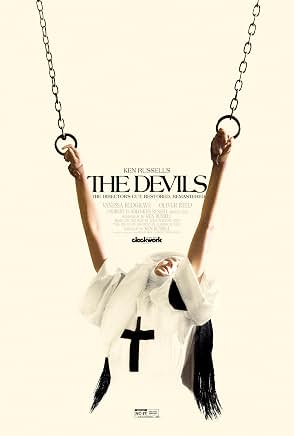

“The Devils” (1971) is a British adaptation of Aldous Huxley’s 1952 nonfiction book, “The Devils of Loudun, France,” and John Whiting’s 1960 play, which the Loudon Possessions of 1634 inspired. If you think Emerald Fennell is scandalous and has a sumptuous vision of elegant decadence with high production values, you will clutch your pearls at Ken Russell’s film. The French city of Loudun is a paragon of religious coexistence with Protestants, specifically Huguenots, and Catholics under the rule of Father Urbain Grandier (Oliver Reed, whom Peter Dinklage resembles) after the death of a beloved leader, but one cloistered nun’s sexual fantasies and religious rationalization become the spring from which the power of the state and the church emerge to crush the city and take control. Respected and established ne’er-do-wells leverage her fevered fabulist imagination as proof that Grandier is in league with the devil. A consummate, committed cast and anachronistic turns from costume designer Shirley Russell and Derek Jarman’s production sensationalize a seventeenth century historical event so that it feels unfortunately germane. Using today’s standards, the movie itself is a time capsule of Seventies sensibilities, and for all the tits and sexual situations, betrays a more conservative and wholesome definition of heroism than expected.
Except for a lot more nudity to get butts in the seats of those ordinarily not into historical period pieces, “The Devils” has a lot in common with Jesus’ story, the Salem Witch trials and generally any story where moneyed interests exploit religion and pair up with religious leaders to persecute, prosecute, demonize and torture people who did nothing wrong. The story feels like a braid with Grandier starting amidst the adoring crowds during a funeral procession or at night prowling the crowded plague-ridden streets, kicking a pair of charlatan medicine men, Ibert (Mas Adrian), the surgeon, and Adam (Brian Murphy), the chemist, from defiling the temple of one woman’s dying body, which is how he meets Madeleine (Gemma Jones in her big screen debut). Gradually, the crowds of people thin. The womanizing priest still obeys a specific code of conduct and governs himself according to the scripture’s impulse to die to himself and get closer to God, which naturally means taming his sexual appetites. He goes from deflecting or accepting the advances of numerous women, including expectant mother Philippe (Georgina Hale), to become a committed one-woman man and settling down with the more devout Madeleine as they become the image of peaceful, bucolic, married life. The further away they get away from the colossal, ebony church, the more holy they become.
In contrast, the humpbacked Sister Jeanne des Agnes (Vanessa Redgrave in spring) stays in a white tiled Ursuline convent where she is the abbess. She is a chaste hypocrite chastising her charges for their relatively innocent mooning over glimpsing Grandier while she pervs out in every nook and cranny of their nunnery. Interestingly in her dreams, Grandier is depicted as a pornified Jesus figure whether walking on water or descending almost naked from the cross. Jesus, Grandier and other men are the equivalent of rock stars to these young women without an outlet for their horniness. Roughly half a century later, cut to “The Fabelmans” (2022).
In theory, considering that Grandier does not know the nuns, there should not be any issues, but facts are meaningless when Grandier becomes an inconvenience to Baron Jean de Laubardemont (Dudley Sutton), who wants to demolish the city walls on behalf of Cardinal Richelieu (Christopher Logue) against King Louis XIII’s orders in an uncharacteristic moment of decency. After Grandier humiliates the Baron’s first attempt, the Baron rallies Grandier’s diverse local enemies, which includes Grandier’s less favored colleague of the cloth, Canon Jean Mignon (Murray Melvin), and his relative, Louis Trincant (John Woodvine), Philippe’s father, to fatten up his numbers and gin up a story. Grandier’s spirit, thanks to the devil, somehow visited them, filled them with lustful thoughts, and they got possessed. It does not even make sense if you believe in the supernatural.
Cue a witch hunter, Father Pierre Barre (Michael Gothard), who conducts himself like an antecedent American Pentecostal televangelist and exorcises the nuns. It is a mixture of sexual sadistic torture with instruments raping some, but for others, it is the closest that they get to an enthusiastic orgy. The nuns combined with their male religious counterparts become the other two strands of the braid, initially isolated and sequestered descending into a frenzied, sexual chaos within the walls of the ebony church. Unfortunately, a lot of extras were unprofessional and took advantage of the scenario to actually sexually assault the women actors so moviegoers who were drawn to these scenes were not getting their jollies off on an acting exercise of theoretical hysterical proportions, but sexual assault. Sorry to spoil the fun, but you will be watching real sexual violence if you see “The Devils.” Russell’s camera movement complements the hurried pace of the situation with lots of rapid zooming in and out to mimic the on-screen masturbation and lots of handheld work. For those unattracted to women, seeing so much nudity and dry humping can get tedious, but it is worth hanging on because “The Devils” becomes undeniably powerful after Grandier arrives in the temple to once again pull a Jesus attempting to drive them out of the church.
The last act of “The Devils” becomes a comparison of Grandier with his persecutors and accusers behaving like the titular figures and the accused acting as they should if they were truly on God’s side. Is it possible to have your cake and eat it too? It is likely that people making the film and watching it reveled in the Sixties sexual revolution and were attracted to the titillating film, but the plot superficially demonizes the main attraction. Of course, the problem is that repression leads to rationalizing and corrupting sexual urges, but moviegoers see and associate heteronormative monogamy as a sign of goodness, calmness and love and everything else as negative, promiscuous, and demented, including the implicit treacherous gay character, Mignon. The only alternative gay figure is the king, who is sadistic and whimsical. His only saving grace is his willingness to mock the entire religious proceeding. A cursory internet search does not reveal if exorcisms were so overtly sexual, but a toe dipped in horror, demon possession edition, has always been sus with a bunch of men tying a young woman to a bed while she writhes and says sexual things in a deep voice.
Grandier’s journey to becoming a genuine Christ figure is moving. He starts as a dissolute, pampered, proud and handsome priest so the suspense becomes whether he will pass the test of his faith, which is equal parts religious as a devotee of Christ and secular as the personification of the city’s relative religious tolerance. Reed’s understated, smooth performance is like an oasis of rest compared to the cacophony of the other characters. The excess of sexual simulations transition to physical torture, which is still effective even though the bright red “blood” looks fake. The fire holds up almost half a century later.
You would have to be made of stone not to be moved, especially since this story seems incredibly timely like “The Uprising” (2026) or “The Nice Ones” (2026). Ripped from the headlines! Plague? Check. People professing to be good while committing heinous acts and hurting people? Check. Normal people become demonized and are forced to rise to the occasion and become heroes of courage in the face of terror while facing psychological trauma? Check. The hysterical, perversion of Christianist fascism seeking to impose a federal dystopian wasteland onto thriving, vibrant, diverse beautiful localities is particularly relevant to this neighbor across the pond. Naturally force would be required.
There is also the destruction of art, books, other beautiful objects and the city. Such destruction is not practically necessary to prove a theory, achieve power over the nation or its people, who will die. “The Devils” does not detail that the real Grandier wrote a book that was for priests marrying and satirized the Cardinal. The film also omits that Grandier received and obeyed orders to participate in the exorcism, which would ruin his image as an elegant resister
As a newcomer to Russell’s filmography, “The Devils” feels as if it was the inspiration for subsequent, more sanitized Seventies cinematic impulse to reframe the past with the then present except without music with such movies like “Jesus Christ Superstar” (1973) and “Godspell” (1973). If you are expecting a horror film, only moral monsters appear onscreen so if that is not your cup of tea, keep it pushing. If you are going to try it, and you are American, it takes awhile to get accustomed to the accents without subtitles, especially because, combined with the movie’s tone, it is a bit of a culture shock, but go with it, and you will find it rewarding. “The Devils” does not feel like a contemporary NC-17, but you should still be wary if you are one of the people appalled at the prospect of seeing Florence Pugh’s breasts in “Oppenheimer” (2023). If you consider yourself a cinephile, it is required viewing. It is not blasphemous considering that the message does not corrupt God, but reveals how people corrupt the idea of God, which itself is blasphemous.