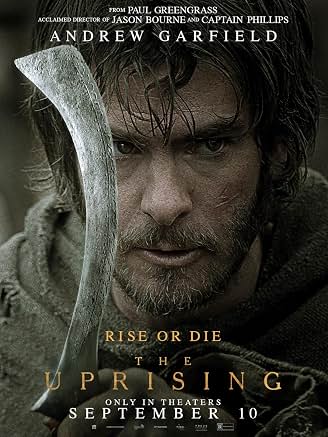

“The Uprising” (2026) is the first cinematic depiction of the Peasants’ Revolt of 1381, which was also known as the Insurrection of Wat Tyler, Wat Tyler’s Rebellion, or The Great Uprising, and it definitely is a contestor as one of writer and director Paul Greengrass’ most political movies. After a pandemic, the Black Death, has ravaged the land, a humble farmer only known as Ploughman (Andrew Garfield) leaves his solitary, lonesome work to pay his taxes. Outraged at the insensitivity of the collectors, he strikes the first blow, which sparks a widespread march to London to rescue the fourteen-year-old King Richard II (Woody Norman), whom they see as a symbol of God’s mercy and as a hostage to the council, to revise the council’s unjust law. Will the King perform a miracle and grant them freedom or are the people’s faith in the system unfounded? Greengrass creates a visceral, ahistorical, experience that could have used some tightening because you will feel the length of the movie, but it is an excellent example of aspirational history, and he uses the movie’s runtime to continue to shift the lens of how the revolt is perceived. He also uses the past to implicitly advocate for action in the present.
Garfield is a great actor and a permanent fixture in pop culture as the Amazing Spider-Man. He leverages his fame to infuse more aura into his performance as Ploughman, a man of the people ready to flip some tables like Jesus in the temple after witnessing outrageous official behavior. If it seems over the top that during tax season, officials were openly sexually assaulting girls and women to determine their age so they can be taxed, apparently it was a thing reported in the tales as a factor that inflamed people. Greengrass’ cinematic style is handheld camera work to make the audience feel as if they are in the middle of the action and not to minimize the number of prose dumps in the dialogue. Greengrass will also have multiple characters speaking at the same time so even if the event is being explained in the context, a movie goer could still miss it because other noise is competing for your attention. This precipitating, tax collecting event is confusing and maybe exaggerated, but it emotionally makes the moviegoer relate to Ploughman’s over stimulation and desire to stop the madness. Despite having no armor, Ploughman can take out multiple armored soldiers with ease. It is more of an action movie than “The Dog Stars” (2026). Greengrass condenses the action to a shorter time span and fewer locations.
Greengrass is extremely heavy-handed arming Ploughman with a sickle, a symbol often associated with communism but more generally with working class solidarity among peasants, predates the long-handed scythe as a symbol of death and justice and in ancient Greek mythology, used to symbolize cutting bloodlines and time when Cronus used the tool to overthrow his father, Uranus. In Christianity, it is an apocalyptic symbol of final judgment, but on a pagan level, its resemblance to the crescent moon signifies a new beginning. Greengrass deliberately invented this character in a historical account that already had main characters, Wat Tyler (Cosmo Jarvis, “Lady Macbeth”) and John Ball (Jamie Bell), but those well-known figures did not endure long after the historical event ended, and Greengrass wants to keep the revolution alive. The rebel from Kent, Jack Straw, a famous participant in the historical account, is never referenced in “The Uprising” and could have been an alias for Tyler. Inventing a peasant character is a deliberate reframe and response to historians who highlight the fact that the historical incident was not exclusively filled with peasants. Ploughman also carries a flint that he uses to spark a bonfire, which is also used to communicate with other regions. He is the spark of a broader uprising and the tip of the spear for the people. Greengrass wants to use Ploughman suggest as a symbol for the people. Ploughman can never be defeated, is not bloodthirsty but outraged, initially defaults to encouraging good behavior, is perspicacious and will use force to administer justice.
Unlike the poem, Greengrass makes Ploughman into a man who lost his faith after a pandemic and a man who is losing his faith in government, but his lost faith transforms into action. In addition, John Ball’s ministry in the movie seems focused on vengeance against the council as if he polluted the justness of the cause. Bell is an expert at playing bottled fury and anger, but in his interactions with Plowman, he is gentle and encouraging him to alchemize his grief over his losses during the Black Death and transmute the spillover of the elites’ divine punishment into practical action. The only historical quote from Ball is, “When Adam delved and Eve span, who was then a gentleman?” He also cosigned the slogan, “With King Richard and the true commons of England.” Promoting equality or a revision of hierarchy is not inherently a call to violence. Alyce (Thomasin McKenzie), an invented character, also furthers the theme of disillusionment with God.
You do not need to hear from Greengrass to conclude that COVID inspired this movie. If Plowman is the everyman, then guess what lessons Greengrass wants his audience to take away from this movie and apply in real life. Joke is on him however because it feels as if the entire world is doing its best to pretend that COVID did not happen, but because this is an aspirational story, perhaps Greengrass is trying to model appropriate behavior. “The Uprising” omits that after the Black Death, but before the rebellion, the death of so many people meant that people could charge more for their work, so the royal government passed laws to prevent movement, keep wages low and forbid lower classes from buying expensive goods. Mass death meant fewer people to tax in the old way, which did not stop new taxes from being implemented. The 1370s William Langland poem, “Piers Plowman,” was propaganda to encourage obedience because rebellion was breaking out in every section of society. People in the uprising used the name as an alias because they were not uniformly illiterate. They reclaimed the literary figure of obedience as a symbol of rebellion. The literary origin is not explicitly referenced in the movie. Naming the protagonist Ploughman is likely the over six century counter response to the poem and its original propaganda intent. Do not ever do anything against Greengrass because he can hold a grudge!
In the last act, “The Uprising” reveals another aspect of the Ploughman’s character, which retroactively imbues the character’s actions with special significance. Normally it would be a spoiler, but the marketing, including the trailers, spoil it. (According to some accounts, Benedict Cumberbatch’s version was supposed to be called “The Hood” then Matthew McConaughey’s version was going to be called “The Rage”.”) Greengrass uses the historical event as an origin story about Robin Hood thus repurposing the folklore about Robin Hood, which is initially referenced in “Piers Plowman.” To be clear, the legends of Robin Hood predate the revolt, and Robin Hood was pro-King Richard I, who reigned in 1189-1199, but movies are not history. It does explain why this marketing approach was briefly used in the US, not the UK, where the history is better known. On the other hand, just as Ploughman/Plowman can be reused for different purposes, the protagonist does not have to be THE Robin Hood to be Robin Hood. It lends an implicit “I am Spartacus” atmosphere to the movie and turns the movie into a more subtle reflection about the power of stories and the function that they serve than “The Death of Robin Hood” (2026) did.
Greengrass takes time to correct historical accounts that frame Tyler as overly familiar with the king, rude for demanding refreshments and overstaying his welcome after achieving his goals, the charters granting mercy and freedom to the rebels. For Greengrass, Tyler is depicted as a man of honor, a veteran faithful to his liege, a patriot, not a person trying to destroy the monarchy, as a lesson to the audience of the rewards of loyalty to a system. He also takes great pains to depict him as a person trying to restrain wanton violence and shares no part in the xenophobic attack on the Flemish. (A rebuke to Brexit?) He is a representation of the plausibility of a constitutional monarchy with people governing themselves. In contrast, the council and Mayor Walworth (Jonny Lee Miller, whom I never recognize) of London are depicted as overtly wielding power and pale in comparison to Tyler and are dishonorable leaders. Richard II’s form of rule is undetermined and becomes the sustained suspense throughout the majority of “The Uprising.” Richard II is perhaps the only character whose emotional journey and development is the sole focus compared to Ploughman, who is constantly in the thick of things and not the sole action on screen. Costume designers Tóth András Dániel and Godena-Juhász Attila effectively convey the morality and class status of each character so no real introduction is needed. With one glance, the story is told.
As the kids say, Norman ate and left no crumbs. Timothee Chalamet, get ready to have a career crisis because a new twink is in town, and he nailed it. Plus, he is British, and they take our jobs. He was absolutely riveting. In one scene when only a sliver of his face is visible, he kind of looked like Michael Jackson. The last line that he delivers to his onscreen mother, Countess (Katherine Waterston), historically known as Joan of Kent, his voice expresses two contradictory emotions. Even if you did not watch “The Uprising,” and only heard that line, you would understand everything about his character. Much like the real-life Richard II, more experienced and renown men surround him, which makes his performance so much more remarkable. Greengrass’ take on the regent is not as flattering as the historical accounts, but Norman imbues the character with humanity that makes it more challenging to judge him in a one-dimensional fashion. Greengrass juxtaposes a king and a peasant as foils and examples of living, breathing participants to a Rorschach test in the way that they react in a crisis.
Waterston navigates a tight rope. The makeup department heavily paints her until she as pale as a doll and is visually the least relatable character appearing to most fit the image of the elite that the protestors are against. Her acting style projects an implicit rebuke of the council’s actions and a sense of urgency that her son gets his crap together. In the historical accounts, Joan is a figure of ridicule for the protestors but never harmed. In “The Uprising,” she is like an intermediary between her son and the people with as much confidence in her son’s ability to create a just rule as the people hold. There are not many women with dialogue, and she becomes a symbol of common ground.
While watching “The Uprising,” you may wonder how you are going to stay absorbed for the entire movie, but as it approaches the denouement, you will not want it to end. More importantly, it is a movie that you will not be able to stop thinking about, a rare quality in movies. It is always impressive when a story from the past offer a fresh way of looking at the present.