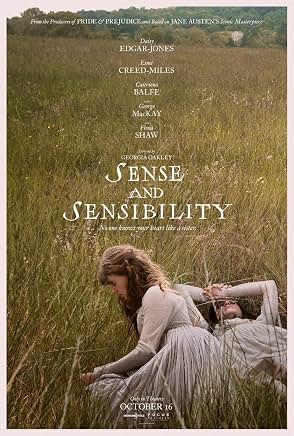

“Sense and Sensibility” (2026) is the latest adaptation of Jane Austen’s 1811 novel about two of the three Dashwood sisters, Elinor (Daisy Edgar-Jones) and Marianne (Esmé Creed-Miles), who are adjusting to life after their father dies and discovering romantic love. Elinor has all the sense and conducts herself perfectly though she feels passionately about Edward Ferrars (George MacKay), while Marianne possesses sensibility or emotionality, preferring the visibly emotive Mr. Willoughby (Frank Dillane, “Fear the Walking Dead,” and real-life son of the actor who played Stannis Baratheon) over the stiffer Colonel Brandon (Herbert Nodrum). Over the course of the movie, the sisters comfort and chide each other over their heartbreak and different personalities until they appreciate the other’s personality and adopt the unfamiliar behavior to evolve and finally find the love of their lives. For those who loved Emma Thompson and Ang Lee’s 1995 adaptation, it may take awhile to warm up to this version, but you will and discover that it is stronger in a few ways.
“Sense and Sensibility” picks up momentum as it unfolds. It is equally about the characters and the character of each place since death means that the Dashwood sisters, which includes the youngest, Margaret (Bodhi Rae Breathnach, “Hamnet,” “Shelter” and upcoming “Werwulf”) and their mother, Mrs. Dashwood (Caitriona Balfe), are about to be thrown out of their home in Norland Park, Sussex, and into the broader world to adjust to life as single, almost penniless ladies. In those days, only men inherited property. Norland Park is a perfect balance of nature and civilization with woods, fields and an ancestral estate with plenty of room. Marianne is the free spirit who embraces her natural surroundings and grooms herself in a way that is more natural, flowing or disheveled compared to the fashion of that time, which makes it easier to distinguish her from everyone else. If one must choose between Kate Winslet, the 1995 Marianne, or Creed-Miles, the latter would win, and I adore Winslet. Creed-Miles’ transition of Marianne’s affections seems less like settling and more like maturity and appreciation of nuance.
The first act involves the change of guard of the women in the house and is almost evenly divided between the new Mrs. Dashwood, Fanny (Stacy Martin), a proud, parsimonious woman married to the sisters’ half brother and new master of the house, John Dashwood (Tom Brooke). If Austen’s work is a pleasure, it is not only for the romantic and financially practical storylines, but the various, realistic women villains. If you told Austen that the world would be a better place if women ruled the world, she would laugh, point at Fanny, and say they already do. Fanny feels no sense of solidarity with her half family and only sees them as possible thieves of her finances with the ability to sustain themselves on air, which makes her incredibly vigilant against Elinor and Edward’s growing attraction because Edward is her brother. MacKay is on a roll with “Sense and Sensibility” and “Rose of Nevada” (2025). Though not my type, he may be the most attractive man in the cast and definitely delivers the most memorable, understated and moving performance, especially when (checks notes) dancing with Edgar-Jones!
Thompson, who played Elinor in the 1995, was instantly memorable and was the apparent protagonist, whereas the 2026 version makes it more of an ensemble affair with the two sisters taking turns in the spotlight. I’m unfamiliar with Edgar-Jones’ work and was unimpressed with her acting in “Twisters” (2024) and “On Swift Horses” (2024). In “Sense and Sensibility,” her style is suitably understated given her character, but as Elinor shows a broader range of emotion, fortunately so does Edgar-Jones. She may be the kind of actor who can only rise as far as her onscreen partner, and her best scene is with Dillane, whose best scene was with her. Dillane is a fantastic actor, but he seems to prefer roles a bit more dramatic than Mr. Willoughby. Once Willoughby’s cards are on the table, Dillane lets loose and Edgar-Jones does with Nordrum overtaking both in record time and finally beginning to catch up with, but still only just touch the hem of Alan Rickman’s garment.
Rickman played Colonel Brandon in Lee’s film, and frankly, no one can beat Rickman. Speaking for me and my house, Rickman was the real catch and more suitable match for Elinor, not Hugh Grant, who played Edward. Bear in mind, that Grant had not embraced being his worst self on and off screen and was still playing the awkward, bumbling, hot young thing, which was still delicious, but nothing compared to Rickman. RIP Rickman. He was hot. Lee’s movie was a powerhouse of four performers at the height of their power whereas “Sense and Sensibility” gives a lot of the supporting characters time to breathe and treats them in a less high-handed negative framing of their character because of howthey differ from the two sisters.
For instance, Mrs. Jennings (Fiona Shaw), who is not a blood relation to the Dashwood clan, but is the uncle’s wife or great-aunt, may still prattle on endlessly, but is also a kind and fierce protector of the clan and the reason that they find a new home at Barton Cottage in Devonshire near the ocean, and get to visit London, the big city. Shaw humanized the role into a relatable, down to earth fave. Another standout is Eliot Sumner, one of Sting’s children, who plays Mr. Palmer, but not as an exacerbated, put-upon husband who hates his wife, but as an avid reader who is also kind and laconic.
“Sense and Sensibility” also had stronger comedic moments such as Lady Middleton (Chloe Pirrie), who can only discuss the weather. The exchanges between Elinor and Lucy Steele (Ceara Coveney) were superficially sweet, but scorching. If it was “Dynasty,” instead of politely talking while standing close to each other as if they were best friends, they would be tumbling down the staircase while tearing each other’s hair out. It was the least annoying, most riveting pleasant passive aggressive fight ever. The coarse, boisterous Sir John Middleton (Turlough Convery) was a lovebug hunter who kept making sure that everyone in that cottage got enough meat. Think a British period appropriate Jack Black.
In some ways, it felt like the most American “Sense and Sensibility” because regardless of finances, the least polished characters, even if affluent, were the kindest. The poshest people were the most unkind and lacked empathy, especially the women, who, without the men in their lives, would have no standing at all. The two Dashwood sisters fall somewhere in between on the spectrum leaning towards the best of them, but not necessarily the arbiters of truth and taste like many Austen heroines, except for Emma.
If “Sense and Sensibility” drags, it may be because obsessing about a man marrying a woman whom he only hung out with a collection of times makes it sound like a horror story in today’s world more than it did before. It is period correct, and as a lover of Austen film adaptations, I was surprised that I could not just leave the world at the door and resume allowing the romance to sweep me away, but such is life. Watching a random guy carry a temporarily disabled woman feels more like a bad idea even if nothing happens. Darn, current events are ruining the fun, but it is not this version’s fault.