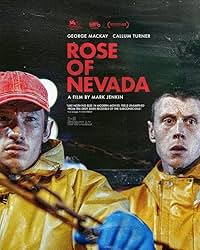

“Rose of Nevada” (2026) refers to a boat that resurfaces thirty years after it disappeared with its crew of two, Alan (Samuel Bassett) and an unknown skipper. Some say that the ship went missing because a crew member, Luke Richards (Callum Mitchell), stayed behind. In the present day, boat owner Mike Bruffin (Edward Rowe) and Tina (Rosalind Eleazar), Alan’s wife, decide to reuse the ship without revealing its original identity. Murgey (Francis Magee) signs on immediately to be skipper with Liam (Callum Turner) following close behind since Liam’s only diversions are the pub and sleeping anywhere loosely considered inside. Family man Nick Dyer (George Mackay) leaves behind his child and the mother of his child, Emily Carroll (Mae Voogd), because their roof is leaking and getting worse. Their next-door neighbors, Mrs. Richards (Mary Woodvine, who helped conceive the story) and her husband. Billy Richards (Adrian Rawlins) are still haunted over what happened to their son, Alan, and sometimes confuse Nick for him. When the trio leave to get fish, they go when the fish are, back to August 13, 1993. Will Nick ever get back to his family? Cornish writer, director, cinematographer, composer, editor and Woodvine’s partner, Mark Jenkin, makes a time travel film that does not spoon feed answers to its audience but is still largely satisfying if you are a fan of ouroboros narratives.
“Rose of Nevada” is a great example of premise fiction: a creative piece that explores realistic human reactions to an extraordinary event, time travel. The three men exhibit different ways of engaging with it, but Nick is the protagonist who struggles against it instead of simply existing within it because in his time, he has real connections. Also, unlike the other actors, Mackay visibly shows exhaustion while working on the trawler. Nick seems to feel time in a way that is dissimilar from the other men. It feels like the difference between flow, which Murgey and Liam seem to experience, and feeling the toll of work. Before they even get to the ship, Nick is introduced stomping down the street for a grim task whereas Liam seems as if he is running towards something when he has nothing ahead of him. Also, Nick was already in a cycle, but it happened to be called poverty.
The roof becomes a symbol of Nick’s futile efforts and how he keeps getting sucked further into a worse predicament. Nick is someone who fights against cycles then loses. Part of his peace comes in the form of expanding his meaning of family, community and existence within it. In many ways, Nick is learning to become a convincing actor and play a role instead of asserting his identity. Are there ways to be fully yourself and fully immerse the self into another? Talk about bringing your work home. Even though this story technically belongs in the horror and sci-fi category, this mutability is not seen as frightening, but the lack of control or informed consent is.
Murgey is probably the happiest of them all. Murgey’s identity is inseparable from his profession and the cycle, and he enjoys his mutability. “What’s in a name?” His only connections are the joy of the ocean and his job, and he is completely in a flow state. Because he chooses to stay in the boat, he experiences no dissonance and probably would not notice if the crew changed. It is interesting that of all the characters, he has the highest risk of being completely submerged and entering oblivion. Only Liam and Nick are grounded enough to rescue him from his own enthusiasm. Even when a human being wants to be a part of something larger and swept away, the nature of humanity is to be in a fixed time and place. There is a solidity to human existence and rules govern a temporal being. Only death frees them from those rules.
Liam’s story is the most uncomfortable aspect of “Rose of Nevada,” and Jenkin’s willingness to linger in that discomfort makes this film great. Liam is not mutable but is fine with being a cog in a wheel, exchangeable, transferable. He is an individual and does not change who he is, but he is also fitting into assigned, vacant roles in the community with enthusiasm. Without ruining the film’s momentum or naming the issue of rape by deception, all the characters tackle the topic in an organic way. Like Murgey, he embraces his mutability and lacks a fixed identity in the present, but in the past, he is assigned one more fulfilling than any that he could have acquired using his own skills. He is like the poster child for the benefits of being neurotypical and heteronormative. He is a culture fit.
Jenkin’s style of filmmaking is also its own form of time travel from the equipment that he uses to the flaws of the present which are recorded for all time in a film. He films in twenty-seven second increments then separately records the audio, including the dialogue, in post-production. On June 23, 2026, at the Coolidge Corner Theatre, which is exclusively showing “Rose of Nevada” in the Boston area, Jenkin said, “There is no past or future. It is just a projection of the present.” The effect of this style is reminiscent of Chantal Akerman as a series of moving snapshots, which forces the audience to observe when objects and people exist and notice if they are new or worn. He accurately describes the effect in two ways, “keep in fragments and build it in the edit” and “the more specific you go, the more universal it is.” Fishermen’s experiences with time become an easy way to empathize with the experience as a movie goer’s way of navigating their quotidian role in society and relating to the innate displacement of time regardless of whether you are living in your time or another’s.
I have a theory about time travel as a metaphor about the profession of fishing as a dwindling opportunity in the present because of the decline in fish population due to overfishing so the community believes that the only way to sustain a community is to return to the past, which will hurt the future because of overfishing in the past thus creating a self-fulfilling tragedy instead of finding a way to survive in the present and move forward. There are two scenes that substantiate this theory: Nick’s work on the roof, and the one fishing trip when Murgey does not stop fishing when the below deck storage area fills, and Nick is physically spent. While Jenkin does not seem to be concerned about the sci-fi aspect of “Rose of Nevada” or an environmental message, it felt obvious, and if I could watch it again, one of the trio, likely Murgey, utters a line (“bring back the fish”) that implies as much when they first set off in the present.
Horror and sci-fi fans, if you are not artsy fartsy, skip “Rose of Nevada” because then you will be pissed with the lack of scares and thrills. It makes “La Jetée” (1962) feel mainstream. “Rose of Nevada” defies the ghost ship trope and transforms it into an investigation of how life itself can be the haunting and how to navigate the past in the present. Jenkin offers words to live by, “Only thing I can control is the authenticity.”