
Disclaimer: I watch the trailer and do not include anything in my review that is not in the trailer, but the review could still feel as if it is filled with spoilers because my conclusions based on the trailer and the scenes therein felt obvious, but I could just watch too many movies and think everything is obvious. Or it could be because I am a lawyer.
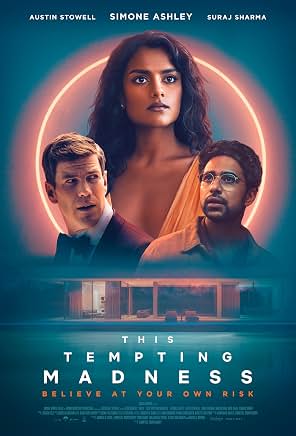
“This Tempting Madness” (2025) is neither tempting, nor mad. Discuss! Well, Simone Ashley is a temptress for starring in a movie that promises a twist, which is delivered, but is anti-climactic. Sporting an American accent, Brit Ashley plays Mia, a woman who wakes up in the hospital severely injured and does not remember how it happened. Her birth family surrounds her, but her husband, Jake (Austin Stowell), is not there. Unlike the police and her family, she does not believe that Jake is responsible and begins to wonder if she is complicit. Two words: Occam’s Razor. It is a first-time film for married filmmakers, cowriter and director Jennifer E. Montgomery and cowriter and cinematographer Andrew Davis. Though it looks amazing, you will be so annoyed if you watch this monotonous, psychological thriller unless you can appreciate the solid ingredients.
Ashley is stunning and credible as she is required to cast doubt and make things look more interesting than they are, which editor Kiran Pallegadda enforces so the viewer can relate to Mia’s confusion. Scenes bleed into each other. Time shifts. People appear and disappear. Mia is depicted as an unreliable narrator because while watching these scenes, there is no stable sense of where and when she is though it is obvious what is happening. Occasionally the filmmakers will show events from other people’s point of view to show how erratic and potentially dangerous Mia could be, so her story seems less straightforward since there are two options: her husband tried to kill her, or she was up to shady shenanigans. Ashley has a heavy lift, and if it does not work, it is not because of her lack of trying.
The story is mostly chronological starting with the accident then gradually moving forward as Mia tries to figure out the truth. There are some flashbacks, which show Mia as a bit of an exhibitionist, ball buster who plays both sides with her birth family and her husband, but nothing that screams self-harmer or complete psycho trying to ruin her husband’s life. Most damning is how Aurora (Niya Brahambhatt) reacts to her mother, but she is likely afraid of how the foundation of her world is clearly wounded. Also, Mia prioritizes Aurora’s well-being over her need to be with her daughter when she unintentionally endangers her because of missing time. As much as “This Tempting Madness” tries to create suspense, it only succeeds in instilling aggravation as her family acts furtively with the facts. She comes from an affluent family, and the movie is likely relying on the audience to be so amazed at the amenities.
If you are hoping that focus on this family will feel culturally rich and not generic, you would be wrong. The actors imbue their roles with more than is on the page, but there is no sense of the specific issues that this specific family faced with the parents, Lakshmi (Zenobia Shroff) and Raj (Amol Shah), who seem to be immigrants, and the first generation siblings, Mia and Ajay (Suraj Sharma), who coincidentally married white partners. It feels as if there is a story about the dangers of assimilation and success with dominant caste culture embedding unforeseen dangers because they do not know how to separate the wheat from the chaff and believe the privilege PR that Jake has to be a good guy because he looks the part and not interrogating further.
Ajay is clearly annoyed at Jake’s existence, but not because there are any obvious red flags, “Calm implies some sort of personality to begin with. This guy was more like a chair, functional but a bit inert.” It is an accurate description of Stowell’s performance, which thanks to this bit of dialogue, supplies a fair excuse that he was following direction, not exhibiting his limited. Again, the implication is a seething resentment for Mia going for someone like Jake as an implicit rejection of the men in her birth family, which Ajay never explicitly states. This theme could be unintentional since there is no follow through. The actors may be bringing the subtext because Shroff was in “The Big Sick” (2017), which touched on these intersectional issues that only get implied here. The gender issues are at the forefront because Lakshmi wishes that Mia was a softer wife. Mia was harsh for maybe one to two scenes, and it was glorious, but far from cathartic or damning.
There is a dissonance between the Jake that Mia knew, the Jake that her family knew and the real Jake. Even though the family immediately locked in and believed that he is the bad guy, there is a deliberate chasm between the guy who could toss his wife from a building and the guy that is an utterly forgettable void. The filmmakers made a bad creative choice which they thought would enhance the story’s suspense. When the big revelation happens, there are too many missing links. He is too severely an underdeveloped character and too little time is devoted to creating the man revealed in the denouement. Instead, the filmmakers prioritize Mia as the battleground between Ajay and Jake thus casting suspicion on both men’s agenda. If “This Tempting Madness” raises an intriguing question, it is why the filmmakers are so devoted to spending so much time making everyone into a suspect except Jake while simultaneously making him the top suspect on the list of the detective, Tony (Mojean Aria), who is functional, but forgettable. If it is to depict how a woman will do anything other than face the reality about her romantic relationship, it is fair, but it feels distasteful and does not fully land.
The costume and wardrobe department and hair stylist Taylor Bennett do more of the heavy lifting on messing with Jake’s reputation. When Jake is shown onscreen in the present, not as a memory, he is wearing the serial killer glasses, and his hair is flat. There is no product for incarcerated people. “This Tempting Madness” is tentative in addressing Jake’s possible mental health struggles and is more invested in depicting Mia’s head trauma. The movie begins with the reassurance that it is based on true events, specifically Montgomery’s friend who got amnesia, temporarily lost her short-term memory and six months of memories. There are no details regarding how her friend got amnesia, but hopefully not like the events in the movie. It is unfortunate timing, but “Backrooms” (2026) handles the conflicting inner lives of two characters, one who is pathological and another who is just traumatized, better, especially the oneiric, time shifting elements.
“This Tempting Madness” looks great, and the cast does their job effectively except for possibly Stowell, who may have a valid excuse for his shortcomings. As a director, Montgomery does a great job, but as part of a writing team, despite their good intentions, the execution does not reflect their aspirations. It results in a film that feels obvious, monotonous and superficial. They deserve credit for finding a way to escape the Lifetime formula, but at the price of not unpacking assumptions about privilege and unintentionally reinforcing them in examining who is considered guilty or innocent even when the investigator’s life is on the line. It could have really soared if it was more overt with the issue of self-condemnation for male-centered women who need deprogramming.