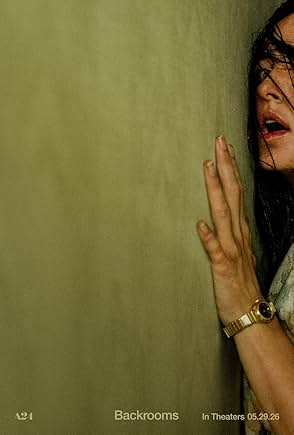

“Backrooms” (2026) proves that you can dress Renate Reinsve in outfits that look like cheap, synthetic upholstered furniture, and she will still look great. The bad news is that she has bills to pay like everyone else, and she decided to sell out now. Chiwetel Ejiofor broke my heart a string of movies ago, so I did prepare myself for this possibility. Though the photograph started appearing in 2011, fans of the 4chan creepypasta thread about liminal spaces that started on May 12, 2019 and Kane Parsons’ YouTube series, which started on January 7, 2022 and is still going, will be satisfied since Parsons directs the feature with Will Soodik writing the story, but what about hard core horror fans entering this world without the backstory? During the summer of 1990 in Santa Clara Valley, California, starting on June 19, 1990, Clark (Ejiofor) discovers that beneath the surface of his failing business, Cap’n Clark’s Ottoman Empire, there is a massive space like a maze. He tells his therapist, Dr. Mary Kline (Reinsve), but dissatisfied with her response, on July 3, 1990, he recruits his employees, Katherine “Kat” Taylor (Lukita Maxwell) and Robert “Bobby” (Finn Bennett), to accompany him and videotape his latest expedition, but things do not go according to plan. Can Mary save them? It is another fucking psychological horror film. While the horror element is present, it is anti-climactic and verging on laughable. See “Exit 8” (2025) instead if it is still playing in theaters near you.
For a horror movie to work, characters must do stupid things without seeming too stupid, and sadly, not one of the main or supporting characters caught up in the never explained anomaly fit the bill. It required a lot of suspension of disbelief that Clark would go exploring without leaving a note or telling more people than those that he invites into the space because he is Black, and it is the Nineties, but on the other side of the equation, he thinks of himself as an architect, and once you hear the gripes from his first session with Dr. Kline, you may be able to go with the flow a little more. Ejiofor is a great actor who always gives his all to his projects regardless of their quality, but he needs a better agent because his last three movies (“Venom: The Last Dance,” “The Life of Chuck,” “Eleanor the Great”) were almost complete duds that make “Backrooms” seem like the best in the lot. The liminal space is like a Rorschach test, and even though it does not seem possible to fail one of those exams, Clark does with flying colors. He becomes addicted to the space and prefers distortion over reality, which reflects his mental state.
His employees are pretty standard with Bobby apparently devoid of any ability to just say no. During more quotidian scenes, Kat and Clark are comfortable around each other and sit closely though Kat has more common sense but goes along with the two men as the audience surrogate to talk sense. There is a scene where she is comforting Bobby instead of hauling ass and making sure that they are clear of whatever freaked him out, but nope. Do neither of them have other friends? It feels like a mild rip off of “The Blair Witch Project” (1999) without the follow up frenzy? “Backrooms” needed one character to nope out and not go in. It was cool how the space seemed to beckon to Clark and Mary using signs and lights, but they were not organically drawn to the space so one of them, preferably Kat, should have turned it down. It waters down the implied mythology of “Backrooms.”
Reinsve is an Oscar nominated actor for “Sentimental Value” (2025) and usually appears in critically acclaimed artsy fartsy independent films like “A Different Man” (2024) or native Norwegian films like “Armand” (2024). She trots out an American accent, and Mary is quite relatable as the dedicated therapist who finds meaning in her work but also has a nagging feeling of unfinished business and going through the motions of functionality. Reinsve gets saddled with clunky therapy talk to explain the significance of the space, so viewers do not feel confused. Is Clark necessary or would it be a better movie without his character? It may have been a mistake to not show events solely through Mary’s eyes or at least predominantly. As the only character with oneiric sequences and flashbacks, her motivation for choosing her profession and attraction/revulsion at seeing the space feels authentic. Would “Backrooms” be a better movie if it was just about her finding the space? Yes.
Instead during the first act, Parsons and Soodik treat the story like an off-kilter relay race with the audio and on-screen events falling a beat behind with time bleeding into each scene. The past segues to the present without fully shifting before switching. For example, Clark is sitting in his little office at the furniture store then Mary’s voice appears as if she is in his office talking to him, then subsequently is shown sitting in a chair in her office while he sits on her couch. Sometimes the time displacement is more dramatic with her flashbacks of the past spilling over in the present to reflect the present association with her thoughts on the past. “Backrooms” is at its strongest during these disorientating scenes, but once events occur in the liminal space, the creative choices are far more conventional preferring to be coy with just showing shadows or things barely glimpsed lurking in corners or appearing in flashes. If that is your thing, terrific, you will be delighted, but it is a bit of a letdown when it starts so strong and ambiguous then when it reveals what is making all those noises (Robert Bobroczkyi from “Alien: Romulus”), a sad trombone needs to play. The doctor and patient are obviously supposed to be foils for each other, and both have epiphanies about themselves while in the space, but just because the filmmakers could, should they?
The mythology is lacking. The found footage elements stem from two sources: Bobby’s school camera and the security cameras surveilling the area. The film reveals who is watching the weirdness. A framed newspaper shows the company monitoring the footage. The denouement explains what is happening, and Mary’s experience in the space include subsequent montages which depict the phenomenon almost in a time lapse fashion except instead of a static camera with the image sped up, the camera descends floors like an elevator but each floor is gradually more deconstructed though it is the same space. It is like a viewfinder without the clicking, and without spoiling too much, watch it then in my review of “Top Gun: Maverick” (2022), skip to the part about distorted images.
This film seems to be begging for a sequel. For all its painful spelling out of the subtext, it still falls short of true catharsis because the yin-yang of the characters was not rigorously paralleled. Instead of one character, there were two, and the creative choice diluted the most important point about how people build walls and cannot escape cycles that protected them in childhood because child Clark does not exist. For them to be equals, they need to be depicted as equals even if they are fun house mirrors of the other. “Backrooms” feels like a mash up of “Identity” (2003) meets “The Shining” (1980) meets “Smile” (2022) meets Mark Z. Danielewski’s 2000 novel, “House of Leaves,” meets “Alice in Wonderland” meets “Lost,” but if each of those works had the same end on a low note quality as the aforementioned television series, you would get this let down of a movie.