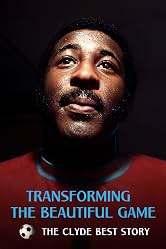

Just in time for the FIFA (Fédèration Internationale de Football Association, which translates into International Federation of Association Football) World Cup 2026, which has matches in Foxborough, Massachusetts, “Transforming the Beautiful Game: The Clyde Best Story” (2026) opens the Roxbury International Film Festival on June 18, 2026 at the Museum of Fine Arts, Boston from 7 pm to 10 pm. Clyde Best is one of the first famous Black soccer players, but is there a reason to watch this biopic documentary if you are disinterested in sports and one of the few people not suffering from soccer fever? Absolutely, but it will still be a heavy lift because it is understandably targeting soccer fans who will be thrilled to see their faves in one place. If the documentary has a flaw, it will lose impact for not offering more context and assuming that most of their potential audience bring a certain baseline of knowledge about soccer, organizations, etc.
“Transforming the Beautiful Game: The Clyde Best Story” is more than a biopic about the titular soccer player, but also the Black diaspora with a special focus on the United Kingdom, the Caribbean and the Americas, Bahamian culture, the history of the West Ham United Football Club, the role that race played in soccer, the North American Soccer League, and a history of other notable soccer players with a special focus on Black soccer players who may not be widely known but paved the way for soccer players like Best and beyond, and comparing British and American racism. Spoiler alert: which country did Prince Harry and Meghan Markle flee and where did they run to during the era of Presidon’t no less? The more things change, the more they stay the same. Who knew!
If you are an American, you may not follow soccer, and “Transforming the Beautiful Game: The Clyde Best Story” does not give you a primer on how this game works, what the positions are, the history of West Ham United Football Club or an explanation of how teams ascend in the ranks of the English Football League Championship to the Premier League to competing in a European tournament. The FA Cup or the Football Association Challenge Cup is separate from the league system, so a team must decide which players to put in one competition from the other. The FIFA World Cup is like the professional soccer Olympics with the best players from the country playing regardless of their usual team membership. Can you get a lot of information from context? Maybe but it is a lot of information to wade through without the benefit of an orienting framework, which includes assumptions about people’s knowledge of international history and colonialism. A lot of football teams recruit from other countries thus it makes sense that a United Kingdom team would recruit from a then British colony. This film’s priority is to keep a story alive that is still in living people’s memory, but a better documentary would be targeting an audience fifty years from now who may be unfamiliar with the British Empire, the Windrush generation, etc.
Actor and Roxbury native Tony D Head narrates it and is credited with being the cowriter of the documentary. “Transforming the Beautiful Game: The Clyde Best Story” is a conventional documentary whose subject is so innately interesting that he makes up for any of its drawbacks. It mostly consists of interviews with the Best family, soccer players, coaches (Edward “Icewater” Smith), historians (Bermudian Kristin White, Colin Babb, Tim Crane), fans, journalists (Glen Fubler), a sports agent (Ambrose Mendu), a soccer manager (Karina LeBlanc), a former Bermudian prime minister (Sir John Swan) and the artist (Barbara Dillis) responsible for all the murals that appear in Bermuda and in the film. Even the talking heads who do not have a personal relationship with Best are moved to tears over this man. Best appears throughout the film, but if it was not for his size and career, he would be easy to overlook considering how soft spoken and reserved he is. He discusses his international career as if he was just going to the store.
Soccer player interviews dominate “Transforming the Beautiful Game: The Clyde Best Story.” Cowriter and director Dan Egan often includes the interviewee’s name, team and years on the team if applicable, and whether they received the honor of OBE (Most Excellent Order of the British Empire) from the regent of their era, likely Queen Elizabeth. As the documentary unfolds, the relationship between the soccer players makes more sense: who are inspired fans turned footballers, friends, and colleagues. They include Viv Anderson, Bobby Barnes, John Barnes, Brandon Batson, Paul Canoville, Tony Carr, Carlton Cole, Garth Crooks, Gary Darrow, Les Ferdinand, Brian Gant, Howard Gayle, Peter Grotier, Shaka Hislop, Hon Randy Horton, Sir Geoff Hurst, Bill Irwin, Mark Lindsay, Rodney Marsh, Alvin Martin, Kasey Keller Millwall, Farrukh Quraishi, Harry Redknapp, Wim Rijsbergen, Jim Serrill, Sir John Swan, Nasir Wade, Ian Wright, Patrick Horne, who is also a historian, and Ade Coker, who came to Boston to play with the Minutemen and did not have the warmest welcome. Hilariously Nahki Wells just kind of appears on screen without saying anything as if he was in a pageant so it likely means that the cameo appearance means that he is enormously famous that a glimpse of him is sufficient.
“Transforming the Beautiful Game: The Clyde Best Story” features a lot of clips of notable soccer games in black and white and color to illustrate their stories, and if no clips are available, Egan turns to montages of photographs, newspaper clippings and archived news broadcasts. The most interesting creative choice are illustrations that recreate a particular event. There are a plethora of family photos and recreations using two contemporary boys to play out the description of how the Best brothers played as kids and how it may have developed Best’s later prowess on the field.
The Best family does not consist of a sizable portion of “Transforming the Beautiful Game: The Clyde Best Story.” His wife, Alfreda Best, appears on screen for seconds to prove that she exists. His daughter, Kimberly, only speaks slightly longer yet her comment is the most incisive regarding soccer, “It’s religion.” Mostly his siblings, brother Carlton and sister Marie offer more frank insight into Best’s experiences than the retiring Best does. Dana Salassie, a cultural curator and one of the documentary’s producers (points for transparency) describes it as “polite racism” compared to other locations, but polite is an understatement considering the practice of throwing bananas on the field and making monkey chants is still a fan favorite deployed at the mere sight of a Black player even when playing for their own team.
“Transforming the Beautiful Game: The Clyde Best Story” presents the tension that soccer poses. On one hand, it is one of the rare careers that overcame racism and used logic and rewarded merit (to make money). What a radical concept! On the other hand, it did not because Best, along with other players, run to (checks notes) Florida as a better alternative. You know, Florida, a famously liberal utopia free of all prejudice. Plus, at the end of the movie, there is a huge list of organizations trying to eliminate racism in sports. During the movie, an interview with Mentivity CEO Sayce Holmes Lewis, head of one of those organizations, teases this issue. So there is a hole here that does not get explored though comparisons to Best, who was a literal child though he looked like a grown man when he started playing professionally, with Jackie Robinson abound.
The hole is a problem faced at less famous workplaces. When an employer like West Ham United’s Ron Greenwood hires based on merit to profit, not based on prejudice to comfort, but is then unwilling to retain or protect the source of that profit, which is just another capitalist way to extract from a person, is it really about merit and being free of racism or a more progressive way to benefit and get praised for being progressive while finding new ways to inflict racism through proximity by allowing others to do so without permitting people to react as human beings and defend themselves, a sneaky virtual or proxy racism?
“Transforming the Beautiful Game: The Clyde Best Story” could have explicitly tackled this issue if they had not treated the idea of more diverse representation in coaching and executive ranks as an afterthought towards the end of the movie. It would have felt more central to the Best story than a tangent. It is an ambitious documentary that wants to tackle a plethora of topics and will be perfect viewing for soccer fans, but more of a lift for anyone more invested in the other themes that the film explores.
Disclaimer: it did not occur to me until after looking up Best, who was born in the Bahamas, that we may be related until I discovered his father, Joseph N. Best, is originally from Barbados. It definitely did not influence how I felt about the film except in keeping me determined to continue watching because it was a bit more sports than biography for my tastes.