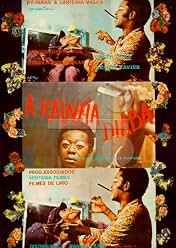

“The Devil Queen” (1974), original Brazilian title “A Rainha Diaba,” is about the events that unfold after the titular crime boss (Milton Gonçalves) meets with his underlings to protect the good looking Robertinho (Edgar Gurgel Aranha) from getting arrested. The plan set into motion has widespread consequences that affect everyone involved, even those in the margins. Even though some of the acting is over the top (think Pee Wee Herman’s death scene in “Buffy the Vampire Slayer,” the movie, not the series) and the fight scenes are amateurish compared to contemporary standards, it is a riveting, unpredictable, well-paced wild ride that paints a thorough, fascinating underworld society. I guess that I need to check out more films from writer and director Antonio Carlos da Fontoura since it was his sophomore feature.
No prose dumping here. “The Devil Queen” opens in a location and expects that the audience will figure out what is going on based on context clues. Violeta (Yara Cortes) clears the room, which appears to be the hosting area for a brothel. Then a group of men trudge in and take their places waiting for the cue so the Devil Queen can receive them and issue orders. Mean Chap is a Black man dressed in a suit with an enormous belly and the only one allowed to bring his gun into the meeting, which means he is likely the most loyal man in the group and the one who knows that the business is in danger because of Robertinho’s activities. Robertinho is mostly quiet for most of the movie, and he is not even the Devil Queen’s consort, just eye candy. The consort role goes to a character whose name is never mentioned but is constantly, enthusiastically tending to him. Dwarf wears a purple suit and does not even seem that short. The Devil Queen loves bullying Limp Leg or the cripple (Wilson Grey), called Manco, which includes taking a disproportionate share of the profits. Necktie looks like a cross between Walton Goggins and Will Ferrell. There are more people, but the most pivotal member of the crew is not present during the meeting because they are already executing the Devil Queen’s plan to protect Robertinho.
Catitu (Nelson Xavier) is a constantly smiling manipulator who is flamboyant, but presumably not gay based on the resentment that he occasionally verbalizes over having the Devil Queen as his boss, and he uses a gay slur, but not in an empowering way. He decides that he is going to set up Bereco (Stepan Nercessian) to appear as if he is the drug dealer to kids, not Robertinho, so the cops will get the fall guy. When “The Devil Queen” first introduces Bereco, he is devoted and waiting for his girlfriend, Isa (Odete Lara, da Fontoura’s ex-wife, yikes), a cis woman who is the headliner at a nightclub. Catitu gets Bereco to stand up his girlfriend so they can have drinks, and afterwards, da Fontoura only shows them as a toxic relationship. Isa talks a good game, but she does not stand up for herself for long. Bereco is physically abusive and is the poster boy for toxic masculinity. Bereco never listens to Isa’s good advice and decides to work with Catitu to compete with the Devil Queen in the drug trade.
Catitu assembles a crew which includes tough talking Mustache, a driver called Tsitu, and Vavá, a man who sounds too smart to fall for all these high-risk plans but nevertheless does so. They proceed to rob people so they can get enough money to buy weed and compete. Throughout “The Devil Queen,” it is unclear who Catitu is going to betray: his boss or the upstart underling. If you want to know what Catitu is thinking, watch when Xavier stops smiling. There is one marijuana wholesale dealer who is dressed like Marlon Brando in “The Wild One” (1953), and he seems to be the only person that Catitu is invested in saving but not because of his looks. Catitu loves a good plan.
“The Devil Queen” depicts a world where every character is unsavory, but interesting and fly as hell. Taking place a few years earlier than the events in “The Secret Agent” (2025), it is set in Lapa, Rio de Janeiro, Brazil and mostly in the favelas, which has a homespun glamour such as the cardboard sign with lights around it to advertise the night club. The power struggle is not the usual one shown in films like “Scarface” (1983). The Devil Queen’s comforts are leopard print sheets, a house party, some makeup and free grooming. The Devil Queen prefers to socialize and hold court with fellow femme gay men, who are his loyal devoted subjects during the betrayal. Gonçalves delivers a nuanced performance like a spoiled impulsive child at turns, but also as a person who is deeply unsettled and aware that he is outnumbered and is gradually losing his grasp on his business. Without seeing how the Devil Queen ascended to power, just the way that people react and are too afraid to face him directly is sufficient to imply that the Devil Queen had to be fearsome to make it. No character is immune from harm, but the betrayal of the Devil Queen feels ugly because the motivation is not only rooted in greed for power and money, but resentment and embarrassment over a queer person defeating cis folks.
On the other hand, “The Devil Queen” depicts Bereco’s ascension. da Fontoura makes some counter intuitive creative decisions that work better than if he took the expected beats. Note when he finally shows Isa performing in the nightclub and looking like a star. Up to that point, she seems common, shabby and pathetic. Once she is in the nightclub, she is finally shown among other women, and there is a glimpse of a lesbian relationship and women friendships or professional relationships with Dilma. Isa’s songs become an external message of her mental process: “a woman who can’t love doesn’t deserve to be called a woman” and “I’m exposed to your contempt.” When a behavior is depicted, it should not be automatically conflated with approval or being shown as a paragon.
Like “Lady Macbeth” (2016), the politics of privilege and power constantly shift, and beauty holds more power than actual power in this world. Pay attention to the most unlikely torture scene in a beauty parlor. The gender of the torturer and the victim is the only thing traditional about it. All confrontations, from the pairing to the physical choices, never unfold in an expected way. Reviewer Chris Knipp believes that Madame Satã or João Francisco dos Santos, a drag performer expert in capoeira, inspired the boss’ story, which now means that Cecil B. DeMille’s “Madam Satan” (1930) and “Madame Satã” (2002) are theoretically added to the infinite queue. If true, da Fontoura left a lot of fierceness on the table, but just seeing the preview of the latter makes Mercutio (Harold Perrineau) in drag in “Romeo + Juliet” (1996) feel like a direct reference.
“The Devil Queen” makes Pedro Almodóvar’s films seem bourgeoisie in comparison and is a profane grindhouse meditation on toxic masculinity, gender and the effect of fascism on the lower, disempowered classes. It infers some terrifying truths about what it takes for dispossessed people to wield power, and while the picture may be pretty, the consequences are not. It is a classic masterpiece that you should watch if you ever are fortunate enough to have the opportunity to see it.