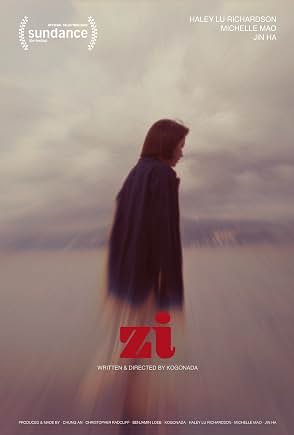

“Zi” (2026) is Kogonada’s latest film, and it is unlike anything that he has ever done before in a feature. The film revolves around three people: the titular character, Zi Wong (Michelle Mao), who has been experiencing time displacement and having strange visions, Elle (Haley Lu Richardson), the subject of her visions, and Min (Ha Jin), who is connected to both women. Kogonada may be returning to basics or the cinematic equivalent of back to the drawing board, but what is a valuable exploration of his craft for him may not be a rewarding experience for movie goers not into experimental, artsy films that rest on improv to flesh out the plot. Also, you can see “Paper Tiger” (2026) or you can see “Zi,” but if you see both, one plot point that they have in common may completely take you out of the ability to suspend disbelief so choose according to your tastes. I would choose the prior.
Time to offer my Kogonada credentials. I never watched his videos or shorts. My favorite Kogonada feature is “Columbus” (2017), which I saw repeatedly in theaters and at least once at home. I do not think that I am capable of entirely expressing why I love that movie. While I have appreciated his work afterwards, it has felt like he will never achieve even a fraction of that greatness, but most people never achieve greatness once, so I am grateful for that one miracle. I have only seen the first season of “Pachinko,” but I still need to finish the second season and am uncertain if I saw the four episodes that he directed. If I did, then it is definitely his second best and outstanding. My most controversial take is that I prefer “A Big Bold Beautiful Journey” (2025) over “After Yang” (2021), but neither are him at his best. While I may like all of his films, “Columbus” would be at the top, and those two only just skirt falling over the line of dislike. Somehow “Zi” is better than those two movies and worse, but I will still rank it above them because it takes a certain level of courage to go small, credit to “Chef” (2014) for the phrase as opposed to “go big.” It feels as if he is resetting and getting back to basics so he can move forward again but considering that his characters have lately been thin at best, it could also be a sign that it is a point of no return restricting his use of color and using composition to find beauty in parts of life that may not feel beautiful while experiencing them. It reminded me of “La Jetée” (1962), especially with the restricted color palette compared to his other work.
Ha and Mao succeed at carrying the heavy load of conveying the sci-fi without Kogonada using conventional sci-fi devices like technology and special effects. Kogonada’s lighting and editing also convey Zi’s medical condition and its time traveling nature. It is superb that Kogonada is clearly more concerned about the effect of time displacement on the characters than the logistics of how it works and where it lands at the end of the movie, but there is one problem with that approach. The characters in “Zi” are thin, but worst of all, the titular character feels as if she exists to be a sounding board for Elle, which in French, translates to She. Richardson is a great actor so nothing here should be attributed to her talent, but there is nothing worse than expecting to have one main character as the protagonist then that character feels substantially under explored compared to anyone else.
“Zi” consists entirely on improv. Mao decided to stick to the physicality and emotion of her character, but other than her character’s profession, affliction and sexual orientation, there is no sense that a movie goer would recognize Zi as an individual if she suddenly appeared in the real world or another actor had to play her. Zi exists as a reason for Min and Elle to interact and as a barometer of their humanity in the face of a stranger experiencing a crisis. She is the premise in premise fiction, and as a human character, it is innately a failure of Kogonada to treat an Asian girl or woman as a person as he did with the adopted child in “After Yang,” which at least could be attributed to the source material. Here it could be a result of Mao’s creative choices. Kogonada is still in the broken clock rule, but three strikes….
“Zi” is Richardson’s movie, which feels weird for a movie set in Hong Kong. Richardson never plays the same character and is the queen of sensitive, nuanced performances. Elle felt recognizable when another actor played her during a different era, so she benefited the most in crafting a character through improv. Zi and Min kind of exist to be drawn to Elle. The negative of having an actor write is that a lot of dialogue consists of biographical prose dumps that tell the audience about Elle instead of showing it. It is heavy handed at best. Also, the idea that a white woman in Hong Kong wearing a wig is anonymous and melts into the crowd felt ridiculous, but no one treats it like a joke. It is meant to complement Zi’s untethered feeling. It reminded me of a scene in “Kiss the Girls” (1997) when Morgan Freeman and Bill Nunn decide to blend in and advise Judd to do the same, and they are the only two Black men in the place. It is such a denial of the reality of a specific time and place. An actor’s tool is their body and appearance and pretending that the context does not alter the effect of that body and appearance only detracts from the film’s trajectory.
Given the parameters of Jin’s assignment and what he had to work with, he knocked it out of the park. It is frustrating that his dialogue leaves the premise as much of a mystery at the end as it was in the beginning but given the emotional journey of his character and his relationship with both women, he made it work. The choices that he and Richardson made to repeatedly have private conversations about Zi without her was frustrating and may have inadvertently presented Zi as too passive and them as infantilizing instead of caring in the first half, which makes the implication of Zi and Elle’s relationship feel like more of a surprise. The constant choice to run around the city all night felt like an inconsiderate nightmare to put Zi through even if it was a creative choice for Kogonada to write an unconditional love letter to Hong Kong. A lot of people mistake movement for momentum, but instead it betrays a lack of grasp on the strength of the story.
“Zi” is a vicarious secondhand horror for anyone who felt like an inadvertent third wheel. Still the sincerity of the performances, the composition of the shots and the youthful ambition of such a big swing and reset dulls the desire to make a swift judgment against the film but was such a boring viewing experience that giving it a second shot feels more like self-flagellation. Life is too short.