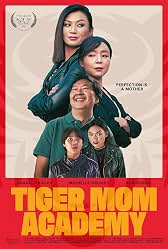

Marilyn Khu (Jingchu Zhang) has felt like a loser since she was a child, so when she receives an invitation that guarantees success for her and her children, Eva (Alexa Loo) and Kasper (William Budijanto), she does not hesitate to accept. “Tiger Mom Academy” (2026) refers to the boarding school that Suki Lai (Michelle Krusiec, who is also one of three cowriters) runs with an iron fist for mothers and children. Is her school the solution to all of Marilyn’s problems or an additional problem? Director and cowriter Shawn Chou’s second film veers wildly in tone from slapstick to severs with high stakes that can be hard to digest which may be the point: to critique obsession about success at any cost. It could work as a pilot for a television series, but the story is entirely resolved.
Zhang is a good sport as she goes through a gauntlet as Marilyn. Chou lays it on thick and puts Marilyn through a series of humiliation rituals that make it challenging to watch “Tiger Mom Academy,” which is supposed to be a comedy, but is too often grim. Marilyn feels like a put upon, dumping ground for everyone’s issues and other than being a well-intentioned underdog, there is not much about her that makes her memorable. Zhang’s emotion keeps the thin character going. Like all moms, she wants her kids to have a better life, and like many wives, she is taken for granted. Her distinct characteristics are smoking, drinking wine, pratfalls and being a pushover, but Marilyn needed more character work beyond people dumping on her since childhood. Did she once have hopes and dreams before life beat her down? She is not a person beyond her relationship to others, and her core wound is related to friendship so not having yearn for that kind of dynamic should have been explored in regular life and threaded as much as the family story line.
The childhood sequences in Beijing establish why Marilyn feels doomed to a certain fate as a bad mom. Did she even want to be a mom then? The opening scene set in China works because “Tiger Mom Academy” starts in a counterintuitive way and draws parallels between the Chinese education system’s physical drills and other visible markers of discipline and Suki Lai’s school. It makes sense why Marilyn would feel attracted to a place similar to the location and tone of when everything fell apart. It is like a second chance at the eleventh hour. On an unimportant note, it was briefly confusing whether the scenes were set in China or Taiwan because the class disparity felt anachronistic for the era. If the movie makes a mistake, it is not restricting the backstory to the opening sequence. There is one additional flashback scene that does not add anything substantial other than information already available in the dialogue.
Before getting to the boarding school, “Tiger Mom Academy” introduces Marilyn’s pitiful life. Most of the two dimensional and shrill supporting characters loudly complain to her about her awful children. Ava is a Goth tech genius who is thankfully good at defending herself but takes things too far. Kasper is too into fantasy, specifically “Game of Thrones,” a bit that pays off in the end, but considering how the last season ends, it may not land as Chou originally intended. Kasper also has zero judgment in predicting the consequences of his actions.
These kids are more annoying than not, but Loo and Budijanto manage to make these kids redeemable and sympathetic, which is a Herculean task. Loo reflects the pain of having a mom who cares more about appearances than her daughter’s pain. Budijanto’s indomitable spirit in the face of huge obstacles makes his character scrappy. Even though he gets a little romance storyline that is essential to the plot, he is so young that it felt unnecessary in the moment No romantic storylines for children that feels wedged in awkwardly. It is obvious that Chou relates to his character more than anyone else, which means that he probably should have made him the protagonist, but the character is not that interesting and probably would not have produced enough fruit to sustain the entire story. Also, they are supposed to be the products of a neglectful father. Ken Jeong also has a heavy lift as the man child husband, Jimmy, who feels like the real villain of “Tiger Mom Academy.” Poor Jeong just barely gets the character to feel worthy of a second chance, and he is a well-known, beloved professional.
When “Tiger Mom Academy” gets to the boarding school, it starts to hit its stride, and Krusiec seems most comfortable with the material and has a fully fleshed out character. It is not a surprise since she is one of the writers. Suki Lai is fun to watch after a long slog of flailing, which explains the appeal of her program. Her methodology is obviously ridiculous, and anyone who has gone to Harvard would quickly dispel her assertion that it makes alumni immune to being mistreated. It is prosperity gospel without the gospel. Any first generation American will be familiar with her ideology. It is only exaggerated because of the setting, décor and numbers. Her chief enforcer, Shoshanna (Nathalie Boltt), seems to relish inflicting cruelty. It was interesting that the school had a Bond villain, Eurotrash and former Communist era vibe, which makes the film more retro and Cold War influenced than contemporary times require.
Suki Lai is more of a tragic figure than a villain. Her commitment to her ideology is where the film’s satire comes in. It is obvious that the movie does not endorse this methodology and is critiquing the extremes of raising children to be excellent, but it is still the equivalent of watching child abuse. Part of the movie’s gag seems to be getting revenge on the kids and enjoying that Marilyn is finally beginning to gain confidence. All the moms have a signature discipline tool and become as tough as Suki Lai while the kids don uniforms and live to study and obey. It is very Stepford without the technology.
It would have been nice to have a small segment of “Tiger Mom Academy” show the quotidian balance between Marilyn’s earlier laissez faire approach and the strict one, but that never happens. Instead, the end is a denouement more suitable for an action-adventure film with ridiculous high stakes, bad CGI. Chou, cowriter Neil Garguilo and Krusiec need to figure out who their audience is because it is not a funny movie though it has humorous moments thanks to Krusiec. The focus on the kids as characters is not sustained in a substantial way, but it may be too silly for an adult audience. It is too fantastical to feel grounded, but too schlubby to suspend disbelief and get into the premise. The tone is too uneven. If Ava was the protagonist, and she started becoming an action figure combined with her tech savvy, the ability to fight back would have balanced the abusive dynamic. Everyone loves a turn the tables storyline.
“Tiger Mom Academy” is a great idea that will resonate with a large audience, especially first-generation Americans, but it may be too serious, and the characters are too insubstantial for it to entirely land. If it did become a series, it would be interesting to watch Suki Lai realize how her assumptions of the world are unrealistic and how she reacts to a world not based in merit.