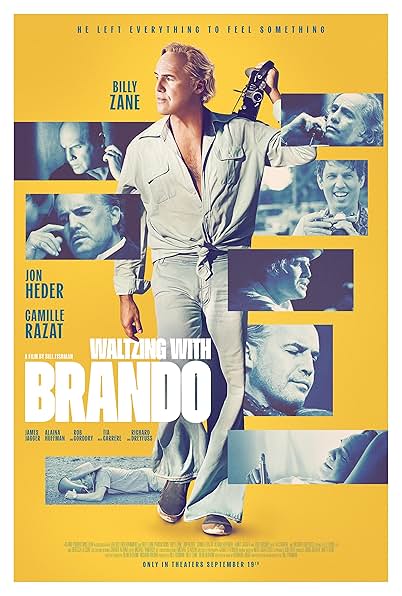

“Waltzing with Brando” (2024) adapts architect Bernard Judge’s memoir, “Waltzing with Brando: Planning a Paradise in Tahiti.” Judge worked with actor Marlon Brando to build a home and hotel on Brando’s private island, Tetiaroa, in Tahiti from 1969 to 1974. Jon Heder plays Judge, who is also a husband and father of a family and lives in California, but with his family’s blessing, he accepts a job unaware of Brando’s relationship to the project that he was initially hired to do. Upon landing in Tahiti, the pull of island life and Marlon Brando (Billy Zane) changes Judge’s life forever, but will it be for the better?
Zane is perfect. He became Brando, and it is virtually impossible to see Zane without concentrating. If you watch movies, though not required, hopefully you are coming to this movie with knowledge of his work to fully appreciate what Zane does in “Waltzing with Brando.” As someone who never bought Brando as sexy, Zane opened my eyes. How can a person with a growing gut and thinning hair be hot? Well, when I’m not looking in the mirror and asking that question, I’ll watch this movie because Zane has whatever it takes. Costume designers Charlie Altuna and Erica Howard capture Brando’s unique sense of style. He plays him as a casual host and an eccentric prankster who is also more of flibbertigibbet than committed to his environmental preservation chatter. Considering that Zane usually plays villains, it is nice to see him play a more affable character, which is a more suitable match considering his offscreen reputation as a cool kid without a mean streak. There is a scene where Zane seems as if he has an extra sparkle in his eye when playing with Judge’s onscreen daughter, Sabrina (Ava Zane), only to later find out afterwards that the child actor is his daughter. There were no similarly resonant scenes with Brando’s onscreen child.
“Waltzing with Brando” is part Brando biopic with Zane getting an opportunity to recreate Brando’s most famous performances on and off screen whether with talk show hosts Dick Cavett or Johnny Carson or acting in “The Godfather” (1972), “Last Tango in Paris” (1972), “Superman” (1978) and “Apocalypse Now” (1979). Stay for the credits to see bloopers. It may have been better to omit the last one considering what has emerged about what Brando and director Bernardo Bertolucci did to Brando’s costar, Maria Schneider, during the shooting of the film then gaslit her pretending that they did not. Either really tangle with uncomfortable truths or avoid them. While the mimicry is seamless, it does have the effect of stopping the narrative’s momentum in its track for a skit to let Zane flex his already considerable thespian muscle. The point of these moments is to flesh out Brando’s off-island reputation and to show how he funded the project, but by taking him off the island, it means that he is not paired with Heder as much, which means a far less interesting movie with no disrespect intended to Heder. Seeing Brando rehearsing his lines and throwing off people who think that he is not acting keeps the movie on track.
After all, “Waltzing with Brando” is supposed to be Heder’s movie, but no one comes to a movie with Brando in the title to watch an architect’s story even if it is the point. Judge gets to be the onscreen surrogate who learns about Tahiti and the Tahitian way of life in the most wooden way possible to educate moviegoers. Judge’s story functions as comedic relief since Judge is the strait-laced guy learning how to loosen up, falling flat on his face then becoming Brando’s eager disciple until he becomes more of a zealot than Brando regarding Tahitian life and commitment to environmentalism. Contrasted with “Eden” (2025) and “Pacification” (2022), the adherence to comedy and ability to veer from drama or tragedy is kind of impressive if you want to describe it complimentary or feels like a complete whitewash if you do not. There are only so many times that it can happen without it feeling redundant. Occasionally Heder breaks the fourth wall to narrate and offer lessons about his work, which is not innately boring, but is the way that it is presented here because of the juxtaposition with the odd couple buddy dynamic. If given a choice between a documentary and a bromance, even the nerdiest nerd will choose the bromance.
Also, even though “Waltzing with Brando” makes it obvious that Judge spends a considerable amount of time falling flat on his face personally and professionally, it does not feel as if there are any real-world consequences or when they are, they get dumped out of nowhere and the tone veers dramatically to the serious before inevitably pulling punches. For instance, his family pushes him to take the job but disapproves as it stretches on. From the first act of the movie, the film teases an attraction between Judge and Michelle (Camille Razat), a flight attendant who is a permanent fixture on Brando’s property. It also equally feels like a bad idea to introduce his wife, Dana (Alaina Huffman), to Brando. These seeds of domestic disturbance are more like seasoning than full-fledged storylines, and a lot of these moments of discontent go nowhere and ultimately feel like a waste though the scene where Brando verbally slaps him out of his stupidity and gives him solid advice is fun. Just change the title from “Waltzing with Brando” to “Touched by a Brando.”
The last hour of “Waltzing with Brando” also feels like an informercial promoting Tahiti and responsible development. Again, if it was blended more throughout the entire story, then it could have worked. It ends up being a farce about running out of money, which gives Richard Dreyfuss a chance to occasionally ham it up as Brando’s accountant, Seymour Kraft, but they feel like non sequiturs, especially when his orders conflict with Brando’s, and it changes nothing. The movie ends with a plea to donate to the Tetiartoa Society, which is also plugged in the narration, and basically continue Brando and Judge’s work. Movies with messages always get heavy-handed and blow up a good story. If the locals played a more central role, these issues could have been inserted into the story in an organic way. On the other hand, if Tahiti is looking for an increase in tourism, writer and director Fishman’s filming of the island makes it look like a paradise whether he is shooting in the style of the era like one of the home movies that Brando shot or shooting the main movie.
Fishman knows how to make an ideal looking film, but it is not enough to overlook its flaws. This fractured movie has some amazing elements, but because it lacks rhythm, it requires that a moviegoer come to this viewing experience with a lot of generosity and grace that should not have been required if Fishman and editor Michael Yanovich had put a lot more time into the finished product. Tia Carrere fans, she makes a hilarious cameo!