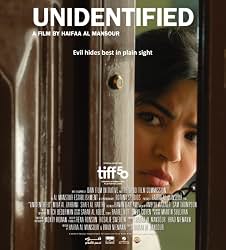

Set in contemporary North Riyadh, Saudi Arabia, “Unidentified” (2025) has nothing to do with aliens (talking to you, Steven Spielberg), but a girl’s dead body (Amal Sami) found in the desert. Nawal (Mila Al Zahrani) is a true crime fan who works at the police station scanning files. When the one woman, Bishra (Fea Al Shaea), a cop, is not in the office, Nawal gets to accompany the cops to help retrieve the body. From that point, she feels compelled to identify her, find the girl’s family and get them to claim the body before the girl is buried in an unmarked grave. Will she be able to close the case? Director and cowriter Haifaa Al-Mansour and cowriter Brad Niemann make a murder mystery that may drag a bit but will make people want to watch it repeatedly once it ends. There will be so many times that you regret not paying closer attention. It is a genius display of how misogyny affects how people view a woman in simplistic, one-dimensional ways instead of nuanced human beings with flaws and features. I fucking love this movie.
Nawal is a familiar type: the plucky young woman who is better than the cops who shut her out from solving the case because of sexism. Well, except she is not an official. She is just a chick who listens to crime podcasts, is always doing her makeup and keeps conflating the death of this girl with the death of her two-day old baby, Dima. Her good-natured boss, Colonel Majid (Shafi Al Harthi), is pretty cool about it considering that her investigation is stirring up a hornet’s nest of anger from the principals of the all girls’ schools who resent even being near controversy, the wealthy families whom she bothers, and the religious men who do not talk to women they do not know. She gets latitude because she gets results.
“Unidentified” shows her able to infiltrate spaces that men cannot go. Because she is relatable, people give her information before they realize that she is not supposed to be there. Her position at the police station gives her access to information and allows her to eavesdrop on the cops’ meeting. It is always easier to root for a woman protagonist in a murder mystery in which the victim is a female because when the murderer’s identity is unknown, there is always a possibility that she could be next, and Nawal does some reckless things alone such as going into residences where she is definitely outnumbered and there is a huge locked gate or chasing suspects onto abandoned property while unarmed. To be fair, she works at a quiet police station, so she probably has the same skill set as the cops with their training. Plus, she can disguise herself better because she can wear clothes that cover her face. Also, because she is younger, she follows clues that other cops may not notice such as checking out people’s social media posts. Because the audience wants to solve the mystery as much as she does, and the film mostly follows Nawal, naturally the filmmakers cleverly use that leverage to make moviegoers root for her more. Then her tragic backstory, which is mostly depicted in flashbacks, just add to the pile in her favor.
Then the filmmakers make one girl’s death into a larger societal problem about how female victims get treated differently. Despite the victim being underaged and affluent, no one is willing to claim her body. It is victim blaming taken to an exponential level. You got your sociological commentary in my murder mystery. You got your murder mystery in my sociological commentary. There is the contrast of how women and girls dress and act around each other versus in mixed company. Jude (Othoub Sharar), a high school student, is downright hostile. Dania (Somaya Al Shareef) is more open to Nawal’s questions, but all the girls are reluctant to give information because their lives are already a prison thanks to family life and society. They are going to get married off and must make the most of what little freedom they possess. There is a glimpse of how other women live at a hookah bar because the musicians are all women and appear freer.
Add to that the religious signs popping up all over town and the lead suspect who makes them, Mishal Abdulrahman or Meshaal (Abdullah Al-Qahtani). People who watch movies generally are bringing a certain amount of cultural baggage so if you are watching a murder mystery, you are assuming certain things about the killer’s motivation and clues, especially if you paid attention to the vehicle in the opening scene. The cops reference a possible honor killing. How many killers have a grandiose mission to offer a veneer of respectability to an inexcusable act? Also, Nawal’s investigation is satisfying because Al-Mansour visually shows how she calculates each step
Al-Mansour often frames Nawal as if she is in prison. When in her home, she favors Dutch angles to show that she is off kilter with the rest of society, but also from the diagonal bars on her window. There are a ton of oneiric scenes where the dead girl startles, chases or attacks her. Her nightmares are just a series of jump scares that are quite confusing until the denouement, especially as they progress, and it is harder to distinguish between realities and dreams. When she is interacting with other people in their space, the scene is often shot in a more conventional way with the framing level with the screen, not askew, but it can also be crooked when she is being deceptive. A little literal so if you do not notice it, maybe subconsciously it will be obvious. Also, the camera also looks down on her when she is in public spaces without others observing her as if God is witnessing or it offers how she feels pinned down.
I normally do not like mysteries because it feels as if by hiding the clues until the end, the writers keep the suspense going, but the viewers get cheated out of a chance to solve the crime themselves. In retrospect, the solution is obvious. Maybe I’m slipping, but I could figure out “Interstellar” (2014) in the first five minutes, but this story kept me guessing until the end though I did notice all the notes and paused but did not do the math. The most obvious one involved a burning car. Once the killer’s identity is revealed, it will be essential to question the assumptions that you brought to the story that influenced how you interpreted what you saw.
S
P
O
I
L
E
R
I’ve always said that it is misogynistic to believe that women are only good because they are human beings therefore capable of evil including murder. “Unidentified” is like the riddle where a boy and his father are in a car accident. The father dies, and when the son arrives at the hospital, the doctor says, “I can’t operate on him. He is my son.” It is “The Usual Suspects” (1995) except the killer is female, which I assumed, but not the right one. “I felt she could have had a life just like mine.” You got me!