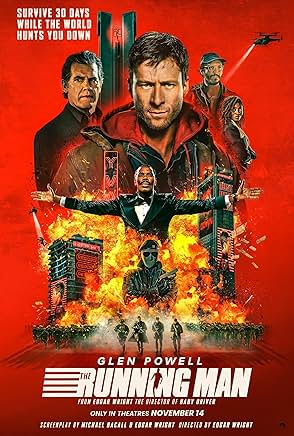

“The Running Man” (2025) is the second adaptation of Stephen King’s novel that he wrote under his pseudonym, Richard Bachman, and director and cowriter Edgar Wright’s most recent film. Set in a futuristic dystopian United States where corporations control the government and all jobs, Ben Richards (Glen Powell) has been blacklisted from every job, and his daughter needs medicine. He heads to the Network to become a contestant on a variety of shows promising his wife, Sheila (Jayme Lawson), that he will not sign up for the titular show because no one comes back from it. Of course, Dan Killian (Josh Brolin) convinces him to break his promise. Will Richards be different? Wright’s film offers action with incisive sociopolitical commentary, but in the final act, loses momentum in trying to find a resolution that lives up to the everything that came before.
I’ve been rooting for Powell since he starred on “Scream Queens.” He is an affable, hardworking actor with a theatrical flair possibly better suited to the stage, camp or over the top fare. I expected that he would make it big even in brief cameos from “The Dark Knight Rises” (2012) (Bane offs his character) and “Hidden Figures” (2016) as astronaut John Glenn, but when I looked away, his star shot straight up with “Top Gun: Maverick” (2022) and “Hit Man” (2023), two films that I have not seen but put him on everyone’s radar. While everyone was watching movies during the pandemic, I had little time for them dealing with life and trying to find a way back into the movies.
The problem is that Powell is currently in an awkward phase. His square jawed conventional good looks dictate that he should go in one direction, but his personality pulls him the other way. “Twisters” (2024) was a good balance between his ability to do action and make people swoon with an ability to make cheesiness and low commercial product compelling. Here, you can see Powell’s acting gears turning as his character wildly veers with little to no gradation in between from madman to family man. It feels as if he is doing a Tom Cruise meets Jack Nicholson impression, especially during an ink blot psychological exam when his no teeth smile creeps up impossibly along his face. It is still impressive, even funny, but not organic. When his character is finally called upon to lose his crap epically, something that he threatens to do from the opening scene, it feels obligatory, for narrative reasons, not cathartic, but also because Powell has not figured out how he wants to approach the material in his way, not imitating others’ road map to success, which to be fair, has served him well. God bless an actor who knows what made him successful and giving the audience more of the same. In one scene, he is oiled up and evading death with just a towel on. I know that he can do better artistically as his own person, but art does not pay the bills. Powell is great and humanizes a character that could just be a vacuous action hero, but it does feel like acting.
Watching “The Running Man” often feels like watching the fictional television series until a counterinsurgent force hijacks it to become less about survival and becomes more heavy-handed to ensure that the audience understands how media manipulates people and perverts the truth. It is a film about turning real people into villains or heroes regardless of the content of their character. All the trailers make it seem like a survival film, but Ben is more on a deconstructionist journey where he must interrogate his values and the world around him alongside other characters who are at different stages in their reassessment of their lives. The people who help or hinder Ben along the way feel like three dimensional characters, not supporting ones, but no one sticks around long enough to detract from his goal of learning how to be a good man for himself, for his family and for the broader public when nothing really works. Wright never really answers that question in a scalable way before reverting to making Ben into a mythic figure instead of the human, relatable one, which makes the film weaker. The story’s strength is peeking behind the curtain, not just erecting another one to create another mythos, which is where the film lands except the propaganda is for the people. It has been a long time since I read the novel so maybe Wright is being faithful to the work, but after the image of ordinary people deciphering and defying in logistical, practical, difficult ways, shifting to farfetched, fantastical solutions feels like a copout even if well intended.
For most of “The Running Man,” Edgar shows the story mostly from Ben’s perspective. Once Amelia Williams (Emilia Jones) appears, the momentum of the story stops because it splits focus from the audience being invested in Ben’s plight to the conventional trope of an action hero teaming up with a civilian and becoming concerned for her safety. Fortunately they do not become love interests, which is usually how this storyline plays out, but the movie demands that Ben forget everything that he and the moviegoers through him learned about the real rules of this universe and how the game is rigged to a conventional showdown between Ben and head Hunter, Evan McCone (Lee Pace, who is criminally masked for the majority of the film). Once Ben and Amelia go their separate ways, Ben is never a person again. He becomes an idea, an everyman Spartacus, but his appeal in this iteration is his individuality. He was good at evading the Network Community Guard or Goons depending on how you feel about them because of his work experience. A shoot out is not as satisfying, especially given the eleventh hour reveal about how hunters are chosen.
Though it came first, “The Running Man” owes a lot to “The Hunger Games” franchise in the way that the Network exec Killian and “Speed the Wheel” host (Sean Hayes, love) are styled like variations of Caesar Flickerman without the warmth of Stanley Tucci. Colman Domingo is another breed altogether bringing his corrupt gentleman portfolio to the silver screen and elevating the phenomenon of the amoral Black man host getting his piece of the pie regardless of who is pulling the strings and how he personally feels about it. His role as Bobby Thompson is a brilliant example of “me first” ideology that finds a way to benefit from the Network without becoming inseparable from the Network. He is a survivor. “The Americanos” are an omnipresent reality show fixture like the Kardashians and God bless the second coming of Debi Mazar.
The have nots are just as notable. William H. Macy appearing as Ben’s first helping hand feels like a direct descendant of the role that he played in “Train Dreams” (2025). Sandra Dickinson’s character could be the poster child of the phenomenon of older people getting mutated into demonic figures from watching too much Network television. Daniel Ezra as another helping hand and Network foil was a delightful surprise, and it is slightly embarrassing that Brit Wright nailed the combining of race and geography in tone over the more erudite American director Kelly Reichardt in “The Mastermind” (2025). Katy O’Brian appears as a fellow contestant, Jenni Laughlin, who is a memorable, bad ass hedonist, and it would have been terrific if her character was more central to the plot. Michael Cera is on a roll with “The Phoenician Scheme” (2025) and now as Elton, as eccentric insurgent who even gives Richards pause. Chi Lewis-Parry, who was the behemoth in “28 Years Later” (2025), appears as a former contestant used to illustrate an archetype of RM player. I’m just excited that he gets lines in this movie.
Wright has been a long-time fave, and it is nice to see him get political at the right time, but he lacks the substance to get more than the aesthetic of resistance. He understands people, human nature, but collective or individual meaningful action that reflects the ethics of that resistance is where he flounders. To be fair, there is no reason that he should have that experience and knowledge. “The Running Man” is a mostly solid movie that cannot stick the landing, but it tried.