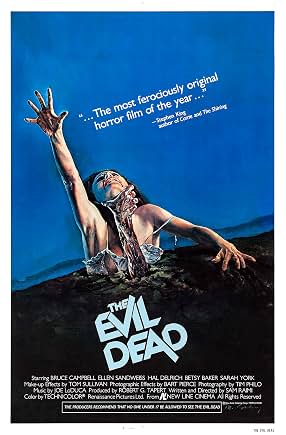

“The Evil Dead” (1981) is the first feature in the “Evil Dead” franchise, which currently consists of six movies, four graphic novels, a ton of comics, a television series and a partridge in a pear tree. It expanded a proof-of-concept short film “Within the Woods” (1978). Five Michigan State University students decide to rent a cabin in the Tennessee woods, which happens to be the location of the Sumerian translation of the Naturom Demonto, i.e. the Book of the Dead, which is a deliberate reference to HP Lovecraft’s work, and a tape recording of the incantations, which allegedly give permission to a demonic entity to possess people; however, considering that the students’ arrival occurs at the same time as an unseen force rushing through the woods to meet them, that detail seems erroneous. Will the entity possess all of them? Despite bare bones characters and dated special effects, this horror classic is still a banger featuring writer and director Sam Raimi’s excellent camera work, editor Edna Ruth Paul’s effective and efficient montages, excess gross outs and unremitting bleak storyline. Raimi is one of the early filmmakers to lay the foundation of the horror trope of the cabin in the woods before it became a trope.
I think that I have watched “The Evil Dead” repeatedly in fractions and whole, but this may be the first time that I watched it with a critical eye. Ask most people what they remember from this movie, and it is the tree rape, which is longer and more graphic in my memory than reality. If you have not seen it, then consider yourself warned. For horror fans, it is a strange mix of classic horror elements. The supernatural woods are not surrounding Dracula’s castle deep in Eastern Europe, but they obey the same rules of safety proportional to the sun’s presence. It is long before the broader public became aware of the folklore surrounding the Appalachian Mountains, which go through Tennessee. Interestingly the opening scene as the students drive to the cabin feels as if it could have inspired “Final Destination” (2000). The blood dripping scene feels like a reference to “The Amityville Horror” (1979). The full moon makes werewolves seem more likely.
If “The Evil Dead” held surprises, it was the birth of an unlikely, unpredictable icon Ashley ‘Ash’ J. Williams (Bruce Campbell). With three women and two men, it is unusual to have a final guy, not a final girl. It is only as the movie unfolds that the relationship between the characters is revealed, but there are some questions that never get answered. Why is Scott (Richard DeManincor) driving Ash’s car? In these pre-Internet days, how did Scott find the cabin? No prequels explore the professor on the recording. Who owns the cabin and did they know what would happen? Scott is depicted as a typical male of that era pretending to be braver than he is, acting like the self-appointed leader, insensitive and dismissive to others concerns until he is the one in jeopardy then he becomes selfish and abandons any pretense of being a protector. Before they reach their destination, Scott puts them in danger and never takes accountability.
The most memorable woman in the group is Cheryl (Ellen Sandweiss), Ash’s sister. Her storyline reveals that the known mythology around the Naturom Demonto is incorrect. Either reading the incantations does not give permission for possession or the first permission was still in effect, and the demon already possessed all organic material in the area, the woods, the timber that made the cabin and anything organic that entered it like Cheryl’s pencil. Possessing the living means anything is up for grabs. Though most possessions start with wood entering the body, proximity seemed sufficient considering that Cheryl briefly loses control of her hand and trance writes. Her hand even changes appearance. She is the most sensitive and the only single woman. Subverting the good girl trope in slasher films, it does not matter if she does not have sex or is the most clothed, she is not immune to attack. It is kind of satisfying that Cheryl gets revenge as a mocking demon and throws everyone around.
The other two women are less memorable. Shelly (Theresa Tilly) is Scott’s girlfriend, and Linda (Betsy Baker) is Ash’s girlfriend. When Linda becomes possessed, it feels like a cross between “The Exorcist” (1973), a witch’s cackle, the Joker’s smile, and a vampire victim dressed like one of Dracula’s brides because she retains most of her original appearance, pretends to be herself to trap new victims and is key to the protagonist’s maturation in fighting evil. It is interesting to see the group dynamics at play when Cheryl is in jeopardy and who has a right to determine the group’s trajectory, solace and resources and is considered reliable. Take away the supernatural elements, survival against evil depends on the reaction to a rape victim’s account. Possession stories in fiction usually feature a girl or a woman possessed then pinned down, but Raimi’s story makes the implication literal. Indeed, anyone who ignores the warnings joins “them,” i.e. evil. The lighting as the remaining trio watches the siblings try to escape is evocative of the poster for “The Exorcist.” Cheryl’s possession becomes impossible to ignore unlike her pleas for help or the aftermath of the failed escape when everyone except Ash is treating their time in the cabin as if it is still leisurely and fun. Only Ash becomes focused on the problem.
Ash functions as a midpoint between Scott’s actions and the other women’s panic. “The Evil Dead” becomes a kind of coming-of-age story. He learns to stop reacting to horrific events using his earlier sentiments, which include adhering to traditional burial rites out of love, and engage in acts that seem brutal and counter to his default nature. Early in the film, he spends more time clutching potential weapons than using them. It is not a Raimi movie without over-the-top blood and bodily fluids gushing, a distinctly American take on giallo movies. If becoming a hero in this mythology was only about brutality, Scott would be the designated one, but a hero is also someone who feels the loss, which distinguishes him from the demonic savagery. He is distinct from the others because he knows that he can be a victim too. It is provocative that it is easier for Ash to kill a laughing possessed woman than an unconscious one, which may make you recall the famous Margaret Atwood quote.
As “The Evil Dead” approaches the denouement, it feels like a bit of a slog, and it may be during the portion when a bunch of substitutes played the others actor, and Campbell became the dedicated MVP who stayed for the entire film. It ends on an ambiguous note and unbelievably, no one intended for it to be a franchise. Nevertheless one was born, and it became the first in the Raimi trilogy cycle.