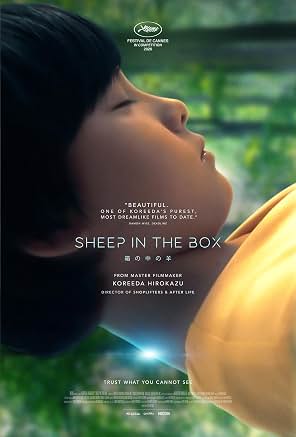

When architect Otone (Haruka Ayase) and her husband, construction worker, Kensuke (Daigo Yamamoto), accept an offer for a free rental of the latest edition of humanoid robot modelled after their deceased son, Kakeru (Rimu Kuwaki), using all available audio and video data. Everyone’s reaction to Kakeru becomes an opportunity to remember the original and confront the loss, but eventually everyone must reckon with the fact that this version is different and an individual with his own hopes and desires. What does Kakeru want? Way more sensitive, contemplative and nuanced than “Good Luck, Have Fun, Don’t Die” (2025), more authentically emotional than “O Horizon” (2025), more willing to fully tackle each character’s hopes and dreams instead of remaining oblivious to complicating factors like “After Yang” (2021), and more hopeful about human beings and machines’ relationship than “A.I. Artificial Intelligence” (2001) and “Her” (2013), and more respectful of a humanoid object than “Toy Story 4” (2019), overall Hirokazu Koreeda’s latest film, “Sheep in the Box” (2026), uses technology to shine a light on the nature of existence, acceptance and coexistence though the last half hour may be too frictionless and unrealistic for most moviegoers to continue to suspend disbelief.
Even though “Sheep in the Box” is not ostensibly about cloning or adoption, it touches on those themes and is about parenting and recognizing the innate independent nature of a child even when all factors are controlled. The biggest asset of this film is recognizing that this drama is not just about the individual parents, but the child and not treating the child like a piece of property though in this scenario, he literally is. Otone almost seems delusional as the most eager to pretend that a robot is her son whereas Kensuke is more skeptical and wary but gradually finds himself slipping into treating Kakeru as his son while fighting to preserve his son’s memory. Meanwhile Kakeru has moments when his difference as a robot cannot be disguised whether it is how he reads books, has an innate kinship with some of the neighborhood children, or stating that he does not need the coin-operated binoculars or tourist telescopes because he can automatically magnify objects. On the other hand, his love of architecture makes it seem as if he takes after his mother, and his interest in trees and wood mirrors his father’s career.
When the family goes public, Kakeru becomes a Rorschach test to others and says more about the beholder than Kakeru. Some treat him like an object. Because Kakeru has many of the original’s son’s memories and engages in his parents’ activities, others mistakenly feel as if he is identical to the original or biologically inherited his parents’ traits, so they act as if he is the same and treat him like a normal boy. Others find him disturbing either because of what he is or as if he is dead. It results in each parent forced to confront the blame that they have towards themselves or others for the loss of their biological son.
Periodically throughout “Sheep in the Box,” there are allusions to missing children and the appearance of a mysterious figure in black approaching Kakeru at a playground is initialy unsettling. It seems a bit cheap to segue from human beings grappling with loss, grief and love to a mystery and the inadequacies of systems to make existence safe. If it was not done in such a brief, sensationalistic, melodramatic way or was threaded through the plot more, it may have worked better. It is left ambiguous whether the missing kids are human or robots or are the same as the kids that Kakeru hangs out with in an abandoned school. If the story falls short, it is for acting as if a corporation would not care about the state of their very expensive products if injured or missing. While bad parents may not file a missing report, most kids cannot just join a group without others becoming concerned about being accused as an accessory or kidnapping, especially since the police are depicted as an active albeit ineffective presence in the community.
It feels as if Koreeda is revisiting themes he originally explored in “After Life” (1998), “Nobody Knows” (2004), “I Wish” (2011), “Like Father, Like Son” (2013) and “The Third Murder” (2017). “Sheep in the Box” underdevelops the theme of child neglect. Because Koreeda does not linger on uncomfortable subject matters, it is like a flash storm that appears suddenly, erupts and dissipates. For robots, it is terminating a contract, which sounds clinical, but is basically child abandonment. Koreeda seems to be moving towards a zen acceptance that no one is at fault, and bad things just happen; however, there are a ton of missing kids; the robots are a company’s property, not the family; and off screen, parents abuse children. While he does not have to connect the dots, he introduces a lot of elements just to offer a vague sense of forgiveness dispensed from a robot and statistics. It is a tall order, and essentially parentification through technology. Adults get no condemnation for neglecting children.
In one scene, Kakeru speaks frankly and ignores social politeness to protect his mother, but afterwards, his mother rewards him by othering him for the way that he acts more mature and reflects insight that is beyond his years. She is repulsed, which is a grave betrayal considering that he only exists because of her need and the context of her history. These examples make Kakeru seem additionally like a symbol for autism. Autistic people often relate to robots like Data from “Star Trek: The Next Generation.” (Or aliens like Spock so Koreeda knows what his next movie could be about.) He also likes trains, and he and the other robot children create community with cats. These are activities characteristic of autistic communities. In addition, his sophisticated insights about architecture, influences and style choices reflect an experience and insight beyond his years.
Kakeru and the robot children’s role in the community parallels architecture principles discussed in “Sheep in the Box” about combining two different elements, organic and synthetic, and finding harmony because originally, they should not go together. Koreeda believes in this possibility of coexistence in society, which is sweet and may explain why he is one of the few filmmakers who centers the child’s autonomy and perspective in an adult drama.
“Sheep in the Box” alternates between a suburban lifestyle to an abandoned school. As the movie unfolds, there is a movement from civilization to the freedom of space, a return to Eden. It starts with the parents then moves towards Kakeru with the parents playing a supporting role. It is also paralleled with wood, which is a dead tree, to real trees in their natural habitat. There is the idea of a tree having a soul and as a symbol of a person but also continues to live after they die So Kakeru is similarly framed as a continuation moving towards Eden as he seizes his instinctual autonomy. It is an optimistic look at the future of humanity and technology with one complication. What would the original Kakeru think if he saw his parents playing with a robot like him? What happens when it rains? Koreeda’s paradise collapses in the face of sin and practicality, but is still a more creative way to dream of utopia.