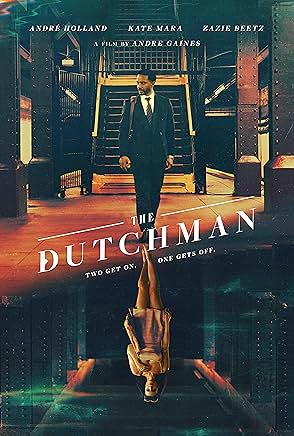

“The Dutchman” (2025) is a meta sequel and/or contemporary adaptation in spirit to Amiri Baraka’s 1964 play with the same title. Set in New York, a Black married couple, Clay (André Holland) and Kaya (Zazie Beetz), are seeing a therapist, Dr. Amiri (Stephen McKinley Henderson), after Kaya had an affair, and Clay is paralyzed because he cannot get over it but will not split and is trying to preserve the marriage. In session, Dr. Amiri suggests that he even the score. After Kaya leaves, Dr. Amiri gives Clay a play to read that may help him, but before he can read it, the play materializes in the real world and casts him in the role of one of the characters. Though seeing the red flags, Clay accepts the invitation of a fellow subway passenger, Lula (Kate Mara), which he regrets after he realizes that he is in danger when it is too late. Will Clay break free from his assigned role? I was so excited to see this movie because of the excellent cast, but I kind of hated it though the idea and some of the execution have enough merit to warrant a favorable ruling. Cowriters Qasim Basir and Andre Gaines, who directs well, needed to get weirder, dump the dated dialogue and get a woman to share the writing burden so the provocative idea did not get lost in some problematic, heavy-handed moments.
I’m unfamiliar with the original play, which most people probably will be, but Clay is nothing like the original character who started this cycle. He is married and not young and inexperienced, just used to operating under different rules and discombobulated from his world being turned upside down. Basir and Gaines put their thumb on the scale to ensure that Clay would remain likeable and not have moviegoers think that he is dumber than dirt for going anywhere with a woman carrying a knife. How? He has a wife who has an affair. It is really her fault. While it is problematic to reach past a man’s misgivings and use a woman to deflect judgment, it could have worked if they did a better job of fleshing out the affair storyline, but they deliberately stop Kaya from finishing her story and keep it vague. How does she know the affair partner? How long did she leave? How long have they been seeing the therapistWomen are the real culprit in this movie, a concept that dilutes the story’s momentum.
Perhaps the writers intuited objections to just blaming the wife, so they make the therapist and Kaya act as if Clay should be satisfied that she came back, and she should be the aggrieved one because she thought he was having an affair because he worked too much. What?!? ? People do not just have affairs based on a misunderstanding. Again, it could work, but it does not because their relationship and its problems are underdeveloped. Kaya is not crucial to the plot as the filmmakers executed it, but they clearly believe that her love and presence give strength to Clay so he can break the cycle. This assertion is not a visceral fact. It is more verbalized than shown. The writers are torn and do not want to leave a Black woman in the cold as a bad guy, so they create a redemption arc. We are not in France. In the US, people are very moralistic, and most people would not be rooting for them to stay together or see Clay as unreasonable for his reaction. According to Reddit rules, “The Dutchman” characters are ESH. Instead, they should have trusted Holland more to strike that balance instead of adding fat to the script, the wife storyline, though who would not be tempted if it meant getting a chance to work with Beetz. We get it.
Holland has always been a great actor, but his most recent work, “Exhibiting Forgiveness” (2024), may be my favorite, and he is just getting better. It feels as if Clay would be at war with Holland’s character in “Love, Brooklyn” (2025). Clay is a respectable rule follower believing that it will confer a better life free from tribulation, but he is in shock over the break in his social covenant. He is gentrification or respectability politics cleaning up Harlem. He knows that Lula is trouble, but he decides to do the wrong thing for once. He takes a bite of the apple, which is an obvious reference to Eve and original sin. I normally enjoy Biblical allusions, which is faithful to the play, but it was too heavy handed for me.
When Clay descends into the subway station, Gaines uses the visual language of “The Matrix” (1999) to symbolize that shift turning the palette from warm colors to a shade of green from the sci-fi classic. Clay is a most unlikely Neo figure. If you look closely at the posters in the subway station, there is an image of Lula before Mara appears on screen. He is in her world, which is why the cops decide to search him. In the train, there are posters about breaking the cycle. If you look closely at the other passengers, you can see their unease and in later scenes, one billed as Crazy Lady (Laurie Crompton) is mouthing words as if trapped and reciting something to herself to keep sane. Bear in mind, she initially seems like a normal person. Lipreaders, report what she says please. Lula’s presence disrupts time, and in the subway, it creates a loop. The cycle in question is a white woman has the power of life and death over a Black man.
Mara and Holland commit to their over-the-top dynamic and the script’s dialogue between Clay and Lula as if it was good (“Let me bop it on you again.”) Their exchanges are reminiscent of reading recent Stephen King books: the slang is outdated, but it was cutting edge when he started. It almost makes the movie unwatchable and detracts further from an already flawed execution. If it makes me a barbarian to reject the original lyrical language, which everyone working on the movie clearly treasured, I lost poetry in law school and will accept condemnation. The biggest mistake that “The Dutchman” makes is not updating the situation and the language. Lula sounds like a racist, but contemporary racism is more subtle. Yes, they are stuck in a cycle, but it should be a cycle that resonates with today’s audience, not an older demographic that may not even watch this movie. Why remain faithful to the source material now! Also, Gaines never makes “The Dutchman” appear to unfold on a hot day.
Basir and Gaines underdeveloped Lula, but their best executed and most provocative idea is making her into a supernatural figure. They choose to flesh out the parts of the play that are left unspoken in the play: their tryst, the party, Warren (Aldis Hodge finally in a role when his character is not in danger of being put to death) and everything preceding the second train ride. Warren was the most surprising element in “The Dutchman.” Has Hodge ever played a morally ambiguous character? It suits him. The most intriguing, revolutionary concept is the idea of whether he is truly Clay’s brother/friend. It is the most countercultural concept that rarely gets examined in movies unless it involves a friend sleeping with another partner or work. Unfortunately, they are less interested in Clay’s friendships than romantic relationships.
Older than she appears, Lula is a Lillith, succubus figure. Gaines shoots them ascending the stairwell from Lula’s apartment with the basement light making everything red as if they are emerging from the mouth of hell. The sound department makes Lula’s laugh sound demonic. The train sounds like her scream. She claims to do one thing, lie, and only want love. This motivation does not resonate. Substitute love for serve or worship, it could work. Dr. Amiri considers Lola to be his enemy.
If you get a therapist who looks like Henderson, run! It is kind of amusing that he plays a therapist in “The Dutchman” and “Beau Is Afraid” (2023), and both have an agenda other than caring for their patient’s well-being. Basir and Gaines see him as a benevolent figure who watches over Clay and appears in the body of anonymous Black men around him, but only Clay and Lula see his identity. Dr. Amiri’s name is not mere homage to the playwright, but he is playing a fantasy version of the playwright. It is a new God versus Satan story with the writer as God and Lula as the devil except again Basir and Gaines should see Amiri as a more sinister figure than they write him, but it could be the point. When the truth is revealed to Clay in a theater, composer Daniel Hart seems to be alluding to “The Shining” (1980) or something Kubrickian.
“The Dutchman” is really a battle for the life and soul of Clay, which feels like a different thesis from the play, so he can stop the cycle and save future Black men from Lula’s clutches. If Basir and Gaines had committed to the supernatural or horror aspects of their story, their reimagining could have soared. Based on my cursory online research, there are no threats of filing false police reports against Clay in the play. Instead, the writers chose a historical tragic truth older than Emmett Till of false accusations leading to lynching of Black boys and men. If they had updated the concept with an extrajudicial execution instead of just using its trappings with cops as Lula’s instruments and Clay’s supporters using today’s tools of counternarrative to presumed Black guilt, it could have worked, but they remain faithful to Amiri’s original concept.
While this historical fact is still germane, now there are also stories of Black men who get away with violence if they have enough fame and/or money. Only 2 to 10% of reported sexual assaults are false, and with an alleged rapist in the highest office, almost nightly news of sexual misconduct from the powerful of all races and a war on women, it would have been wise to not promote a narrative which is not faithful to the play and unintentionally supports an agenda used to quiet victims of sexual assault. Being as good as the worst, even if it is a way of embracing humanity to alleviate the dehumanization and mechanization of exiled into perfection, may be a key to fighting Lula, but it also feels wrong though not the way it is applied in the denouement.
For all its flaws, “The Dutchman” does a better job of exploring cycles than “Candyman” (2021), which has more in common with “Manderlay” (2005) than intended. It is inherently a problematic concept to suggest that Black people are the authors of their own persecution, which is ahistorical and was not a part of “Candyman” (1992) or likely Baraka’s play, but in Basir and Gaines’ reimagining, Lula exists before the play and only gains flesh through Dr. Amiri’s imagination. He is culpable. Substitute fear instead of imagination, and by Jove, they would have gotten it. Another generation can rise above the fear of an earlier generation with the victories that the antecedents won. Clay can finally win if he becomes imperfect, which is symbolized when he jumps the turnstile without reprisal, the reprise to when he initially entered her realm. Clay does not just speak to his malleability in society to survive, but feet of clay and also Adam’s origin as God’s sculpture from dirt and is echoed in the figure in the dollhouse size theater.
When “The Dutchman” ends, it toys with the idea that it was just a dream. Boooo, tomato, tomato. Basir recently triumphed with his solo film, “To Live and Die and Live” (2023). “The Dutchman” is Gaines’ first foray into directing and writing fictional features though he has plenty of experience producing scripted work, which includes Basir’s earlier referenced film, some horror (“Da Sweet Blood of Jesus” and “Children of the Corn”) and “The Knife” (2024). Gaines normally directs documentaries. Watching their joint venture felt like watching “Goodbye June” (2025) as if they lacked a way of conveying organic human experiences on the screen, which is not true. If they have a fatal flaw, they do not have enough experience in horror and are too deferential to Baraka’s work, which makes sense considering Henderson was his friend. A for effort.