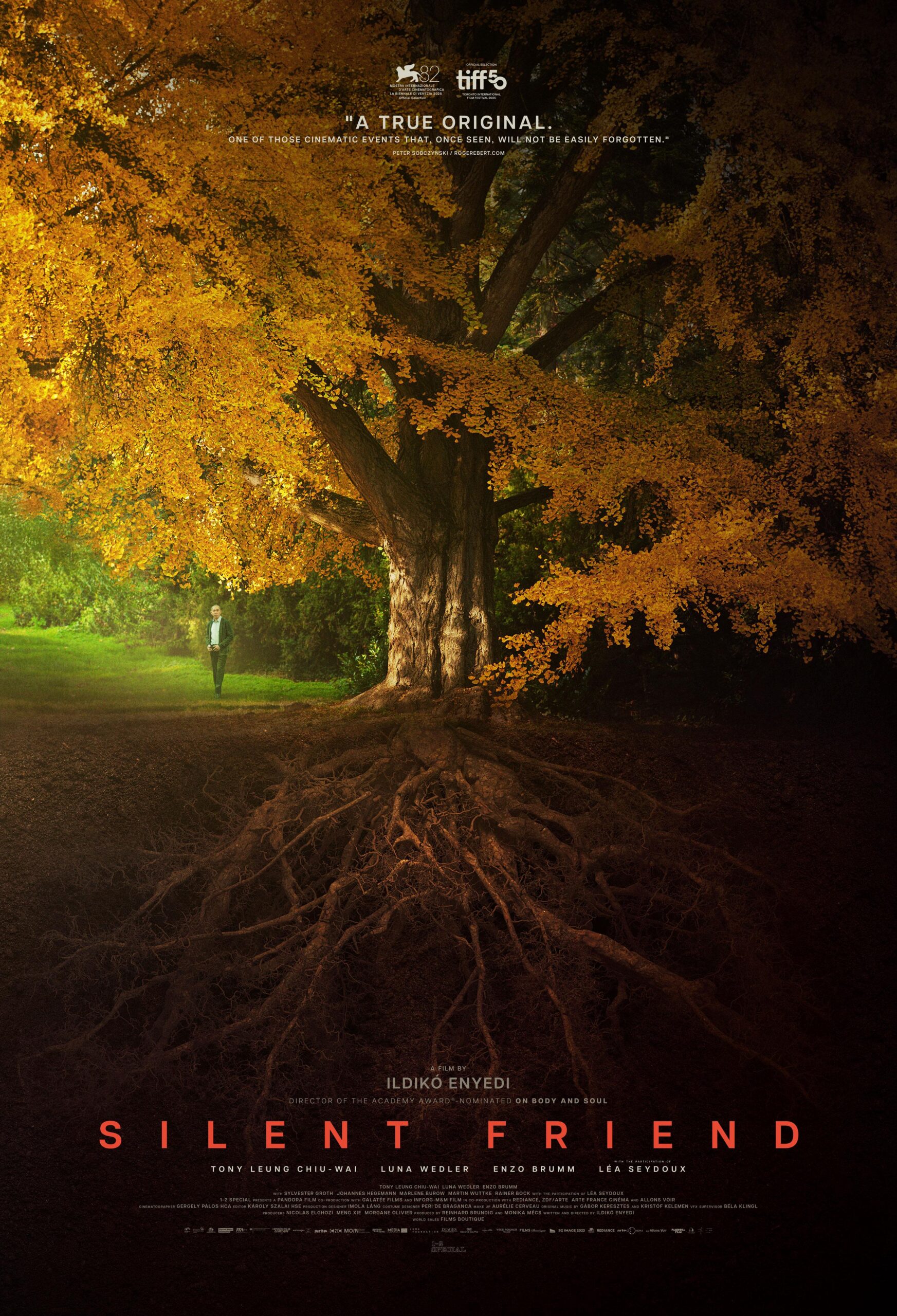

One character in “Silent Friend” (2025) asks, “what would you do if you wanted to connect with a being but had no common language?” Though set in Germany at the University of Marburg in the Botanischer Garten Marburg, the writer and director Ildikó Enyedi is Hungarian. It explains why a film with a similar presence as “Sound of Falling” (2026) feels so much more alive since Enyedi focuses more on life revolving around a gingko biloba tree born in 1832 instead of a rural farm filled with problematic people over the course of one-hundred years. It is also easier to digest though the film would have been better if Enyedi did not start wondering into sci-fi territory and tackled her subject head on without making it so approachable.
Disclaimer: I did not get to see “Silent Friend” two times, in one sitting or on the big screen so it is possible that the praise would be higher if conditions were different, but the average movie goer will have a similar experience so maybe this assessment is better than usual for the average person.
“Silent Friend” takes place during three different eras: 1908, 1972 and 2020 with a chronological storyline within each year, but the actual events are interspersed throughout the narrative presented to the audience in the following order: 2020, 1908, which is shot in black and white then 1972. While the dates are not obvious, they are easily inferred while watching the movie. In 2020, neurologist Tony Wong (Tony Leung Chiu-wai) leaves his research in Hong Kong for Marburg just before the Covid pandemic hits, which empties out the campus. Without human subjects, whose brain waves can he analyze? After watching Dr. Alice Sauvage (Léa Seydoux) do a TED Talk, he decides to make the tree his subjects much to the horror of Anton (Sylvester Groth), a random omnipresent employee on campus.
This era is my favorite sequence, and if the whole movie took place at that time, it would have been an undiluted success. Enyedi enjoys using a still camera on a tripod and keeping it focused on the relevant subject to show what the person is looking at then alternating to the other side to gauge the character’s reaction then switching back and taking turns blurring the foreground with the more distant subject. Then Enyedi cuts and changes angles to show the broader context of the space that the character is inhabiting before reverting to the preceding scene and changing focus. This visual language conveys a quiet exchange between the tree and the person even if the person is unaware of it. For instance, after a dinner during his first night in Arburg, Tony pukes on the tree. Later Alice explains that female trees are pungent, so it implies a question: how did the tree interpret their first encounter? Did the tree appreciate the warmth and think of Tony as a fellow woman.
Also Leung is the kind of actor that anyone would be lucky to watch knit a sweater. There are some lighter moments in the artsy fartsy film when he meets his interpreter, Jule (Yun Huang), who is a hot mess, and whom Tony speaks better English than. In a virtual conversation, it is possible that a naked man just casually passes in the background while she is talking to her boss. She is the most unintentional worst. Tony’s complete patience with humoring her reveals a lot about his character. “Silent Friend” does not spell it out, but a movie goer could infer that Anton’s hostility could originate in anti-Asian sentiment with the virus. He is not a colleague but feels entitled to interfering with his work. It is easier for Tony to communicate with the tree than Anton, but he finds a way.
A lot of people assume that communicating with another being without a common language refers to human beings and trees, which is the cover story, but each era reflects how the dominating sensibilities hurt someone who is an outlier based on their characteristics and that outlier’s inability to commune with the mir mainstream contemporaries. Grete (Luna Wedler) is the main character in the 1908 storyline, and she deals with aggressive sexism and sexual harassment without it being physically graphic. All the violence is contained in words. During Tony’s sequence, anyone well versed in film theory will recognize that the scientific dialogue is reminiscent of descriptions about filmmaking. Tony explains, “We perceive the world around us in quick focused moments.” Grete stumbles upon the magic of photography, which acts as a bridge to the career that she wants over gender discrimination. Photography’s usefulness becomes the common language between the sexist students and faculty and her desire to study botany. It felt as if Enyedi may be reaching for an even higher cinematic meaning like Bi Gan’s “Resurrection” (2025).
The shakiest section involves Hannes (Enzo Brumm) in the Seventies. Maybe Enyedi was trying to be egalitarian and wanted German male representation but could not figure out how to imply that he is innately an outlier like Tony or Grete. So this section is dialogue heavy with Hannes expressing annoyance at the campus radicals and equating them with the Bible thumpers back in his rural hometown. He has a crush on Gundula (Marlene Burow), who is trying to communicate with a geranium as her test subject. It felt as if Gundula should have been the main character in the Seventies section. She had the real relationship with the geranium, and Hannes felt wedged in.
When she goes away, she leaves Hannes in charge of the geranium. Here is where “Silent Friend” kind of goes off the chart in depicting how plants communicate with people. If Gene Roddenberry got something wrong in his depiction of other species in “Star Trek,” it was his proclivity for depicting other species as humanoids and sexy. If “Project Hail Mary” (2026) was fresh, it was creating a very different species though it punked out a bit on the interspecies communication front. In the Seventies section, Enyedi basically reverts to a human based, tangible, not a visually lyrical embodiment of language, and it made the rest of “Silent Friend” challenging to watch. It completely severed the suspension of disbelief and destroyed the film’s artsy fartsy cred. In another movie, it would be darling, but it cheapened the rest of the film. It reminded me of if “The Happening” (2008) had a plant ally for the human beings.
While people describe the tree and plants as the main characters, it is inaccurate. They are supporting characters, and a movie told exclusively from their point of view would have the ambitions of “Dunkirk” (2017) with no solid human thread, the narrative style of Chantal Akerman and the abstract visual language of Terrence Malick. There should be no interior shots. The main supporting characters would not be human beings except as villains. J.R.R. Tolkien was closer to the mark with his ents. Plants do talk to each other and feel pain. So adjust your expectations if you are expecting an experimental film otherwise you may be disappointed, and no one should walk away from “Silent Friend” with their head down.