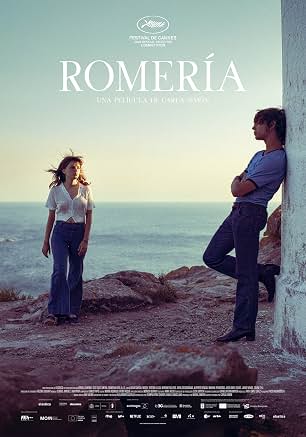

“Romería” (2025), which translates to pilgrimage, is director and writer Carla Simón’s third film, an autofiction story about an eighteen-year-old woman, Marina (Llúcia Garcia in her film debut), visiting her father’s family for the first time in her life from July 16 to July 20, 2004. To get context for the location that she is visiting, she reads entries from her mom’s diary, which are based on Simón’s mother’s letters, from the Eighties and uses her video camera to memorialize the visit. As Marina meets more people, she reassesses her relationship with them and tries to piece together the real story of what happened to her parents. Will she accept what they give her or get what she wants? While the story is innately powerful, it may mark the first time that a Spanish filmmaker’s magical realism sequence did not entirely work seamlessly.
Marina starts the experience trusting, enthusiastic and authentic but as “Romería” unfolds, she starts to withdraw as she notices the growing chasm between how people present themselves and who they really are. Gradually she openly challenges them and stops obeying the rules of her paternal family’s version of polite society’s rules. Garcia is a natural, and during the magical realism sequence, it is easy to distinguish between Marina and the character that she is playing in that sequence. It is Garcia’s first time at bat, and she just knocks it out of the park. When the film falters, it is not because of her. Also, it is a huge responsibility to play a character that is a younger version of your boss! Her character’s motivation sounds clear and straightforward: get some paperwork fixed so she can get a scholarship for school. Should be a piece of cake.
“Romería” introduces the family in a naturalistic way. Her uncle, Lois (Tristán Ulloa), his wife Denise (Celine Tyll), and their three sons, Nuno (Mitch Martín), who resembles Marina’s father, Basilio (León Ronmagosa) and Eugene (Hans Eomagosa). They warm up to her instantly and are frustrated when their fellow family members do not mirror their behavior, but they also perpetuate a gap between the knowledge that they possess and the truth with ambiguity about the intention for this lack of alignment.
Marina’s aunt, Olalla (Miryam Gallego), has a similar sense of style to Marina’s paternal grandmother, Rosalia de la Cruz (Marina Troncoso), and gifts a tangible connection from the past to Marina, but when Marina meets Olalla’s daughters, Carlota (Lia Mora), Sabela (Helena González) and Antía (Gala Rodríguez), they reveal a crucial detail about why the family has not been a part of Marina’s life and why the family treats Marina as less than a full fledged family member. Any movie goer familiar with the Eighties will immediately figure it out based on the girls’ clues. Olalla’s husband, Ramón (Toño Cassais) does not appear until later in the film and is barely of note. Olalla’s sense of family and life prioritizes image over genuine warmth. Aunt Virxinia (Sara Casanovas) is physically warm as if she is trying to make up for lost time and speed up the process of acting like family, but her demeanor is more of a reflection of her current insecurity in society and conveniently forgets to compare herself to Lois, the one family member with an objectively better life.
Once Marina meets her other uncle, Iago (Alberto Gracia), who apparently knew her father better than anyone else, the family divide is spelled out for the audience and Marina regarding what happened to her parents. The costume and wardrobe department gives obvious clues from the moment that Marina leaves the ferry in the opening sequence, but only if you know what to look for even if you do not trust your instinct. It explains why her paperwork needs to be fixed, but everyone in the family acts as if she is a welcomed member. The biggest turning point is when she finally meets her grandparents, which includes the patriarch, Alfonso Pineiro (José Ángel Egido). The family reunion is the most riveting scene in “Romería” and ranks as high as Roman Polanski’s “The Fearless Vampire Killers” (1967) of showing all the rules that lead to self-abandonment and cooperating with your own destruction. Acts of kindness disguise incredible cruelty. Simón’s blocking in the scene is brilliant even the order that the grandfather greets the children, and how the children choose to line up, which reflects their understanding of what is happening.
Unfortunately, the release of “Romería” follows “Forastera” (2025), which comes at the idea of grief and identity from a completely different angle and the prior handles more difficult circumstances. The latter manages to address the elephant in the room during the magical realism sequence without crossing a line. The casting choices, specifically the Adam and Eve to the fall sequence, had the effect of hijacking Marina’s story. The overall sequence does work if it exists as Marina’s imagination creating a film about her parents’ existence, an observable experience so she can know the unknowable. Her entrance into this fantasy worked amazingly well. The lyrical dance scene feels like the biography of a generation and is spiritually accurate.
The experience of watching “Romería” feels like a losing battle with the siren call from your bed. While it is a gorgeous movie embedded with a relatable story, especially as Marina decides between compromising or standing her ground, the diary reading interludes with clips from Marina’s video recording of her family vacation contributes to the deliberate pacing of the story. While it is excellent preparation for the audience to get used to asking when they are and who is addressing them before the denouement’s magical realism sequence, the texture of these scenes slows the pacing and makes it harder to reenter the present.
Simón does a superb job of explaining the innocence and inexperience of the young people of the early twenty first century compared to their parents. Marina refuses the modest recreational diversions that her other cousins enjoy because of her issue of inheriting the judgment cast on her parents. Iago delivers a much-needed speech to humanize her parents and others with that similar experience instead of pathologizing it.
As a lawyer who used to specialize in paternity issues, I love that “Romería” parallels the legal issue with Marina’s lack of access to her personal history. There is a visceral frustration that everyone else knows more about her and her parents than she does and an idea that she should be satisfied with what she received. For all of Lois’ flaws, he is willing to do the hard work to ensure that she gets what she needs, embrace discomfort and take a stand to do so. His last scene with his arms crossed and watching over everyone warmed my heart.
If you are unaccustomed to watching foreign films, “Romería” is probably not the movie to start experimenting. If you are a fan of Spanish movies or personal history stories with subtle family tension and nuanced conflict, this movie will be perfect for you, but bring a coffee.