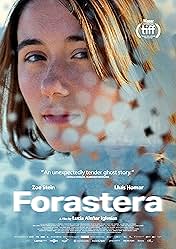

“Forastera” (2025), which means the feminine form of outsider, stranger or foreigner in Spanish or Catalan, expands the short film “Foreigner” (2020). It will leave movie goers asking which character is the title referring to. Before her senior year, Catalina (Zoe Stein), nicknamed Cata, and her sister, Eva (Martina Garcia), are spending their summer with their maternal grandparents, Tomeu (Lluís Homar) and Catalina (Marta Angelat), but when she is the first to find her grandmother dead on the steps, she begins to change and act like her namesake, which her grandfather and mother, Pepa (Núria Prims), notice. Stein is the second coming of Saoirse Ronan. Spanish filmmakers are the best at magical realism, and writer and director Lucía Aleñar Iglesias in her feature debut easily joins the ranks.
“Forastera” primarily rests on Stein’s young shoulders, and she seems to handle the weight effortlessly. Without special effects, just using her physicality and tone of voice, her character seems to transform from Cata to Catalina and vice versa. The unspoken question is whether Cata’s changes are supernatural or a normal way of coping with grief by amplifying commonalities that always existed to feel closer to her deceased loved one. In one dinner scene, Iglesias tips her hand briefly regarding the answer, but it does not matter because movie goers will still wonder. Even before Catalina’s death, the halogen light in the kitchen flickers ominously. There is a sense of foreboding, especially at the threshold between the exterior and interior. The latter use of natural light and shadow flickering felt reminiscent of “Hereditary” (2018). Instead of horror, Iglesias uses these possible supernatural indicators as comforting. What if you wanted someone to haunt or possess you?
Even though “Forastera” only spends a short amount of time with Catalina, thanks to the cast’s understated acting, the naturalistic dialogue and Iglesias’ subtle composition, specifically focusing on hands alone in some shots and how the characters use them to express love to another character, it does feel as if Cata has become Catalina. Angelat lays the groundwork for Stein to build on before Angelet has her final curtain call. It is a heavy lift, but she nails it. The best actors use their hands to embody their characters and even in long shots, can make others’ eyes drawn to them so Iglesias’ creative choice only underscores that phenomenon.
After you watch the movie, (re)watch the trailer for “Forastera,” which does an excellent job of condensing moments that are more spread out in the story to flesh out what is going on if you watch the film and have the urge to rewatch it to see if it holds up on repeat. In the beginning of the movie, Cata spends more time with her sister and people her age and possibly having her first romance. She also admires how her grandparents interact with each other, which includes another focused shot focusing only on their hands holding the others’ with her grandmother smoking a cigarette with her free hand. For Cata, they are aspirational, especially since her father is not mentioned. If she is mimicking her grandmother to reconnect with her, she is also using her grandfather like a role-playing proxy for what she wants in a future partner. If she is not, they have a second chance to at least be together.
It is a provocative premise without becoming prurient, sensational or pushing the limits of good taste because if Cata becomes Catalina, then a granddaughter and grandfather are potentially having an inappropriate relationship. This concept was explored in “Went Up the Hill” (2024) as a horror device with no blood shared between the lead characters, but there is no willful, unwanted possession or horror elements. Fortunately, “Forastera” never goes all the way there, but the audience may find themselves unconsciously holding their breath and thinking, “nonononononono.” Homar walks a tight rope and going too far either way would ruin the story and turn his character into a villain. Tomeu already strains nerves when he behaves likes a food critic and does not lift a finger to feed himself. Iglesias helps when some shots are done from a character’s point of view, but Iglesias does not reveal until a few beats later whose eyes the audience is seeing through. When Pepe walks into his room while the two are having a photo session, it did feel for a second as if there could be a backstory explaining why Pepe jumps to alarm instead of assuming that the two are engaged in innocent dress up like before, and if her reaction could explain the clear long-standing tension between father and daughter. Let’s assume that Iglesias is not going there, and “Game of Thrones” made everyone into worst case scenario thinkers.
Lean towards a mournful, lyrical, poignant “Freaky Friday” instead. Garcia is underutilized, but if Iglesias had to choose between a sister and a boyfriend, “Forastera” is the exception when choosing the guy makes more sense, especially since Tomeo is his foil. Max (Nonni Ardal Hammarström) is a year older than Cata and is appropriate for a summer romance, but when he tries to wade in deeper waters, he discovers that he is not up to the task. Hammarström was given a huge responsibility to not come across as a callous jerk or easy to dismiss teenage boy, and he handled his job perfectly. He conveys that Max is a person who has not encountered death, and if any viewers have, they will understand that people far older fumble the ball. It is a subtle character study that should not be overlooked.
There are so many elements that contribute to making “Forastera” work. Costume designer Pau Aulí uses clothes to convey the transformation with one gorgeous dress. Also, even though Prims does not get a lot of screentime, but her character’s wardrobe is so unique, feminine and enveloping that it tells a lot about the character. Choosing the location of the home and beach locations make the situation simultaneously seem ordinary and liminal with the uninterrupted blueness of the horizon. Iglesias uses the grandparents’ homes doorways to frame the infinite space. Cinematographer Agnès Piqué Corbera’s nighttime beach scenes are reminiscent of cinematographer Claire Mathon’s “Portrait of a Lady on Fire” (2019). Composers Filip Leyman and Anna Von Hausswolff’s score evokes an otherworldly, rush of wind haunting during interlude scenes as if the threshold between life and death existed in that area between the patio and the rest of the interior. Editor Paola Freddi and Iglesias may think too highly of its audience because there are a few rapid cuts, which are supposed to depict something that Cata sees which spurs an elevated emotional reaction, but it is hard to discern what it is if you are not watching it on the big screen (I saw it on a television screen). Here is where the trailer helped a little because there is a juxtaposition of scenes that are not adjacent in the movie.
Even if “Forastera” tells a story of grief and remembrance that you do not relate with, the underlying sentiment will resonate if you have experienced the loss of a loved one. It is an empathetic, sensitive and transcendent work that proves that it is possible to push to the furthest corners without falling off the edge.