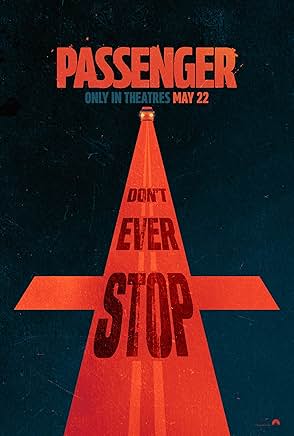

“Passenger” (2026) is about a young couple who break all the rules of the road (they drive at night and stop), which means bad news. A man (Joseph Lopez) who looks like a cross between Rumpelstiltskin (Robert Carlyle) on “Once Upon a Time,” but not as verbal or hot (sorry) spends the whole movie psychologically torturing them and plans to kill them. Will these two crazy kids make it out alive and together? It is a solid enough movie with some great direction and sound design, but the story feels as if it runs out of runway before it lands in this “Final Destination”-lite flick.
The acting is functional and feels naturalistic, but nothing particularly outstanding. The MVP is Melissa Leo who makes two appearances as Diane Larsen, a van life veteran of twenty years, who is the equivalent of the older man sitting at the gas station and warning teens not to go to their intended vacation spot notorious for being the site of mass murders. You do not need a character to point out the obvious when the signs are all there. Mistake number one: Maddie (Lou Llobell) and Tyler (Jacob Scipio) decide to leave a huge, exposed brick apartment in Brooklyn for (checks notes) isolated areas. Mistake number two: they decide to live in a van, which Tyler adores, and Maddie adores Tyler so she thinks that she can suck it up. She cannot suck it up. Mistake number three: living in a van means living on the road and winding up in precarious situations such as crossing paths with a demon. It also means hanging out with large groups of strangers who may view them with hostility, but it is a horror movie, so it is because of demon attachment, not racism, though they are the only brown people for miles, and it is set in the US where sundown towns still exist. The Green Book (not the movie) existed for a reason.
“Passenger” is cowriter T.W. Burgess’ first rodeo and cowriter Zachary Donohue’s second feature (the first was “The Den”) so let’s give them a little leeway for not imbuing the story with any deeper significance of people of color on screen getting terrorized and killed on the road. Instead of a natural disaster saving a relationship, it is a demonic presence forcing them to hate van life and cling to the bosom of conventional civilization and conform. Though Tyler instinctually thinks that she is cuckoo for cocoa puffs, he shows some promise when he realizes how shaken up Maddie is and snaps into solve it mode ready to kick the air if he must. Before that, he is a bit of a red flag for being oblivious and dismissive of her concerns, but Maddie shares some blame for not speaking up before disposing of their personal possessions. Other than being an attractive couple, they seem dumber than dirt about who they are, who they are to each other and what they want out of life. Is it a new franchise called “Touched by a Demon” where a demon wreaks havoc thus helps couples communicate and make it work?
It is a bit saucy to think that you can opt out of a house and the rat race only to discover that you did not escape the prospect of a haunted house, only exchanged the option for a haunted van, but the co-writers litter, toss that idea on the side of the road and decide to aim for something more needlessly lofty. They could have kept it simple, and it would have been just as or even more effective. The rules are unclear in practice because there is plenty of driving at night with zero consequences among many other things. There is a religious theme in “Passenger,” but it feels half-hearted as if a huge amount of the mythology ended up on the cutting room floor.
At Burning Van (instead of Burning Man, get it, GET IT), Maddie takes a religious pamphlet, considers visiting a traveling church and a man leaning on a cane is staring at her as if he knows something. All that portentousness goes nowhere. The St. Christopher medallion gets used a lot like a crucifix stopping a vampire complete with burning on contact. In the beginning, the screen shows the prayer, “Protect me today in all my travels along the road’s way. Give your warning sign if danger is near so that I may stop while the path is clear. Be at my window and direct me through when the vision blurs from out of the blue. Carry me safely to my destined place, like you carried Christ in your close embrace.” The story of Saint Christopher’s first interaction with this demon is told so quickly during the story that you may be able to sue for the film for inflicting whiplash. It is a cool, but underdeveloped mythology that never really resonates, especially when the Passenger enjoys using its telekinetic powers to force his victims to stretch out their hands like Jesus on the cross. Oh, blasphemy is so twentieth century. So it begs the question, why not just use the cross and the medallion because even Saint Christopher did? So Catholics may eat well if they think the mythology gets it right, but everyone else is going to leave scratching their heads.
The good news is that director André Øvredal elevated the material with a collection of well executed sequences, specifically Maddie in the gym parking lot. He combines quotidian danger with supernatural, oneiric fear, and I do not want to ruin the delight that you will have while watching it for the first time. The opening scene is mostly shown in the trailer so let’s address that one instead. When a friend returns from urinating on the side of the road, he discovers that his friend, Daniel, is no longer in the driver’s seat. The camera stays in the car and turns to follow his movement as he circles the car. The use of the lighting adds a rhythm that ratchets up the tension, particularly the red and blinking of the car’s blinkers. If there is a flaw in this sequence, it appears near the beginning when Øvredal reveals a flash of the ground that is getting watered, and it is too rapid to understand what he is trying to convey. Was there something on the ground that he wanted the audience to see that revealed a crucial clue about their impending doom or a redundancy to underscore the dialogue? Otherwise, there are some great images that verge on original even if they also feel like references to Pennywise though it adheres more to the road imagery or “Poltergeist” (1982) during the “Roman Holiday” (1953) sequence.
The sound design and composer Christopher Young’s score amplifies the fear with cracking branches and echoes of the Passenger’s solidity. One song on the soundtrack, Studio Musicians’ “Evil Got a Hold On Me,” sounds like chains. The closing credits roll to Siouxsie and the Banshees’ cover of “Passenger,” which of course, and even if you love that group, Michael Hutchence’s cover from the “Batman Forever” (1995) soundtrack or the original Iggy Pop version feels as if it would have fit the horror theme better.
“Passenger” barely got any promotion. There was no screening or screener for critics before its release. While it does not touch the hem of most of the horror movies currently in theaters (see “Obsession”), it is also not bad or unworthy of belonging in the genre. It could have been better if the filmmakers were aware of what the story did well and leaned on those elements than try to add on unnecessary elements without retrofitting it to blend with everything that came before. It is a film too tentative and generic for its own good, but Øvredal makes it worth your time. It also does not commit a cardinal sin that a certain widely anticipated horror film does with the promise of original horror before becoming laughable and feeling like a waste of time.