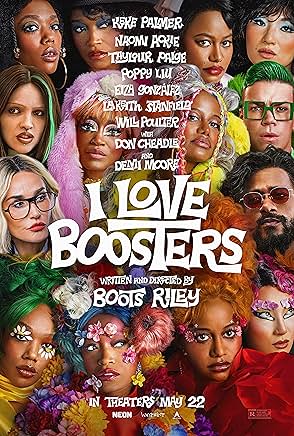

“I Love Boosters” (2026) is Boots Riley’s latest film, and it makes “Sorry to Bother You” (2018) seem downright conventional. Aspiring fashion designer, Corvette (Keke Palmer), is such a huge fan of Christy Smith (Demi Moore) of Metro Designs that she and her two friends, Mariah (Taylour Paige) and single mom Sade (Naomi Ackie), exclusively steal clothes from Metro Designs then resell them at a lower price. Their exploits are so successful that Christy Smith notices their handiwork, dubs them the Velvet Gang, wages a social media war against them and uses psychological warfare to get an advantage, but as she steps up her tactics, Corvette’s goals begin to shift as she and her friends recognize that they do not know each other as well as they think that they do. How can boosting clothes make Corvette feel connected and known?
If you think too long while watching “I Love Boosters,” you will miss fifty things. For some people, that kind of firehose creativity is a turnoff. For others, it is a welcome challenge, but there are not always opportunities to watch movies repeatedly, use subtitles or have time to reflect about a movie, and it could leave you feeling constipated while trying to process Riley’s latest film and keeping all the balls in the air. So, if you just want to watch a movie that feels like a live action “Looney Tunes” cartoon, laugh a lot, enjoy a feast for the eyes, and get a very rushed lesson in Riley’s brand of how to fix what ails the world, you are in for a treat. Everyone else should either buy two tickets and schedule some time afterwards to think about what you saw.
“I Love Boosters” feels less about characters, but concepts that Riley wants to explore, and they sound like him, not individuals. There is a sense that no one, not even Christy Smith, is immune to the uphill struggle, overstimulated, unnatural life that we lead except Riley takes those concepts, makes them literal and visually sumptuous. Unlike his villain in “Sorry to Bother You,” Christy does not seem as if she is having a good time being on top of the food chain. She lives in a leaning skyscraper so just living in her home/working in her home is a nonstop core work out and even she is not immune to sliding and losing her hierarchal status. She feels like a feminized combination of Steve Jobs meets Elizabeth Holmes meets Andy Warhol. Moore disappears into the role. When Christy airs her public grievances, her barely veiled racial aggressions and exhaustion come from a place that feels real. The people running the world are really working hard and not having fun wrecking everyone’s lives while not realizing that maybe stopping and taking a step back would make everyone, including themselves, way happier. It felt as if the assistant, Jamie (Kerris Dorsey), was being set up to play a bigger role, but set that expectation aside because it ain’t going to happen.
Corvette and her crew are more recognizable and relatable. Because life comes at them fast, mostly in the form of a kaiju sized ball of worry made from all the elements that makes her life difficult, there is not a lot of time for them to sit still without devising their plan for their next heist. When they lose a crucial member of their crew who distracts the store employees, they shake things up, easily get jobs at their next target and meet Violeta (Eiza González), an employee who wants to unionize and has an eye on the big picture, but they do not trust her. Though they have different objectives, they do trust and join forces with Jianhu (Poppy Liu), who has a better method of boosting clothes. Christy accordingly steps up her security which leads to a gonzo grand finale that mixes horror, sci-fi and stop motion animation. All the actors, production designer Christopher Glass, costume designer Shirley Kurata and set decorator Lizbeth Ayala do a lot of heavy lifting to flesh out the characters to make them feel unique though three-dimensional may be a stretch. They do not seem to exist in a tangible way except in relation to Christy Smith, which may be a fact, but also a flaw of their existence that “I Love Boosters” never overcomes. The care is devoted to the idea of how these characters will stop Christy’s global and personal exploitation.
There is only one problem. The catharsis of connection through action feels theoretical, not visceral, because not enough deliberate groundwork is laid down from the beginning of “I Love Boosters” to the end to make it feel as if the solution fixes everyone’s problems. It does not even feel as if it solves Corvette’s specific problems. Instead, it becomes a vague sense of people coming together to work for a common purpose. Is it what we yearn for? Yes, but there is too much hurly burly for it to land. It is broad. When the ridiculous conspiracy winds up being the truth in “Sorry to Bother You,” it worked on a surreal level for the protagonist and in the story overall. Riley sprinkles that feeling throughout this movie, and the final reveal about the boosters’ last objective, the expensive suits, works, but not as a solution to a puzzle being solved throughout the film. It is more like a funny footnote.
When subtext becomes text, it is harder to miss the point, but it also means that there is less to take away because the audience did not have to do anything but hold on for the ride’s duration. If there is a message that resonates, it is the idea of losing sight of the people closest to you while engaging in a bigger cause, which is the problem with “I Love Boosters.” Riley flattens the characters for the larger purpose, which may convey political science talking points in a fun way, but does not bring moviegoers closer to the characters. Corvette and Sade are friends because of proximity, but most movies make the mistake of not making a friend group sincerely feel like one before threatening it. On one hand, it is believable because who has time to appreciate people when the business of financial survival keeps everyone busy. On the other hand, it is a movie and does not have to be realistic, so it does not feel as if it is necessary to sacrifice character interactions and development for a broad call to action.
It was a joy to watch how everything unfolded and live in the revolutionary funhouse of Riley’s mind, but if “I Love Boosters” does not hold up as well in a second watch because of the lack of surprises, then leaving the first screening feeling vaguely at sea regarding what to take away from the experience is not just an accident, it may be a judgment. If there is no sense of what each character is like without the struggle and the hustle, then it needed more revisions to work.