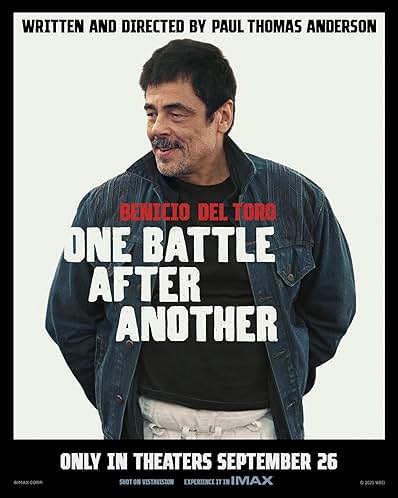

“One Battle After Another” (2025) is elevated Roland Emmerich with a Hallmark message that may wind up like “Civil War” (2024)—much lauded and enjoyed around opening weekend but forgotten during awards season. Thomas Pynchon’s 1990 novel, “Vineyard” inspired writer and director Paul Thomas Anderson which probably seems ripped from the headlines. The French 75 begins the revolution, which ends up being the stomping grounds where the explosive Perfidia Beverly Hills (Teyana Taylor) meets explosions expert, Bob Ferguson (Leonardo DiCaprio). Their relationship turns physical. A baby, Charlene (Otillia Gupta) soon comes, which makes Bob adjust his priorities while Perfidia stays on course. Colonel Steven J. Lockjaw (Sean Penn) becomes obsessed with Perfidia, captures her and cracks down on the group. Sixteen years later, he is determined to finish the job and eliminate Charlene turned Willa (Chase Infiniti) if necessary, but not if her dad or the rest of the French 75 have their way. Which parent’s priorities will Willa choose to emulate?
“One Battle After Another” features an ensemble cast, but the primary players are the trio, Perfidia, Bob and Colonel. Whenever Taylor is in a movie, she is usually the most interesting person on screen leaving a void behind when she leaves. Perfidia is a character that has a huge story arc in a short period of time. Taylor projects more conflicting feelings on her face than the blustering dialogue indicates. If “One Battle After Another” has a problem, it is the way that it depicts revolutionaries in the way that the right wing describes them with more in common with the sixties than present day uprisings. A movie does not have to adhere to realism, but with the right describing regular people as if they are on the FBI’s most wanted list, showing this imagery feels occasionally feels like ceding ground, which is respectability politics, but in a world that already stereotypes people, especially Black women, seeing a militant Jezebel figure is not something that is easy to take in stride without imagining the fallout outside of the theater.
DiCaprio is supposed to be the pleasant comedic relief playing Bob, a lapsed revolutionary who spends his days getting drunk or high. It is fun to see DiCaprio do comedy, and he does not miss a beat. Like all parents, Bob worries about his daughter’s safety, but unlike most parents, he has grounds for his fears. He is the film’s heart. Though a stoned screwup, he lives in the real world, and his inability to navigate the once familiar, ridiculous world of reactionaries versus revolutionaries makes him an everyman for the audience to relate to. Because his heart is in the right place, he can skewer both sides’ sensibilities without repercussions.
Willa is more capable than Bob on her worst day, which is what is unfolding on screen. As the story approaches the denouement, Willa begins to take center stage, and it is easy to get invested in her story. When it is Infiniti’s time to shine, her performance and Regina Hall’s character are the closest that the movie feels to seeing normal people in exaggerated circumstances whereas everyone else feels like a caricature with mixed results, which is the point. Unfortunately, Anderson shoots the two women in extreme close-ups, and it is virtually impossible to tell where they are in relation to each other, which is a deliberate choice, but the meaning behind this positioning is elusive. If Willa was the main character for the majority of “One Battle After Another” instead of sharing the spotlight with a big cast of experienced thespians, Infiniti could have carried the movie.
Besides Willa, Benicio Del Toro as Sensei Sergio St. Carlos may be the best character in the movie, and a rare few may wish that that the movie revolved around them instead, especially since the Sensei is in the center of a real, feasible fight to protect undocumented people and keep them together with their families. The present-day revolutionaries are good people because they care more about keeping Bob and Willa together than their own well-being. Of course, the revolution is just a sensational backdrop to a domestic drama. Perfidia is a bad mom naturally and chooses herself over her child. If you swap sex for love, Perfidia is in the middle of a love triangle. Willa becomes a symbol for the battle of the soul of every character, including Willa’s. The Colonel and Perfidia represent two sides of the same coin: people who choose ambition and ideology over people. Bob only cares about family. As Willa gets exposed to violence and starts training, there is some concern which path she will take, especially since she does not know the whole family story.
While everyone at the screening seemed to love “One Battle After Another,” if you do not, you are not alone. There is nothing innately wrong with using humor to tackle serious issues, but this film does not tackle serious issues. It uses them as window dressing for a father and daughter learning to appreciate each other. Whether it is being a target of racists, a migrant driven underground or a bunch of high school kids subject to interrogations without their adult present, people who are in these predicaments may find it difficult to laugh at the absurdity of it and may feel as if it is using their pain for entertainment. Watching a factory filled with workers suddenly seized may be highlighting a problem, but in Anderson’s latest film, it also feels like part of the punchline. Anderson is not punching down or making fun of the vulnerable but keeping them as part of the nameless margins to function as the equivalent of a natural disaster movie that aims to reunite a family, and it feels exploitive.
Prioritizing family and people over theory is the poignant, resounding lesson. It is a good one, but I’m a little weary of auteurs like Alex Garland using hot button issues to elevate basic stories and have a veneer of seriousness to excuse a desire to indulge in nonstop action. People who sneer at Michael Bay would probably love his films if Bay spun the wheel of news cycle misery, picked a headline and used it for atmosphere. Anderson uses ICE detaining law abiding undocumented immigrants as the backdrop. Willa and Bob are just the whitewashed, radicalized version of those normal families relegated to playing wallpaper and acting as extras depicting families of undocumented immigrants also running and hiding from the feds. It exhibits a lack of faith in audiences, which is well founded, that they would care about an average father and daughter if they did not speak English or look like the majority in their audience.
Penn’s physicality in “One Battle After Another” is memorable, but his character barely feels human. Movies are a bit lazy and one dimensional when it equates military men with bad guys. At least “The Long Walk” (2025) occurs at the end of a war and in a dystopian world, so it is possible to imagine how they got there. A lot of people just have a knee jerk bias to seeing people in fatigues, but the military is not guilty of the worst domestic abuses in this country. They are not masked and grabbing people off the street or behind extrajudicial executions. These movies create an image of the military that is more uniform and sinister than it currently is in the US. The military contains all types of people. A lot of people theorized that the US Army’s 250th anniversary had troops marching poorly as a display of malicious compliance. Also, footage of National Guard units picking up trash are probably their way of protest. The military is not detaining people. “Mickey 17” (2025) is the only movie that gets closer to reality.
While there are people like the Colonel, and the behind-the-scenes machinations of the people that he aspires to rub elbows with occasionally feels like a documentary, the closest that the film gets to portraying a realistic bad guy is the polished Virgil Throckmorton (Tony Goldwyn). Anderson is like a lot of filmmakers that prefers to depict racism as obvious and heavy handed. It creates a false narrative that makes everyone viewing feel superior because they are not like that, but they probably are the people who drag their feet and want to talk to death in a meeting anything that happens to correspond with meaningful equity.
If this kvetching is turning you off, remember that most people loved “One Battle After Another,” and there is a car chase scene that shown on the big screen, will alter your brain chemistry without requiring any substances or 3D glasses. The road is serpentine like a roller coaster and watching it has the same sensation. It is not the only scene filled with a kinetic power that feels visceral, but it comes at the right time.
“One Battle After Another” is well acted, shockingly heartwarming, and often hilarious, but do moviegoers really need to wait almost three hours for a pat lesson of family first. If “Eddington” had a heart, it would be “One Battle After Another,” but at least with “Eddington,” it feels haunting for the right reason. This movie feels disturbing for not understanding its own lesson and spending more time on the revolutionaries and reactionaries than the less flashy migrant families just trying to wind down for the night.
S
P
O
I
L
E
R
S
While I enjoy Anderson’s films, ever since I found out that Anderson balked at casting his mixed-race daughter in “The Master” (2012) because he thought it would be unrealistic to have her appear in a department store scene as an extra, I have viewed his films with a more personal lens to determine what they reveal about his subconscious and innately flawed reading of the world. This time, a biracial girl is the center of the plot. He can imagine a Black or biracial girl in a world that is antithetical to her existence as if she was born guilty. Totally fair. He is scared for his kids. He should be.
Willa has two daddies. If the hurly burly gets discarded, is this movie really about Anderson’s feeling about his role as a father, especially of a biracial or Black girl, then could the Colonel and Bob represent different sides of him? The Colonel is where he dumps all his negative characteristics: his career ambitions, his bias, his resentment at his duty for being a father, his anger, his patheticness. From a child’s point of view, it is alarming and uncomfortable that he can imagine a character like this. It is like Stephen King writing “The Shining” then horrified at Stanley Kubrick’s valid interpretation of the text. People think that having a child of a different race inoculates the parent from prejudice, but for some, it could be the opposite.
Bob is not much better. He is incompetent, well-intentioned, lovable and loving—not quite in “Jurassic World: Rebirth” (2025) levels, especially compared to Perfidia, but it is again a bar is in hell approach to acceptable fathers. Unlike most people, Bob does not suffer in comparison to Colonel. He seems like father of the year, especially since Willa is not his biological child, but he does not know that. Hopefully it would not matter. Either way it is pro-bad dad propaganda. Sure, Willa is parentified and exposed to activities inappropriate for a child, which is abuse even if unintentional, but at least her dad cares about her, is willing to learn pronouns and is not a racist trying to kill her. Ummmmmm. The bar is in hell.
Of course, “One Battle After Another” is a movie, not life, but movies tell stories. The story in the forefront is not necessarily the lesson that is being taught or the issue being wrestled with. Anderson is thinking about fatherhood and the effect of a father’s actions on his kids, but he pulls punches on contemplating the enduring harm of a father’s inadequacies and harm.