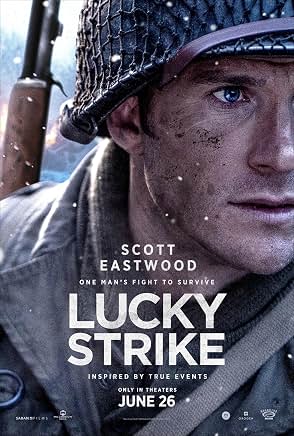

“Lucky Strike” (2026) refers to the brand of cigarettes that Americans smoked during World War II. Americans have a distinct way of smoking them, so they do not make it easier for the enemy to determine their whereabouts. Mostly set during December 1944 in Belgium’s Ardennes Forest, i.e. the Battle of the Bulge, it follows Colonel John Castle (Scott Eastwood) (like “The Punisher?”), who, while wounded, traverses the shadow of death to complete his mission and return to the relative safety of the Elsenborn rally point. The present day story framing his struggle is set after the war with Castle meeting with Mrs. Caldwell (Aunjanue Ellis-Taylor). Why is he visiting her? As an action movie, it is solid, but as a drama, Eastwood is not a strong enough actor for a drama to rest on his gorgeous shoulders. Good looks and great genes are insufficient to keep audiences interested during the non-combat scenes.
Glenn Powell tossed his innate charm and charisma for a mixed Tom Cruise impression and more money, but less memorable appearances. Ellis-Taylor proves that she is an amazing actor because Eastwood is most animated with a twinkle in his eye during his exchange with her as if he is doing an old school Powell impression. Otherwise, his line delivery and acting style is monotonous, and his expression is generally the same regardless of the emotion that any scene requires. His square jawed acting style would have worked during World War II when studios were incessantly pumping out movies set in the European theater, but now, a great head of hair, the ability to read and memorize lines and a solid physique will only get you so far.
If you do feel empathy for Castle, thank editor Christal Khatib who uses montages of life at home with his hot wife, Rebecca (Alexandra Vale) and his newborn son (Leonid Josifov), to elicit emotion. Khatib also brings to life his motivations and shows what he imagines would happen if he dies. Also, because Castle is the only decent person alive onscreen, what are you going to do, not root for him! Run, Castle, run! Whenever he crosses anyone’s path, good or bad, it is a guarantee that the person will not stay alive for long. The most engrossing part of the story is figuring out how he is going to get out of a predicament where he is outnumbered and outgunned and taking on more injuries with each step.
“Lucky Strike” lays it on thick but may have unintentionally made a film that starts off appealing to the wrong side. It is a cynical movie that breaks the number one rule of filmmaking: try not to kill the Black characters first. Nazis gun down a whole truck of Black men so the filmmakers can prove that Nazis are bad, which, duh, but a huge segment of society may now like them for that exact same reason. Have you seen how people react when Black people die lately. They only recently stopped having picnics under their bodies. George Zimmerman’s gun sold for $250,000. It is a scene that Castle did not witness hence it did not have to be in the movie though later Castle does cross their path towards the middle of the film, and it is self-explanatory given everything shown before and all the people that they gleefully kill whether French civilians, animals or American soldiers. It also serves another function: to make the viewer wonder which of the soldiers is related to Mrs. Caldwell and set up the expectation that Castle is there to tell her about a relative. It also provides a stark contrast between how Castle and the Americans act versus the Nazis.
In the scene where all Castle’s men are lying dead, and he is gathering their dog tags, they are depicted as religiously, regionally and ethnically diverse. He is kind to a French family and would prefer to crash a purloined tank than kill a dog. Also, these Nazis are so bad, that the script belabors the point that killing them is totally cool. Don’t threaten us with a good time. Cue Chekhov’s flamethrower, which is awesome and worth the price of admission. In addition, Americans are generally depicted as not like Nazis, and when Castle has an opportunity to talk to a Nazi, they find common ground, but the Nazi’s distinguishing characteristics are his attitude towards people of color and (wait for it) his lack of understanding of sports. Sorry, guys. Watch another Ellis-Taylor movie, “Origin” (2023), and eek, Nazis learned it by watching the US.
So, is “Lucky Strike” aspirational or propaganda? It feels more like the latter though the intent is probably the prior. By projecting all negative characteristics as traitorous and symbols of Nazism, othering them, especially during this particularly bleak period of global dystopianism, a lot stemming from Presidon’t’s regime and effect on every country (got oil?), not grappling with the problems of the past led to this present. Despite that reality, the denouement reveal of the relationship between Mrs. Caldwell and Castle is cathartic, but felt a little derivative from another movie, which retroactively solidified the Powell vibes.
“Lucky Strike” also suffers from the now notorious feature that Matt Damon tattled about, i.e., Netflix’s instructions to making movies: repetitive inane dialogue to remind the audience what happened earlier. It is not as egregious as “Chum” (2026) or “Smothered” (2025), and a lot of the cast mumbles so while it is annoying, the constant visual and dialogue reminders of pivotal points that move the plot forward will probably be necessary for anyone watching without subtitles as long as enunciation is not valued. Let’s sign a waiver for the cigarette smoking technique, but not for the cowriters Rod Lurie, who also codirects, and Marc Frydman’s heavy-handed reminders that Castle did not have to be enlist because he is an engineer.
Visually Lurie and Frydman made interesting creative choices. The aforementioned opening scene appears to be black and white. There is a general media critique that twentieth century civil rights movements are depicted as older than they actually were to make the problems seem more historical, a thing of the past, as opposed to the contemporary of journalist Barbara Walters, who used to feel very edgy and of the moment. The scenes between Castle and Mrs. Caldwell are shot in color and are vibrant, i.e. progress is contemporary, modern, now. Castle’s arduous journey through the Ardennes Forest starts looking as if it is black and white, but gradually color is more discernible. Here is an interesting question to ask yourself: what does seeing color symbolize in the context of “Lucky Strike?” There is also some oneiric imagery of a white horse crossing Castle’s path, a moment of peace during his explosive struggle.
The marketing around “Lucky Strike” touts that this production includes the same people who made “The Outpost” (2019) so if you are a fan, run to the theater immediately. For everyone else interested in World War II, see “Pressure” (2026) and find another source to learn more about the Battle of the Bulge. It is a solid streaming choice. Save your money.