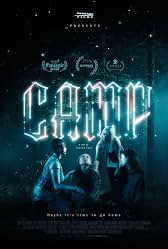

Horror fans should stay away from “Camp” (2025) unless they are also fans of ambiguity, artsy fartsy vibes and Jane Schoebrun’s work if she remade and distilled “Midsommar” (2019) combined with a sequel to “The Witch” (2015). No slasher psycho killers or straight forward scares here, only the existential crisis of feeling guilt and responsibility. Writer and director Avalon Fast’s sophomore feature is about Emily (Zola Grimmer), a young woman who accidentally killed a kid who ran into the road and in front of her car. Emily is fun at parties…not. Then the hits keep coming so with a little prompting from her dad (Michael Tan), she takes a job as a camp counselor and finally finds her people. The only complication is that her people are a bunch of girls who engage in sacrifices to feel good. Not narcissists, but witches maybe. Definitely Satan worshippers in their own words. Will Emily stay with her new friends? Undeniably gorgeous in a surreal cosmos way, “Camp” is the kind of movie that benefits from a big screen, but drink a coffee or risk being lulled to sleep. It is another psychological horror film, but not annoying because bad things are happening, they are just not the priority.
“Camp” features an acting style that feels naturalistic because people talk like these characters in real life, but if you met them, their demeanor does not exactly instill confidence that they should watch your kids. Clearly no one did a background check on any of these people, or it is like Covid where the safety of your kids is less of a concern than just finding a place to put them, so they are out of the way for reasons. The entire movie feels like a trip, another ouroboros narrative. There is a strong possibility that nothing is real in this movie in a “Jacob’s Ladder” (1990) way except Fast’s characters are mostly indifferent to anything except being on the margins of their chosen community. Morality does not matter as much as belonging.
Fast’s opening sequence looks like a black and white film home movie before segueing to a more fragmented, color sequence to tastefully depict the vehicular homicide, an oneiric image that repeats later as Emily delves deeper into the community at the camp, but wait, not so fast (sorry, dad joke). The next scene takes place at a party, but it also may not. There is an image of an overexposed fairy or angel-like creature, that appears in front of the television before entering it, an image that repeats in the denouement in the forest. Next to the television, a woman looks in the television’s direction before facing the camera. She is not shown actually attending the party though she stands in a similar room for a beat as the movie title appears on a tube television. At the party, the angel image is playing at the worst party ever before Emily shares her worst secret to Ange (Rowan Wales). It is an ESH situation for Reddit lovers, and my idea of hell on Earth. Emily just wants to hang out with her friend, Charlie (Giselle Morrison), and there is a surreal scene when she joins a group of four laidback female revelers (Jillian Frank, Mari Geraghty, Destin Sttewart, Jaris Wales) dressed in red offering drugs. In the credits, they are described as the Honeycomb girls so perhaps they are a visual reference to Fast’s feature debut, “Honeycomb” (2022), which implies a Fast universe. Somehow things get worse, and now Emily feels damned for all time (yes, that is an intentional “Jesus Christ Superstar” reference to Judas’ song).
The next scene shows Emily in her room with her dad, and it is a rare time that she expresses an emotion that is not muted. For most of “Camp,” everyone talks in a monotone way. She and dad walk in the forest when he suggests that she work at a camp. She then takes an old timey train and begins to lose time and go in and out of sleep there. The train has leather seats and elaborate brown curtains. Two men watch her, but when she wakes up, two females are looking at her. One resembles Eden (Izza Mulci), a camper that Emily will not meet until later. Either this film is a period piece with the tube televisions and corded phones, but my bet is on surreal because she casually goes to a sleeper car with a corded phone and her dad calls soon after she arrives. There are references to cell phones though none are visible. She wakes up in a field with no roads before walking through a wooden arch that says Camp without the horizontal dash or the middle line in the A kind of like a rune.
Emily thinks that the camp is religious, a “God camp,” especially after meeting the head, Dan (Austyn Van de Kamp) and Jo (Sophie Bawks-Smith). Four counselors accept Emily immediately: Rosie (Cherry Moore), who has a birthmark on her left cheek and is very cheery, Clara (Alice Wordsworth), who is very self-possessed and Goth, Hope (Ella Reece), who recognizes another camper and expresses ambivalence about what she wants to be like, and Nev (Lea Rose Sebastianis) who enjoys “sacrificing” or sleeping with he inexperienced male counselors. Rosie looks like the woman at the television, and Jo always wears white and resembles the angel. These four girls cackle all the time maybe like witches over a cauldron (“Macbeth” reference).
Emily would prefer to have a one-on-one friendship with Clara, but the rules are that they must be together as a group. Emily starts to lose time, have strange dreams which start with Kayne (Henri Gillespi), a fellow ,l taunting her for not being able to move and not knowing where she is and indulging in more substances. Like “Forbidden Fruits” (2026), the other girls start cluing Emily into their deconstructed agenda in the “attic,” which from the exterior, resembles the tree house lighting wise in “Hereditary” (2018) and the first gathering is like a communion/support group. The sacrifices are unclear. It can range from taking life force through sex to death, but it is not the point. People kind of dwindle in numbers. The point is that these girls can confess anything to each other and still be together. It is reminiscent of Dani (Florence Pugh) being held when she is screaming and sobbing except everything is muted, depressive and laid back here.
With all the self-medicating, disassociation and missing time, a moviegoer may wonder if Emily is also a sacrifice. She gradually begins to lose her ability to connect with her dad. The other four girls show no wear or tear from their all-night revelries. The dancing around the fire is very witchy, but the partying feels like maenads or bacchantes. Fast depicts their world as if Van Gogh or Magritte designed the environment or a reference to the wind phone from garden designer Itaru Sasaki in 2010 as a way for loved ones to talk to their dead. It is like a Coleridge poem come to life but medicated.
It is interesting that movies about women joining cults or witches are becoming more muted and less cathartic. This one feels like resigned oblivion instead of the ecstatic denouement of “Suspiria” (2018). Side note: Fast played the Seltzer Girl in the first act. Though unlikely, if it is implied that Emily is biracial, it felt as if there was subtle subtext about that subject and only being exposed to a majority culture which implicitly condemns anyone for not being in the dominant culture, has a value of perfectionism and never offers unconditional love. Anyone can be kicked out of privilege, and with a mother belonging to that dominant class, she may not know of other options. While it is an utter triumph, the film had a soporific effect and will likely benefit from repeat viewings.