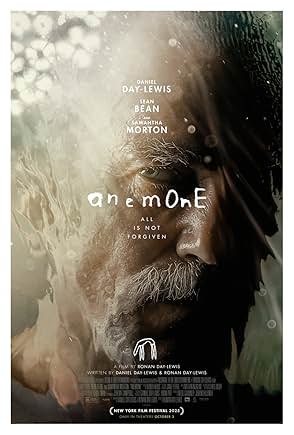

“Anemone” (2025) is about an unusual kinsman redeemer situation. Desperate to save his stepson/nephew, Brian (Samuel Bottomley), from following in his father’s footsteps, Jem (Sean Bean, who does not die in this movie) jumps on his motorcycle to visit his brother, Ray (Daniel Day-Lewis, “DDL”), who lives in a small circular clearing in the Northern English woods, to convince him to return home since Brian is Ray’s biological son. Jem delivers a letter from his wife & Ray’s baby mama, ex-girlfriend, Nessa (Samantha Morton), which contains similar pleas. Meanwhile Brian stays lodged in his bedroom refusing to return to his post with the British Army because he is shocked at what he is capable of. Is a family reunion enough to heal what wounds these men? Apparently.
In my screening, one critic walked out because he was so bored and tired. Others woke up enervated to the point of becoming comatose though their love for DDL remained firmly intact. I liked it, which means that I like pretty, boring movies if they have gorgeous cinematography, great performances and deliberate direction so consider yourself warned and don’t blame me if you watch it and feel like you wasted your money to fall asleep anywhere else but your bed. I also grade first-time directors on a curve and am fine with them peacocking visually, which is why I enjoyed watching “Anemone.”
This much-anticipated film marked the return of DDL, who left retirement for his twenty-seven-year-old son, Ronan Day-Lewis (“RDL”), who is a painter and has an exhibit called “Anemoia” at the Megan Mulrooney Gallery in LA until November 1, 2025. It is a film of firsts for the Day-Lewis family. After a lifetime of top notch acting, which he retired from in 2017, DDL decided to try his hand at writing, and RDL is directing and cowriting a feature for the first time in his life. RDL is at least three generations deep as a nepo grandbabywith a grandpa like playwright Arthur Miller in the genetic wings, but no one cares if you are a nepo baby and talented. His painterly eye translates well to film, but the heavy-handed dialogue that tells more than shows suggests that father and son need to work on film writing so they go beyond the Lifetime for Men story arc and do more than just layer references to a horrific list of traumas that somehow evaporate in the snapshot that this film offers.
Bean deserves the prize for acting while giving an excuse to Ray to wail at his brother without sounding like a madman if he was alone, for not making Nessa retrieve Ray, which would dilute the theme of men’s pain with romantic relationship angst, and for having the gravitas to deal with Ray’s eccentricities without being intimidated. Lesser hands would have fumbled the ball of a being the straight man. Jem is a devout Catholic and family man clearly in love with his wife, adoring of his step son and understanding of his brother, but if a moviegoer does not come to the theaters with Biblical knowledge, his motivation for inheriting his brother’s life would be confounding and seem unrealistic considering the messy family tree.
Morton is a great actor, and she makes a meal out of morsel with a tropey character, the woman who keeps it down at home and continues to function in society while the men in her life fall apart. “Anemone” needed at least a couple more scenes with Morton and Bean to establish the strength of their relationship because the elephant in the room is her yearning for Ray as much as her concern for her son. Morton and DDL are so good that they can just stand in their respective kitchens and make their silence feel solid. As an ordinary person, I find myself rolling my eyes at the dialogue where she dismisses Brian’s valid desire for Ray to be held accountable for failing him, but Morton makes Nessa seem sincere. In lesser hands, it would come off as toxic and a case of denial setting her son up for more problems and dashed expectations.
Bottomley has a thankless role because he is given even less to do than Bean. There are so many close ups of his knuckles that they should get second billing. A silent scene smoking a cigarette with Hattie (Safia Oakley-Green) is evocative of the comfort that they have with each other. Bottomley is at his best when he has a scene partner, especially Morton. Everyone else defines Brian instead of treating Brian like a grown man. It is as if he is still a sad little boy stuck in amber waiting for his dad to come home, which is the point of the story, and he lived a whole lot more life than that. If “Anemone” falters, it is this commitment to the theme that the world revolves around Ray instead of fully creating three-dimensional characters who are working around a hole in their heart thanks to Ray’s abandonment. Of course, there is a reason for that flaw.
“Anemone” exists to revolve around DDL and the way that he interacts with the landscape. If the script changed to make him a reclusive rock star, it would have still worked, and he already had the shades and tight bod to pull it off. DDL could do a silent film, and maybe RDL should have taken that route since his camera work already conveyed the characters’ thoughts and relationship to others. The monologues are almost unnecessary given the way that DDL depicts his character. Ray is like a Prospero figure who forgot that he has the magic and control. Ray’s story is a bit muddled even though it is the only one given substantial screentime. His grievances start with an abusive father, an abusive priest and a traumatizing service in the Irish Republic Army during the Troubles in Northern Ireland, which seems to have resulted in his fugitive status though one of his monologues implies that it could have been brushed under the rug. The source of his latest trauma seems controversial, but colonialism is probably back in, and the memo got lost in the shuffle of the cavalcade of recent historic events.
RDL opens “Anemone” similar to Ari Aster’s “Midsommar” (2019) with a drawing instead of a tapestry offering Ray’s backstory in service. There are a lot of visual references to “Hereditary” (2018) and “Beau is Afraid” (2023) as well. RDL even has a “Magnolia” (1999) moment to symbolize the first of two Ten Commandment style Biblical plague if Ray refuses to do his duty. While the concept is derivative, the execution is visually original and riveting. The constant use of blinding light functions as a substitute for the explosion that shattered Ray’s life. A character quotes Psalm 103:15-16, “As for man, his days are like grass; he flourishes like a flower of the field; the wind blows over it and it is gone, and its place remembers it no more.” This quote partially explains the message that the landscape tells. The clock is running, and these men have a chance to save Brian from the pain that they endured. How? Shhhhhhh.
You know yourself. Can you enjoy “Anemone” without thinking about the actual logistics of breaking family curses and healing from trauma? If you cannot, definitely skip it because the story does not go beyond the idea that Ray simply appearing and meeting his grown ass son for the first time in Brian’s life will solve everything. Nice work if you can get it. Don’t try this at home. Despite all the propaganda that being a present father is sufficient, it is not. This work is not for the weak, which is why I kind of love the scene, though eyeroll worthy and so trite, when the obligatory “brothers physically fight” scene happens, and of course the dad who stepped up handled it like a light day at the office while Ray has been chewing the scenery and thumping his chest. It is unintentionally hilarious how he is all bluster.
As I wrote in another review, I’m beginning to wonder if British films are actually good or the country landscape is so breathtaking that the key to a good movie is capturing the beauty on film at the right time to evoke the perfect prevailing mood of the story. I think that I let a lot slide for quality imagery, and “Anemone” is no exception. While the movie does not speak to me personally, it has so many good qualities that I’m just gently noting the flaws. Next time, RDL needs to work on the story and rise above tropes for a more rigorous character study that does not lean on sensation.