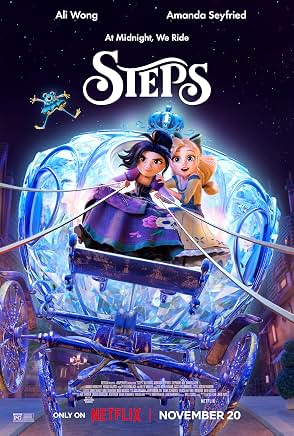

“Steps” (2026) is a reimagining of the Cinderella fairy tale from the elder stepsister’s point of view. Lilith LeGrand (Chloe Kuo as a child and Ali Wong) and her little sister, Margot (Luna Hamilton as a child and Stephanie Hsu), move to Alouette so their mom, Li Wei (Gwendoline Yeo), a dressmaker, can marry Edmund LeGrand (Matt Lowe), the father of Cinderella (Amanda Seyfried). At first, the three girls hit it off, but Priscilla (Sofia Mortera as a child and Nikki Glaser), the Queen Bee, puts a wedge in their relationship. On the night of the royal ball, things do not go the way that Cinderella’s Fairy Godmother (Bette Medler) intended. The three must work together to get the world back on the right track. What do they need to do to fix everything? The idea is relatable, and the execution is solid, but the middle drags a bit.
If you go into “Steps” as a blank slate, you will be pleasantly surprised. It looks like a pleasant pastiche of Eighteenth-century Rococo style, anachronistic, contemporary stylings in the palette choice and Goth aesthetic, and East Asian clothing. The stepmother and stepsisters are East Asian while everyone else is majority white with some Black people, who do not have any major named roles. The dialogue between the Fairy Godmother and Lilith pokes gentle fun at the race bending nature of the story. The match between Edmund and Li Wei is not deeply explored, but it is clearly a love match, and the blended family in isolation is a success until they leave the house. The world outside is less hospitable than the Le Grand, spins the legend of an evil stepfamily and causes a division within the family. The village of Alouette is bewigged and wearing period appropriate clothes, including Edmund, whereas the three sisters appear more natural while Cinderella is the only one who wears her down. While bias is implied, the mistreatment of the Lilith and Margot could be attributed to not obeying those social norms, including the way that they have fun instead of following the Queen Bee’s lead.
Lilith is framed as the narrator, but the story structure does not sustain that device beyond the introduction. If you are familiar with Christian mythology, the name choice is brilliant. “Steps” does a good job of redeeming her character and explaining the motivation behind her meanness to Cinderella without pulling punches on how mean she gets. She begins as a girl who is excited to join in, but when she is rejected and demonized, she lashes out and leans into their negative view of her as a defense mechanism, but she is only pretending not to want the community to accept her. As the oldest daughter, she takes the brunt of community disapproval and protects her mom and little sister while blaming Cinderella for being complicit in her persecution.
Cinderella is essentially the same person that everyone knows and love. It turns out that she compulsively cleans to deal with all her negative emotions or whenever a situation is uncomfortable. She still talks with all the animals. She prides herself on being kind, but a sin of omission and her avoidance of awkwardness gives the rift opportunity to take root and flourish. While she is a supporting character, her fate affects the entire kingdom. Magic becomes a form of privilege and unfair advantage that Cinderella never asked for and never needed except to protect her from the world’s perils because of her open and sweet nature. Gradually she gets used to operating without magic and becomes a formidable physical presence thanks likely to all the housework.
The central relationship is between Lilith and Cinderella, and the goal is their reconciliation. Margot gets along with her sisters because she is younger and into frogs. Without any bad behavior, Margot also gets lumped into the stigma that Lilith takes the brunt of but does not lash out and treats Cinderella like her sister. While her story is underdeveloped, the story implies that she is internalizing her hurt. In contrast, Priscilla recognizes that Cinderella is everything that she is not and uses control and bullying to obtain an advantage. Her adult is Roderick (Peter Dinklage) who is has the physicality of the Terminator in “Terminator 2: Judgment Day” (1991), Bane’s demented love of his substitute daughter in “The Dark Knight Rises” (2012), and the girl dad energy of a man who treats little girl concerns like high stakes, life or death matters. His emotion and dedication make him endearing while his actions scream unhinged madman with zero judgment.
Priscilla wants the Prince (Daniel Radcliffe) so she can control more people. The sisters just want to have fun at the ball, but of course, Cinderella and the Prince fall in love over their shared favorite flower, daffodils. “Steps” is hilarious in the way that they flesh out the Prince and his search for a match in one night. It never feels like the story revolves around him, and the story redeems his inability to recognize the love of his life without the aid of an impractical shoe. There is a twist explaining why he may not remember her face or name, but he does recognize her on a bone deep level, which sells the romantic story line and is better than most movies.
“Steps” begins to lose momentum in the middle and feels like it is just trying to increase the runtime. The sisters are forced to leave Alouette then make their way back. While it improves on repeat viewing, during the first viewing, it is the point when distraction will take over. It is also the point in the story that is not a twist on the story, but complete invention. Trolls get introduced, including a hot outcast troll, Gef (Young Mazino in a role that should have gone to Keanu Reeves), so Lilith can get a love interest. On one hand, trolls are framed as fellow society outsiders, but after the reaction to “The Princess and the Frog” (2009), it will be interesting to see if Margot and Lilith’s storyline will be deemed a mix of redemption and further othering. Lilith cannot get a human love interest? Initially the trolls seemed extraneous, but by the end, their function ties everything together. Also, the steam punk monster house is an essential addition.
After the success of “KPop Demon Hunters” (2025), Netflix is probably hoping that lightning will strike twice with “Steps.” While the entire soundtrack is not as memorable and instantly addictive as the award-winning hit, Justin Tranter’s songs were generally perfect for the story. Let the credits roll to enjoy the best two songs, Tranter’s “I’ll Be There for You,” and Blackpink’s Jennie’s “Someone to Hold.” The prior song accompanies the ending, which is so good that it makes up for any earlier deficiencies. Is it the song or the denouement that will leave viewers misty-eyed? Let’s just say that it got rewound a few times, and I found myself singing along to it. Congratulations, Tranter, you won. You got me addicted to your song.
While “Steps” is a kids’ movie and adults would have to multitask a bit to get through it, it is a great addition to the “Cinderella” pantheon. Even with the violence and romantic themes, it is still family friendly and appropriate for children. If you want to do a double feature with “The Ugly Stepsister” (2025), don’t unless there are no kids in the room, and you have a strong stomach for body horror.