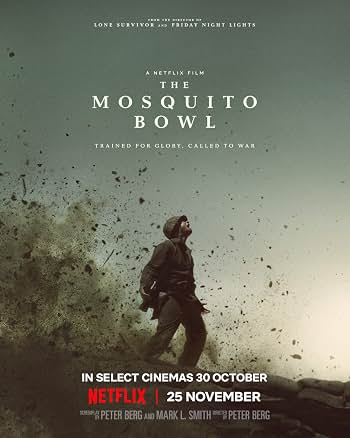

“The Mosquito Bowl” (2026) adapts Buzz Bissinger’s novel, “The Mosquito Bowl: A Game of Life and Death in World War II” (2022), which Bissinger credits to Terry Frei’s research that was the basis of Frei’s sports and history book, “Third Down and a War to Go: The All-American 1942 Wisconsin Badgers.” Frei is the son of Jerry Frei, who was football teammates of Bob Baumann and Dave Schreiner. The film follows Baumann, Schreiner, their rival Anthony J. Butkovich, and Brown University baller John McLaughry, four of sixty-five players who would play in the titular game on December 24, 1944 at Guadalcanal during WWII. If you like football and an emotional broad strokes picture of the Pacific theater of WWII experience, you may enjoy this movie, which could have benefited from a shorter runtime, a more focused story and without casting a dud actor to anchor the stakes.
“The Mosquito Bowl” features some outstanding performances. The actors have a heavy lift because they do not have a lot of time to establish their characters’ personalities before they get their hair buzzed and tossed in uniforms, which will make it more challenging for moviegoers to distinguish them from each other. Director and cowriter Peter Berg does a decent job of highlighting each person among the chaos of the battlefield to capture their work without losing touch with the hurly burly realities of war though he is given to embracing certain cliches such as having a character clearly say a person’s name or say something memorable before a shocking death.
Bad or good news first? Let’s start with the bad news. Nicholas Galitzine is not handsome enough to excuse the fact that he does a better impression of a bump on a log than embodying his character. He is the movie’s weakest link, and he opens and ends the film as McClaughry, a veteran returning home. Berg and cowriter Mark L. Smith start the movie in media res or the how we got here trope, which sucks a lot of the suspense from the story and could confuse an audience unfamiliar with that narrative structure device. If you hear movie goers saying, “What is going on? When are we,” it will be during the opening, and largely because Galitzine does not take his character on an emotional journey and only hits one note. Mac is supposed to be the foundation of “The Mosquito Bowl,” but he feels like an afterthought. Also, as the Ivy Leaguer, the story sets Mac up as an intellectual whom war strikes dumb, but it is a short fall for Galitzine who spends most of the film during peacetime staring into the distance, which is his go-to move. In contrast, some of the supporting actors make a meal out of a morsel during their fifteen minutes of fame such as Jack Ingram. Sure, it does not hurt that Ingram has a red buzzcut and a flashy intro, but even so, he keeps making an impression. Dominic Bogart gets some great lines as Sgt Wilkes and makes them land naturally without chewing the scenery though he could have chosen the default and really hammed it up.
You know who does not have red hair? Most of the cast, and they do an outstanding job. Bill Skarsgård is as close to a brand name as “The Mosquito Bowl” has. His face is instantly recognizable, and it is so eerie how his American accent sounds so similar to his brother, Alexander. Did they use the same vocal coach or is it part of a family acting workshop? As Bob, he alternates between childlike and driven. Bob is a bit of a hype man but is also unsettled at his ability to embrace whatever game he is playing. Like all the characters, there is not much on the page, and the actors must fill in the blanks. Skarsgård does his job well, but his performance is not the one that you will think about the most.
Who the hell is Tom Francis? He has not been in a lot of movies, but hopefully he will be. He does not even look like Schreiner, but Francis makes Schreiner feel like someone that you would recognize anywhere. He feels complete and knowable. Schreiner is a guy who takes everything seriously, but in an earnest, not a self-important way. He cares about the people in his life: his girlfriend (Lola Bond) and his mother. He is naïve while sounding certain and grounded. Naughty casting directors chose similar looking actors to play the mom and the girlfriend. After the heat of their first battle, Schreiner is still pissed at Tony (Ray Nicholson) for beating them in their last game as civilians. Before the movie’s final battle scene, he delivers a line casually that could have been overwrought, and it is the right move. He is just so good, but not the best despite being an undercover Brit.
Nicholson may be better than his daddy. Jack always seemed as if he was going to be the bad guy even if he was not supposed to be. He just does not look trustworthy whereas Nicholson has that same face, but feels more like a character actor and often disappears in a role despite that distinctive mug. As Tony, he embodies a good-natured, humble, star quality of an All-American, but in his first on-screen football scene, after getting a devastating blow, he locks in without malice then returns to equilibrium. Nicholson gets the most exuberant emotional beats to work with, but he is not someone who grabs low hanging fruit. Like Francis, he takes his character on a journey with peaks and valleys and somehow manage to skirt the cliches of a freshly enlisted man.
The same cannot be said of “The Mosquito Bowl” which is as subtle as a sledgehammer. Berg’s artistic notes of juxtaposing nature, including acts marked with images of Earth from outer space. The latter feels like a visual reference to the overview effect. Astronauts often experience the overview effect as a transcendent moment that makes war and borders seem ridiculous. Berg often shows other images of nature, and the most memorable is Nicholson and a bird chilling with each other. The wartime images are graphic, but do not feel gratuitous though paired with the acting, is quite impactful as the American soldiers are shocked at the Japanese soldiers and civilians’ actions during war. Imagine seeing seppku or hara-kiri for the first time ever. Don’t worry though because the film also shows American brutality. It is always a mistake to juxtapose real life footage of a historical person next to an actor playing them otherwise the mixture of archived film footage and photographs with the film is an inexpensive and effective way of taking the temperature of the time and setting the atmosphere.
There were a few scenes that felt anachronistic for the time though the dialogue heavy-handed dialogue was germane for contemporary purposes. Caveat: I’ve never read the novel or Jair’s book, only general WWII accounts, so maybe the movie’s sentiments are accurate, and I am off base. The four football players are depicted as horrified at the atrocities that American people inflicted on Japanese people, and in the heat of war, that seems unlikely, not because of who they were, but in the context of the Pacific theater and Japanese wartime forces’ cruelty to everyone who crossed their path. At the time, it was barely seen as balancing the scales though hindsight is 20/20. Also, though it is likely that American soldiers had shell shock, now known as PTSD, emotional outbursts from men were culturally frowned upon, and WWII veterans were often tight lipped about the mental fallout of their service. There is also a comment about oil as a source of conflict, which was factually accurate, but may not have been expressed as cynically as it is in the movie.
WWII movies get a pass, but “The Mosquito Bowl” feels like propaganda extolling how football won the war, and to get men to extol the virtues of war at a time when the lines of battle are not as clear cut or just. Here is a counter idea. The men started to lose their minds because during training and battle, as individuals, they were losing their identity, but because football reminded them of who they were before training, it is their individuality and memories, not the actual game, that helped them win the war. Also, they were as broad as a wall. The entire cast is objectively more attractive than the average dude walking around outside. At the end of the movie, they showed the four main characters’ real-life photographs, and respectfully to both sets of men, the actors, including the objectively hot Skarsgård (sorry Galitzine), are a bunch of uggos compared to the original men. What the what? If you are a shallow perv, there is probably less than a minute of footage of the four men showing their butt in a cleansing/baptism scene in the ocean. This movie feels more like atmosphere than an insightful character study and is light on historical detail so consider your tastes and choose accordingly. If it is your cup of tea, trapped in a theater may be the best way to get through the uneven parts and help you to appreciate the film’s scope. At home, it is sure to lose its impact when translating it from the big to the silver screen, but if your wallet is a bit drafty, you can wait until November 25 to see it on Netflix.