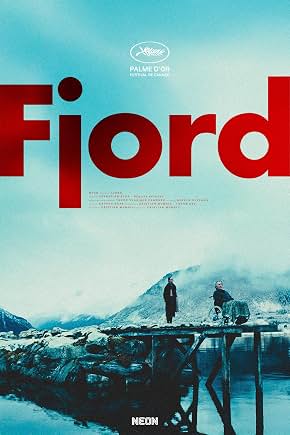

Initially welcoming, Norwegian neighbors gradually turn on the Gheorghiu family, who practice Christianity in a way that is perceived as proselytizing. When oldest daughter, Elia (Vanessa Ceban), sports bruises, and others overhear her discussing physical punishment with her brother, Emmanuel (Jonathan Ciprian Breazu), Child Protective Services gets involved and take the five children away from their parents, Mihai (Romanian born Sebastian Stan) and Lisbet (Norwegian Renate Reinsve). Using Ruth and Marius Bodnariu’s real life story that started during November 2015 when Norway’s Child Protective Services took their five children into state custody as inspiration, writer and director Cristian Mungiu attempts to create a more ambiguous story without taking sides but fails in the transition from fact to fiction. Even if well-intentioned, “Fjord” (2026) is a manipulative movie and betrays Mungiu’s beliefs even if he strived to shove them to the side. In trying to “both sides” the debate, he still put his thumb on the scale and cheats himself and the audience.
Stan has struck a healthy balance in his acting career seesawing between keeping that sweet Marvel Cinematic Universe money rolling in as Bucky turned the Winter Soldier and periodically getting his artsy fartsy card stamped by accepting roles that are less glamorous and deliberately putting his verging on perfect looks aside. In “Fjord,” he shaves off most of his well-conditioned, thick hair and buzz cuts the rest to cosplay a bald person. Also, he finally gets to use a regional accent more like his birthplace to depict Mihai, the Romanian half of the controversial Christian couple. While he does a great job playing a husband and father whom no one should notice, the little axe punctuation at his frustration of the system was a little too hot and bothered for a man whom the metaphorical jury should be out on. If a man wants to convince the world that he would not harm his children, he will not go anywhere near blunt or sharp objects in public while emotional unless he did have anger issues. The film is stronger when he cannot help but tell Jesus in a manger story while in his own manger or playing hymns every time that he is near an electronic keyboard. He is convincing in these moments and recognizable as a man who sincerely does not get why people see his behavior as proselytizing because it is endemic to the fabric of his life. It also would be obvious how that behavior could activate people not socialized similarly. It is likely the fault of the direction, not Stan’s creative choices, that the most melodramatic ax take made it into the movie. If Stan did not get awards for “A Different Man” (2024) or “The Apprentice” (2024), and gets one here, it will be disappointing because it is not his best work and may encourage him to pick relatively lower hanging fruit.
Reinsve has worked with Stan before in the prior and has only begun to cash in with “Backrooms” (2026) so it is a relief to see her back to her usual routine. For Reinsve, the Norwegian Lisbet is a quieter character than she normally plays, and Lisbet is the standout because Reinsve must show emotion while staying in character. Unlike Mihai, Lisbet is proselytizing against the rules of her job as a nurse at a home for elderly people, but no one minds though they may correct her in a polite way if she puts a miniature cross with a deceased person who did not share her religious beliefs. It is an understated, sympathetic portrayal, but the idea of rewarding her for playing a sympathetic mother is as revolutionary as florals in spring, but Reinsve’s overall body of work is solid enough that this reward is unlikely to alter which jobs that she accepts.
The child actors are perfect. Ceban has the heaviest lift as the character who lives in both worlds, the secular, new to her, Norwegian community and the devout Pentecostal life that she is accustomed to and chooses. Elia never falters. Given a storyline alluded to, but not shown, of a younger sister, Judith (Teodoro Sabina Barau), rebuking a classmate with a same sex sexual orientation, the ambiguity of Elia’s storyline with next door neighbor, Noora (Henrikke Lund Olsen), is frustrating. Noora clearly has a crush on her, and Elia inadvertently becomes part of a love triangle when a jealous classmate, Elsa (Sofie Vartdal), fumes at Noora’s redirected attention. Elia may befriend Noora, but she would not tolerate a crush without a rebuke unless Elia reciprocated that relationship. If “Fjord” is maddening, it is for introducing more provocative elements that were not in the original story then not fully exploring them. Emmanuel tags along on all of Noora and Elia’s hangouts so it is unlikely that anything actually happens. Timotei (Filip Sebastian Barau) is easy to forget because he is rarely shown or discussed in the movie.
For a movie about children’s welfare, the kids spend more time off screen than on, and the parents’ drama takes center stage. Mungiu omits showing how the parents spank their kids or the incidents that alarm the school administrators other than when Frida (Lisa Loven Kongsli), the bus driver, overhears the older two kids talk about the corporal punishment and the gym teacher spots the bruises on Elia’s body, which are visible from space. In a later scene, Noora casually mentions that she knows how and when Elia got those bruises, and even though the Gheorghiu family’s lawyer hears this comment, no one pulls this thread. Maybe the credibility and identity of the witness would make it easy to dismiss Noora’s testimony, or the Norwegian judicial system does not like having minors testify. It ruined “Fjord” because it was so implausible that no one would at least explore the one rational reason that the state had to intervene. Well, there is a good reason for it. It never happened. There were no bruises in the real story.
“Fjord” is not a movie that creates ambiguity to show the wrongs on both sides. It creates ambiguity that wrongs both sides. Without knowing anything about the real story, it is easy to confuse Mungiu’s film with a Christian produced movie because of how it lays on thick the idea that Christians are persecuted (somewhere a Muslim immigrant family is pissed). It makes sense that American critics may be particularly sensitive to this impression because Christofascists are moving in the direction of criminalizing any sexual and gender orientation that does not align with their world view. When Mungiu does not show the kids who bore the brunt of being told that they were wrong for being gay within the movie’s universe, it is annoying to see a depiction of Gunda (Ellen Dorrit Petersen), the Child Protective Services employee, and Frida wringing their hands over theoretical thought crimes. It is hard to sympathize with invisible victims when two parents are constantly exclaiming in agony. Mungiu only shows hysterical, self-harming lesbians whose mood improves after hearing about Jesus. He does not have to be interested in those kids, but he is not particularly interested in the Gheorghiu kids either.
A man swatting a kid’s butt sounds harmless to an adult, but how does the kid feel? It would be interesting to know Mungiu’s position on adult children who later confront their parents for abusing them because spanking, regardless of the parents’ intentions, is abuse and illegal in Norway. There are enough scientific studies showing that “spare the rod, spoil the child,” a common Christian adage, is poor advice for positive child development and is an indicator for a higher likelihood of mental health problems, substance abuse, aggression, and future vulnerability to abuse, sexual and physical, as an adult. Some advocates are pushing to have it recognized as a precursor to sexual abuse. Spanking should not be conflated with protective physical restraint to prevent a child from hurting themselves or others, which is depicted in “Fjord,” and permissible. Is the conflating intentional as a bit of sophistry or an honest mistake? Mungiu is playing a bait and switch game by showing the permissible as a substitute for the wrong. “Fjord” dismisses spanking yet does not show the Gheorghiu kids getting spanked. The lady doth protest too much.
The de facto real case was about xenophobia and prejudice against children of immigrants even if one partner was Norwegian. The Bodnariu family was not the only one affected though they felt their tribulation stemmed from their religious beliefs, which may have played a role. Mingiu reinforces this idea subtlety when he offers a glimpse of the Gheorgiu’s lawyer’s Buddhist statue and incense to show that she at least can relate to them in theory as someone who is not purely secular. It is scoff worthy how their secular counterparts bemoan the Gheorgui family’s refusal to play video games, use YouTube or own cell phones as if it was some grand loss. (See “Your Attention Please.”) If they were attacked for their beliefs, it is wrong until their beliefs negatively affect another person outside of the family. Introducing bruises takes the heat off the Child Protective Services since they have a rational entry point, which actually detracts from the real-life family’s plight, which reflects that Mungiu is not a schill who would side with conservatives. If Mungiu is not actually on the family’s side because for the purpose of the story, he wants it to be feasible to attack the family while also making them sympathetic, then what is the point?
Mungiu’s movie is more primal and common. Mungiu prioritizes the parent’s pain, not the kids on either side, which is an extremely conventional view that both political sides actually share. In his effort to ring the alarm that liberals can be persecutors too (duh), he misses that he has a lot in common with them for scoffing at a kids’ first mentality, which was also not a feature in the real-life case. During the trial questioning of Gunda (Ellen Dorrit Petersen), the person who exercises the state’s authority and seizes the children, one of the questions clearly scoffs at the idea that a person who is not a parent should even work for Child Protective Services. So employers should discriminate against single people? The real enemy is anyone that takes away a parent’s authority over a child who is not a parent themselves, especially if they are (ew) childless. Regardless of intention, Mungiu has a three point agenda: maintain parents as the primary authority, children belong to them, not themselves, and single people, especially women, are a problem.
There is only one scene in which a child’s autonomy is briefly depicted and validated at the end of “Fjord,” but it also could be related to lying or sentimentality, which Mungiu adores. He hits the breastfeeding point hard, as he should, even creating the scenario that Lisbet loses the opportunity to ever express milk before she reunites with her baby. In real life, Ruth had no such problem. He is not interested in reenactment because reality is far less dramatic. It is about prioritizing parents and ejecting state interference. For instance, when Gunda and Frida tell Lisbet that they will remove the children, a huge Norwegian flag starts billowing in front of the window.
Mungiu does capture the beauty of Alesund, Norway. The opening shot is a sunny day solely focused on the snow-capped mountain while the hymn, “Amazing Grace,” is sung. It looks like heaven on Earth or the idea that their location makes them closer to God. With the constant threat of avalanche handled without awe, it becomes an image of people immune to God’s judgment and refusing to react to nature’s power more than as if it was just another day in the office. Or the classroom. Or the gymnasium. Or the courtroom, whose procedures are unclear as depicted in an anti-climactic patchwork of scenes. Generally settling happens earlier, and in the US, the criminal trial would happen first so the statements made in civil court cannot be admitted in a criminal trial.
Under ordinary circumstances, “Fjord” should be a television movie except for the level of talent, experience and skill in front of and behind the camera telling the story. It is alarming how Mungiu’s elemental emotional manipulation stirs audiences into a fervor in the same way that he wants people not to do once they are in the majority and have power. No hope for humanity if a movie cannot model its principles.