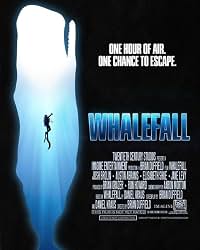

“Whalefall” (2026) adapts Daniel Kraus’s 2023 novel, but I like to think of it as Jonah and the whale, the secular, scientific edition. Apparently, Austin Abrams has not had enough tentacle horror, but at least it is organic and not grown in a lab like “Resident Evil” (2026). After a legend in the local diving community in Monterey, California, Mitt Gardiner (Josh Brolin), weighs himself down and dives off his boat to commit suicide after receiving a fatal diagnosis of mesothelioma, which prevents him from doing what he loves, his son, Jay (Abrams) is determined to retrieve his father’s body (what) and secretly heads out with only a tank filled with one hour of oxygen and no gloves. During his one-man (!) body retrieval mission, he gets caught in the wake of a sperm whale hunting a squid and ends up in the whale’s belly. How will he survive? With a one hour forty-six-minute runtime, it begins to lose steam after one hour, but people with daddy issues may eat it up.
There are allegations that Timothee Chalamet thought his biggest threat was Tom Holland, but nope, they are not even in the same category. If there can only be one “scrawny” white man, Abrams is the one. He is the kind of actor who is interesting to watch alone on screen going through a multitude of tribulations, has a growing body of work as a solid character actor that most people do not recognize in his various incarnations (“Weapons”), and is not a showboat about his version of being dedicated and method. If you are a striver, aim to be an Abrams, not a Chalamet. Abrams creates the impression that it is about the work, not doing the work to get to the accolades, and “Whalefall” is no exception.
The survival drama is an elaborate backdrop for the emotional struggle that Jay feels about reconciling his relationship with his father now that his father is gone and sorting through the issues that they had with each other when Mitt was alive. “Whalefall” will appeal to parents with estranged children. It is the basic lesson of the strict, strident parent meaning well and the child not knowing it until that parent is gone. Mitt’s lessons are touted as so good that he posthumously could save his son from the belly of the beast. While Jay is entombed, director and cowriter Brian Duffield and cowriter Kraus intercut the scenes with flashbacks of nonlinear father and son flashbacks from Jay’s babyhood to their last night on the boat together. If you cannot get into this sentimentality over loss, consider yourself warned. If anyone other than Brolin was saying those lines, they would sound less profound or instructive. It also does not hurt that Brolin often appears shirtless and tattooed during these flashbacks. A little sugar makes the medicine go down.
The battle for survival in the belly of the beast is initially riveting if you never think about the production logistics. The fight between the squid and the whale is impressively done then the squid’s effort to get a final meal in the form of the protagonist eclipses the opening volley. If you can ignore that a whale hitting a person at full speed would probably be like getting hit with a Mack truck, the drama of not getting crushed in the whale’s digestion system is absorbing, but after awhile, it gets old, and it becomes easier to think about what the set looks like. Instead of a ball pit, a soft boulder pit? Also, it is an obvious rebirth metaphor. While in the whale’s belly, Jay finds peace and conflates the whale with his father (the title and the opening come into play here), and both root for Jay to escape them so he can flourish in their wake. It is theoretically beautiful but may not land with every moviegoer. The confinement becomes a literalization of the frustration over their inability to communicate with each other. It makes sense that Mitt would feel irate that his son dumps him to go to SeaWorld, but Mitt could be a lot possibly crossing the line into abuse at times.
It is not the point of “Whalefall,” but a little alarming the lessons that it imparts to the audience about what behavior should be tolerated or excused. Everyone else in Mitt’s life is easy going and chill, but do not seem alarmed at the dynamic between Mitt and Jay and place the burden on Jay to mend the relationship. Mitt seems to be the life of the party around other people. Elisabeth Shue is positively radiant and the image of peace and calm as Mitt’s wife. Jane Levy and Emily Rudd play Jay’s exuberant sisters. This trio appears totally believable as a loving family, but if you know any of these three characters names without reading the book and before the credits roll, then you deserve credit for having excellent hearing and being detailed oriented. (Rudd plays Nan, the younger sister, and Levy plays big sister, Eva.) John Ortiz is memorable though the opening scene is so disorienting that it feels as if off screen, someone is holding him at gun point and ordering him to look straight ahead and fish.
While “Whalefall” captured how other people could have a wonderful experience with a beloved figure and another person could have the opposite reality while both accounts are true, it was sadly also accurate that everyone dismissed Mitt’s behavior as rough, and no one was in Jay’s corner. If the whole spiritual experience of breathing in belly juices helped Jay get right with his dad, sure, but it is a lot of extreme heavy lifting and punishment for a burden and sin that Jay should not have to bear as the child in this relationship. It still works as a secular Jonah and the whale story because Jay must get with his dad’s program if he wants to escape and become a part of a community that he was trying to get away from except nature/whale is more like God.
If I’m being honest, “Whalefall” lost me at the absurd idea that one man was going to search the ocean for a body, i.e. an edible toothpick that all ocean wildlife can devour and help disappear. I went with it because of the talent involved in this production and the virtual tourism shots of the breathtaking above water shots of the ocean. As the outside of the water, underwater shots unfolded, everything increasingly looked très CGI and laughable, especially towards the denouement and the close-up eye shots. Even one scene when the whale emerges from the ocean was less majestic and rough. The belly interior scenes are fantastic, but after watching “Nope” (2022), punches were definitely pulled. More acid! I came in blind for a survival movie, and it delivered, but the other elements were uneven.