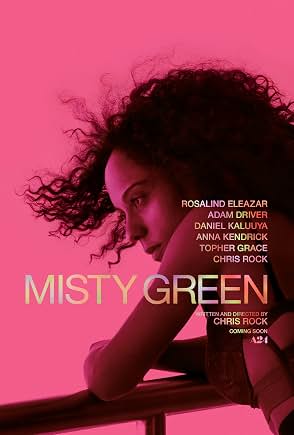

“Misty Green” (2026) is not a good movie, but it is not a bad movie. Rosalind Eleazar (“Rose of Nevada”) plays the titular character, who is straight out of a Thomas Hardy novel if he was writing about contemporary Hollywood acting. If you watch the trailer, it just seems like a woman with talent trying to get her big break, but it is a heavy handed, bleak narrative that lacks the focus to be a meaningful character study and pulls too many punches to at least earn the reward of being unflinchingly realistic. Formerly successful Misty has talent, but she is depicted as her own worst enemy. It is like watching a humiliation ritual, but some of the elements are quite good.
Eleazar is one of those elements and delivers a brave performance as an unlikable, self-sabotaging, entitled character, whom moviegoers may still root for, which is its own stirring accomplishment. Casting may have put the thumb on the scale to be impressed with her singing talent when only a horrible singer is shown for contrast, but Eleazar is moving and a joy to hear. She wears very few articles of clothing, and what few items she wears, they do not cover a lot, but there is no nudity so for a sordid movie about a woman with oversized appetites, it is practically chaste, which means “Misty Green” feels more like an artsy fartsy Sid Davis cautionary film with writer and director Chris Rock shaking his finger behind the camera and on screen to emphasize how Misty is bad and needs to change. Rock shows some restraint when he does not use a rolled-up newspaper to hammer home the point. Misty is less a three-dimensional character than a person who exists to shame. Rock is no John Cassavettes, but Eleazar’s work will make you wish that he was.
While watching the movie, imagine if Misty was not depicted as a messy person immediately and “Misty Green” was a better paced film that took its time. Nothing like that would happen in such a short time. Adam Driver acts as if he is in a better movie. If I’m annoyed at Rock, it is for making me side with Driver, who makes a hot sleazeball like Zach seem like a good bad idea until he becomes a downright harmful one. The opening, lighthearted definition of the bag sets the wrong tone for how Rock will treat the bag literally during the denouement. He creates Misty so he can torture her then does not and makes her noble instead of an actor who took too many wrong turns. His idea of torture is also pedestrian, and the average person with Google and time can guess how bad things can get if she follows Zack down the road of good intentions. Here is a hint: coprophagia. Everyone knows that Rock will not be watching “The Devils” (1971). He is too much of a prude to rise or rather lower himself to the concepts that he introduces.
Most of “Misty Green” takes place over seven days, and the sand is flowing rapidly to the bottom of that glass before her life turns upside down. Rock starts the beginning disorienting the audience as much as Misty without giving many clues regarding who she is, where she is, what her rights are and how to feel about the situation. The fabulous and gorgeous Amy Landecker, who is filmed in the least flattering way, busts on to the scene, and Misty is mystified, but obedient and fawning. In retrospect, that scene should have more meaning and her reaction retroactively makes sense, but it is not a theme that gets explored rigorously.
Rock thinks that everyone will put the pieces together if he throws them against the wall to see what sticks. The movie’s main problem is that too many themes explored superficially: mental health issues, racism, interracial dating, acting industry, substance use, etc. Daniel Kaluuya makes his first onscreen appearance in four years since “Nope” (2022) as Misty’s brother. A flashback from their childhood raises more questions than it answers, but she feels obligated to care for him. Kaluuya is a bit too convincing as a figure that anyone would worry about if they knew about his situation, and it is hard to watch, but his character, Jay, begins to hijack Misty’s storyline.
Jay is not the only one who eclipses Misty’s story. If “Misty Green” has a problem, it was Rock casting himself as Jordan, a director of a “Dreamgirls” reboot and Misty’s childhood friend. Rock is a hilarious comedian, but a limited actor, and he cast himself as the angel of Misty’s better nature. The whole point of the story is for Misty to fall for Jordan, work for him, and straighten up and fly right, and nothing else is the right choice. It feels like his fantasy of what happened to the women who did not prioritize him. Jordan chastises her for her bad behavior while simultaneously engaging in that behavior and scowling at any immoral characters. It is a maddening have your cake and eat it too character, especially with cheating treated as the ultimate test of love. The role and his acting are more repugnant than his protagonist’s choices, so it is an epic fail.
“Misty Green” kind of stops feeling like anything but self-indulgent during the diner scene when Eleazar is forced to laugh at Rock’s least funny material. There are some good lines in the overall movie, but not many are in that scene. Also, the editing feels less like a time lapse montage, but more like an at home haircut with a weedwhacker. Comedians can be needy, and Rock belongs in that category with no one to stop that impulse since he is at the helm. Either Rock needed to put a better actor in that role or turn Jordan into the protagonist observing Misty, which is emblematic of the movie’s instinct to hold her at arm’s length with its nose up in the air and perceive her with disgust and judgment. Rock is the weakest link in his own damn movie.
“Misty Green” has a terrific ensemble cast: Topher Grace as Misty’s agent, Anna Kendrick as her best friend and retired actor, and Alexandra Shipp as a fellow actor. There is an unofficial “The Devil Wears Prada” reunion with Tracie Thoms, Rich Sommer and a race bended Andy Sachs. As Rhonda, a mover and shaker in showbiz who is likely a thinly veiled Shonda Rhimes character, Thoms does not get enough time, which is one of the few problems with “Big Baby” (2025). She is too talented to not get enough to do. Similarly, Sommer would be forgettable as Misty’s best friend’s partner if he was not so recognizable, and he looks even better than usual.
“Misty Green” is not an opportunity for a Black woman to tell a typical, realistic LA story with its unglamorous side in the spotlight. Black actors should get the same opportunity as others to play complex characters, not just ideal, respectable role models. This movie is not bad because it trots out tropes of the tragic mulatto and Jezebel, but because it does so without letting its main character take and keep center stage. She is not a shallow flibbertigibbet who fritters her life away until she comes to ruin but is still satisfied with selling her soul for fame and money. No, she is another trope: the long-suffering Black woman who should feel worse for letting down the men around her than letting herself down. The bag is not even for her. She is denied the shallow depth of Carrie from “Sex and the City.” It felt as if the real motivation behind the story was some elusive, famous actress turned down Rock, and this movie is his told you so dance for not accepting his role in her career and personal life. It feels like a weird fantasy of his, not a portrait of an imperfect person.