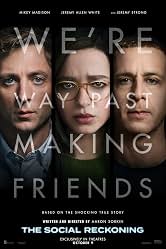

“The Social Reckoning” (2026) is the best television movie made for the big screen. The standalone sequel takes place thirteen years after “The Social Network” (2010) and revolves around three awkward, work-obsessed people: Jeff Horwitz (Jeremy Allen White), an investigative journalist for the Wall Street Journal’s San Francisco Bureau, a Facebook data scientists Frances Haugen (Mikey Madison), and Facebook founder Mark Zuckerberg (Jeremy Strong). The action jumps around the timeline between 2017 through 2021 to chronicle how Haugen became a whistleblower, which led to the seventeen-part Wall Street Journal series, “The Facebook Files.” It is a preach to the choir movie, but if you are part of the choir, you will dig how writer and “director” Aaron Sorkin ties together a multitude of political and social ills then lays some of the blame at Facebook’s feet. If you are not, you are going to hate this movie, which may be a rare time in history that cinephiles have something in common with Presidon’t supporters.
If you are a little scared to see “The Social Reckoning” because White and Strong are teaming up again after the epic letdown “Springsteen: Deliver Me from Nowhere” (2025), do not be. White is on thin ice after delivering the worst voice acting of the year, if not of all time, in “Star Wars: The Mandalorian and Grogu” (2026). At least as a journalist, White delivers reams of dialogue naturalistically without lulling the audience to sleep and with enough of a sense of humor and aplomb that he is credible. Horwitz serves as a double function. As an investigate reporter, he is the passport of old-fashioned respectability and credibility, so the story does not sound like the ravings of a lunatic spinning yarns about a conspiracy. As a luddite, he is an audience surrogate who gets to play dumb, so moviegoers do not feel bad if they fall behind. A lot of the dialogue is prose dumping with jazz hands for people who are never going to read Horwitz’s work in real life.
The real protagonist is Frances, and Madison is unrecognizable in her first appearance after winning an Oscar for headlining “Anora” (2024). Sorkin cannot resist finding reasons for the camera to ogle her constantly climbing up her body. Her opening scene feels like an outtake from “Flashdance” (1983). The aesthetic of dating is projected on her meetings with Horwitz, and Sorkin does make it seem like he may drop in an eleventh-hour romance, but no. Wardrobe using her surreptitious meetings with Horwitz as an excuse to dress her in skimpy (for them) outfits. Madison rises above it and delivers a relatable performance as the every woman nerd in the workplace who is incredible at her job then ignored at her employer’s peril. “The Social Reckoning” nails the dynamic of how women in the workplace can be infantilized and dismissed as if gender norms should override their expertise. Her orders are basically to shut up, blend into the scenery and get laid. “The Social Reckoning” may be the only movie in history that suggests not dating and nerding out are revolutionary. Sure, it may be work propaganda, but its work propaganda about being the change that you want to see in the world so let’s sign a waiver.
Other than the objectification of Madison. Sorkin does a solid job writing women characters in a realistic way, which includes Raya (Wunmi Mosaku), who is on Zuckerberg’s team, Kris or Kristina McCann (Betty Gilpin), the editor in chief at the Wall Street Journal, Morgan (Anna Lambe), Frances’ coworker, or Blair, the chooser of ties who is on the verge of strangling someone. In one scene, a Facebook employee is presenting a proposal to Zuckerberg, does not lose her cool during the presentation, but firmly makes a point, which results in a chilly, wordless reaction that implies she was done not only with the presentation, but possibly her career. It is a great example of how people act as if women need translators in the workplace to be understood, not as if the people listening to them have problems communicating, which involves talking and listening. People in power are depicted consistently as poor communicators, which translates into problems when they actually need to appeal to people whereas the good guys are depicted at liking women who do not adhere to niceness and have the same emotional freedom and agency as men such as Zuckerberg.
Strong is perfect as Zuckerberg, which is no surprise because Strong is generally perfect at everything he does. With all due respect to Jesse Eisenberg, Eisenberg never seemed right for the role, but if they ever make a movie about Zuckerberg’s tech bro makeover with curly hair, gold chains and leisure wear, maybe he can come back (he does not want to). Strong nails the voice, the physicality and the demeanor while also humanizing Zuckerberg to show that the man has feelings underneath that rigid exterior. He depicts him as a man who became stone to move forward without allowing the arrows hurled at him to nick him but has also become immune to good sense penetrating his thick armor. That sense comes in the form of Bill Burr as Charlie. Zuckerberg makes sense in theory even if he is a complete villain. Flashbacks of Facebook deciding to change the algorithm into something sinister are done in black and white. With the all caps, block print behind Zuckerberg, it feels Orwellian. It is definitely dystopian.
At its heart, “The Social Reckoning” is a zombie outbreak movie meets copaganda. It opens with Portia Doubleday as a drunk woman harassing a couple of well-intentioned cops, who happen to be people of color, Deputy Otumbo (Michael Braugher) and Deputy Diaz (Sierra Capri), who gives face the entire scene. Throughout the story, Frances can hear people say the most outrageous things and legitimatize it with a cite to Facebook. It culminates in a mass assault of police, who are shown injured, beaten and trampled intercut with all the Facebook movers and shakers stunned into silence. It is a powerful chain of events even when it is clunky. For instance, seemingly non sequitur shot of feet marching and pants legs appear abruptly and feels like a reel mistake, but it is not. Someone has been watching too much Les Mis, but once it coalesces, it works. Only one problem: the law-and-order folks who are a member of the horde do not actually believe in law and order, so it is not going to persuade anyone who is not already onboard. Points for trying.
“The Social Reckoning” is precisely the kind of movie that “Digger” (2026) ridicules: verbose, intellectual, not meta, and takes no actual action, but hey, it does what it can. While it is definitely not as well executed since David Fincher is not in the director’s chair and is more pedantic than the average Adam McKay docudrama with a star-studded cast, it wears its earnest heart on its sleeve and is entertaining, which means it will raise more awareness than a documentary. Whether anyone will do anything with that awareness is yet to be determined, but if you want to keep the ball rolling about the newer dangers of social media, check out “Your Attention Please” (2026), which features the real life Haugen.