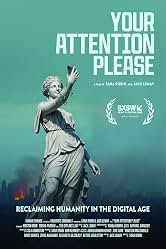

“Your Attention Please” (2026) is a conventional, polished documentary about the effect of social media on children with a focus on how bullying and relationships with inorganic beings can result in suicide. While it is one of the better films about the tech bros selling out the future for profit, it still feels like a cross between an infomercial for the other side which feels furtive in sections, and a preach to the choir movie that thinks it is being persuasive but will only attract audiences already inclined to agree with their position. The feature debut of director Sara Robin and writer Jack LeMay is a better start than films with more experienced filmmakers (“The AI Doc or How I Became an Apocaloptimist”) or films with bigger distributors and resources (“The Social Dilemma”), but their film would be stronger if it was less slick.
“Your Attention Please” has a healthy mix of advocates, ordinary people and talking heads, but occasionally they all sound a bit stilted as if they rehearsed their lines and had multiple takes before being interviewed. Responsible Tech Innovator and founder of ReThink Tricia Prahbu is probably the talking head with the most practical and successful approach to the problem. She asserts that she found solutions and has the data to back it up. Unfortunately, she is becoming a lawyer so the best mind in tech is studying. Figures! The other talking heads share their observations, move the thesis forward and add an expert’s sheen to the proceedings, but felt more like filler despite their esteemed experience: MIT’s Sherry Turkle who authored “Alone Together,” NYU Professor of Marketing Adam Alter who authored “The Outrage Machine,” co-author of “Screenschooled” Matt Miles, former US Surgeon General Vivek Murthy, Georgetown Professor of Computer Science Cal Newport, who authored “Digital Minimalism,” and Online Harms Prevention Group’s executive director Josh Golin.
Some of the talking heads had amazing, memorable insight, but did not get enough screen time such as digital socialization expert Joni Siani, who authored “Ceiling Your Soul,” technology ethicist. Frequent documentary interviewee Tristan Harris, who co-founded Center for Humane Technology, unsurprisingly gets the lionshare, but there was a missed opportunity to focus on the areas where the advocacy was more than talk, but actually successful. Cue the lawyers, Eric Baum of Eisenberg & Baum, who appears once on screen in what had to be an undisclosed recreation of his first meeting with a client before he offers an exclusive interview with the camera about his class action lawsuit, and Social Media Victims Law Center attorney Laura Marquez-Garrett, who explains section 230 of the Communications Decency Act, which was passed on February 8, 1996 with the best of intentions to an immunity hell for users of social media trying to get big tech to take responsibility for what happens on their watch.
“Your Attention Please” is a cross between academic infomercial and human-interest story, but the latter feels more substantive and has more innate narrative momentum though the documentarians choose the wrong fictional story structure to emulate. Kristin Bride, a parent survivor of her deceased son, Carson Bride, is depicted like the average Frank Capra protagonist going to DC to get Congress to do the right thing and pass KOSPA, the Kids Online Safety and Privacy Act. Her casual meetings with Prahbu feels stilted and staged, not like two people who often talk with each other. The DC moments feel like the elected members are using the parent survivors for political theater, which is excusable because their advocacy did get bipartisan support before the okie doke takes hold. Like most documentaries, the Republican elected officials get more screen time and Fox news clips in a cynical move meant to gain conservative support, a common move in such documentaries, but they have the unintended effect of lending credibility to people and organizations who may not deserve it since it winds up being performative. (Interestingly a walk to Senator Romney’s office ends in the hall with the former Massachusetts governor nowhere to be seen.) The hurried reassurances that the bill is not a censorship bill either needed to be more substantial and evenly debated or not mentioned at all.
The real meat of the story is hearing from the parents like Bride such as Amy Neville, Todd Minor (his wife, Mia, stands silently beside him), Deb Schmill, Christine McComas and Cheru McCormick Brown, and how their children died. Expressive animation recreates the past with their words playing over the images. If “Your Attention Please” made a mistake, it should have taken a few seconds to explain what the platform was and how it worked because any film should hope to be evergreen, timeless and understandable to future audiences. Most people now may be unfamiliar with such platforms as YOLO, Snapchat or LMK.
Instead, a better narrative to emulate are films like “Erin Brockovich” (2000), “A Civil Action” (1998) or “Dark Waters” (2019), especially considering the success of the litigation, which is treated like a footnote. “Your Attention Please” was close when it referenced the smoking gun in the tobacco legislation case, and there is a whistle blower in this case too: former Facebook Product Manager Frances Haugen who is known as “the Facebook Whistleblower.” Haugen is probably the best interviewee in the whole bunch and deserved more of a profile like the parents. The documentary would have been stronger if it started with the parents’ story, emphasized the lawyers’ story more then focused on Haugen’s testimony before Congress with more insight on the personal and professional fallout before segueing to the talking heads explaining how Haugen’s work got drowned out because social media was working as designed then ending with Prahbu’s solutions and the courtroom victories in a couple of states.
Instead, the narrative is scattered and loses focus as it approaches the denouement. “Your Attention Please” shows practical community efforts towards solutions, which is anecdotal, but no evidence of actual success, scalability or sustainability. It falls more in the inspirational zone but could also be viewed as a nightmare to some in the audience. The documentary becomes a global jetsetter as it focuses on different branches of The Offline Club, a meetup group where they check their cell phones at the door before socializing with likeminded strangers. A teenager from Carson’s hometown gets encouragement from a memorial bench. It always feels a bit queasy to have underage interviewees onscreen even if they are enthusiastic participants, especially considering society’s prejudice against all things regarding honesty about mental health. Then a Brockton High School in Massachusetts touts its cell phone free policy without addressing the elephant in the room. God forbid, but how do children and parents communicate if there is a lockdown? See “Uvalde Mom” (2025)!
“Your Attention Please” could have benefitted from not approaching this film in such a gee whiz tone as if social media invented bullying or the time before the internet was Edenic. Such a frame actually detracts from their strong and correct argument. Film as activism persuades when it is more like a cohesive, moving story, not like a film shown during a political convention before a speaker appears.