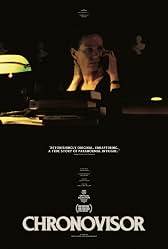

Starting at the Tavern on the Green, “Chronovisor” (2026) follows academic Beatrice Courte (Anne Laure Sellier) who is writing a monograph on memory. Enthusiastically sharing her discoveries with colleagues at their Thursday weekly dinners, the multilingual Beatrice is usually more solitary as the film follows her routine of researching at her apartment on Madison Avenue and 79th Street or various locations such as the New York Society Library, New York Public Library Main Branch or The Yale Club. When she hears a cassette recording of the inventor of the titular device, Pellegrino Ernetti, discussing the machine’s ability to use soundwaves to create images from the past, she goes down the rabbit hole to locate the machine. Will she find it and how will this search affect her? If you are the kind of person who does not enjoy reading at the movies, you should steer clear of this movie because the required onscreen reading may move too quickly for you to keep up. If you are a complete nerd, and your favorite aspect of “The Blair Witch Project” (1999) was the marketing and figuring out whether it was real, then you may love this film, but even so, some may judge the resolution to be anti-climactic, and the pace too slow.
Codirectors and cowriters Jack Auen and Kevin Walker’s feature debut, “Chronovisor” shows and does not tell. Most of the film shows what Beatrice sees or shows her reactions. The camera’s distance from Beatrice reflects her interest in what she is watching. When the camera is facing her back, it reflects her routine. Sudden stillness shows that her attention is focused. When the camera is facing her front, it is to reveal Beatrice’s reaction to what is happening. Sideways or moving shots are more neutral or how an outsider would experience interacting with Beatrice. The entire movie reflects her single-minded devotion to her work, and as the movie unfolds, it is obvious that her research into the titular device alters her. For example, around the twenty-four-minute mark, a week has passed, and at the next dinner, she is quiet and not contributing to the conversation though it is not noticeable to her companions. The camera rarely shows the faces of other people even when she interacts with them, which may reflect the lack of individual importance that they have in her life whereas most of the film shows what she is reading. They do not get names or a word in edgewise when she is not preoccupied. When she talks to people on the phone, she gives them space to talk more because they have information that she wants.
Before Beatrice discovers Ernetti, Auen and Walker do not translate the pages that appear on screen. “Chronovisor” puts the moviegoer into Beatrice’s mind thus imbuing us with the ability to read texts written in any language if she is interested in it. The glow of the translated text makes research into an enchanting, magical experience.Auen and Walker overlay a translation over the text, and it delivers that same sense of pleasure that she may feel as she gets closer to what she wants. They show her doggedness when she is willing to use any tool, microfiche, cell phone, transportation, VHS repair kit, or use any form of media, VHS tapes, archived news articles, magazines, hardcover books to find what she is looking for. Her attraction to the chronovisor seems understandable considering that she is willing to do anything in the name of work, including lying. One machine would make everything easier.
There is a book, Morag Coate’s “Beyond All Reason” (1964), a non-fiction autobiography about a descent into psychosis and recovery. Beatrice reads and repeatedly recalls a passage from it, which seemingly functions as her personal mission statement of treating herself like a camera with some elusive outside force as the filmmaker to create a film that she will not understand until she dies. The Chronovisor embodies this passage. In other words, she objectifies herself and is more of a brain than a body though her body is of great importance in “Chronovisor.” Towards the middle of the film, she gets a papercut, and there is a close up of her bleeding finger then a long shot of her reading poorly to a group and forced to be tied to a time and place, which requires existing with people, not when and where she wishes to be. It is the only time that other people are visible and share the same frame as her. Her physical existence enables her mind to consume and know the past. In many ways, the film is making its own argument about dualism and the need for the mind and body to work together. All these spaces are suffused with warm lighting and a pleasure to the senses. Most of Beatrice’s haunts and preferences are from the past. She is a hipster in spirit. In many ways, the story is an argument for physical media, mostly a rejection of the ephemeral contemporary world of cloud storage, digital and streaming though Beatrice is not precious. Given the choice between a horse drawn carriage and a hybrid yellow cab, she chooses the latter, and without those choices, it would be easier to believe that this film was made in the Seventies (compliment).
Because Beatrice’s research is so visceral, it does feel as if numerous people appear in “Chronovisor”: Ernetti thanks to the magic of cassette audio, his nephew thanks to VHS tape, and Peter Krassa and Francois Brune thanks to the cell phone. Most of the story is based on real-life figures and the primary and secondary sources are real. Sellier is a real life academic who only happens to have a Charlotte Rampling aura though more sensible and starched. “Chronovisor” is autofiction and found footage on retro steroids. Research and tech as time travel shape the narrative into an ouroboros structure. It is mostly vibes, but way more rigorous than anything that Dan Brown has to offer.
If “Chronovisor” was less wedded to Christian related institutions and texts, it would feel more Lovecraftian though the horror is limited to the eleventh-hour implication, not palpable. Though never referenced, it feels like a cautionary tale about the tree of knowledge of good and evil, but not as God trying to monopolize the power of knowledge, but as a cautionary tale about oblivion because a human being’s mind is only capable of knowing and holding a limited amount of information. As Beatrice delves deeper into the lore, the past, she is more divorced from the present and her present community. It brings a whole new meaning to “give us this day our daily bread.”
I saw “Chronovisor” on a screener on my television and eventually, I pulled a chair up to the television so I could pause, rewind and take time reading the text, especially because sometimes it appeared diagonally. It is a parent’s nightmare as I disregarded all the instructions of my youth. Your eyes! It was the first time that the experience of watching a film felt more like reading a book, an activity that I used to adore and do not engage in very often. It was an extremely pleasurable experience, and while I would advise seeing it on the big screen, I cannot imagine the frustration of not being able to absorb everything at my own pace, but maybe the larger screen would make it easier to do so.